
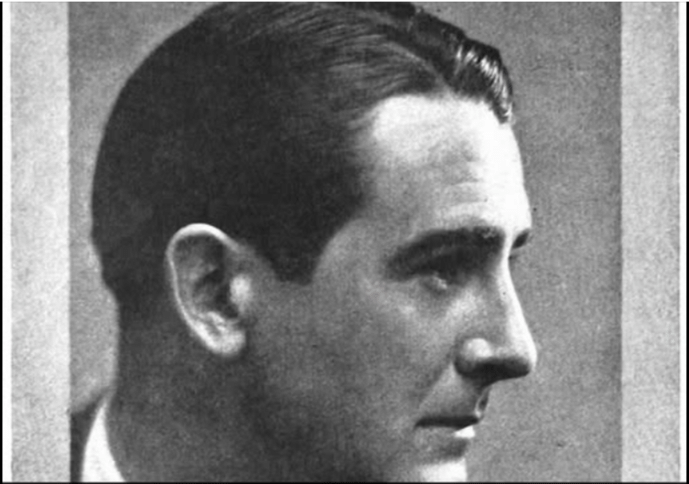
Rex Ingram: The Hollywood Director Who Followed His Heart to Islam
He launched Rudolph Valentino and made some of the biggest films of the silent era. Then he walked away from Hollywood for the desert.
1920. Hollywood. A young Irish director called Rex Ingram insists on casting an unknown dancer in the lead of his new epic, The Four Horsemen of the Apocalypse.
The dancer is Rudolph Valentino. The film is a worldwide hit and makes him the biggest heartthrob of the silent era.
The Director
Ingram is one of the most admired directors in Hollywood. Then, in 1923, he leaves. He sets up his own studio in Nice and starts shooting in North Africa, falling in love with the desert and the people he films there.
A New Faith
By 1927, the year he made The Garden of Allah, he was already being reported as having embraced Islam. In 1933, the New York Times confirmed he was becoming a Muslim and left pictures. He adopted a son and named him Abd el-Kader.
He returned to California to sculpt and write, and died in 1950. He still has a star on the Hollywood Walk of Fame.
- Born Reginald Ingram Montgomery Hitchcock in Dublin, in 1892 or 1893 depending on the source.
- The son of a Church of Ireland rector, he emigrated to the United States in 1911.
- Erich von Stroheim once called him the world’s greatest director.
- James Joyce, in Finnegans Wake, called him “pageant master”.
- Died on 21 July 1950 in North Hollywood. His star is at 1651 Vine Street.
His Life in Dates
Understanding the Verse
Verse 2:256 is one of the most quoted in the Qur’an on freedom of belief. It teaches that faith cannot be forced on anyone and must be a free and sincere choice, because the right path has been made clear.
The Arabic word translated here as “idols” is taghut, which scholars generally explain as anything worshipped or obeyed in place of Allah. The “certified bond” is al-‘urwa al-wuthqa, often translated as “the most trustworthy handhold”. Different translations phrase this verse differently, so it is worth comparing several.
Films to Look For
- The Four Horsemen of the Apocalypse (1921), the film that made Valentino a star.
- The Prisoner of Zenda (1922).
- Scaramouche (1923).
- Mare Nostrum (1926).
- The Garden of Allah (1927), shot in North Africa.
These are silent films. Some are available through film archives and public-domain collections, but availability differs by country.
Further Reading
- Ruth Barton, Rex Ingram: Visionary Director of the Silent Screen (University Press of Kentucky, 2014), the most complete recent biography.
- Liam O’Leary, Rex Ingram: Master of the Silent Cinema (1980).
- Patrick Geoghegan’s entry on Ingram in the Dictionary of Irish Biography.
Photo: Rex Ingram (Wikimedia Commons). Sources: New York Times, Dictionary of Irish Biography, Irish Times, Wikipedia.

Be First to Comment