
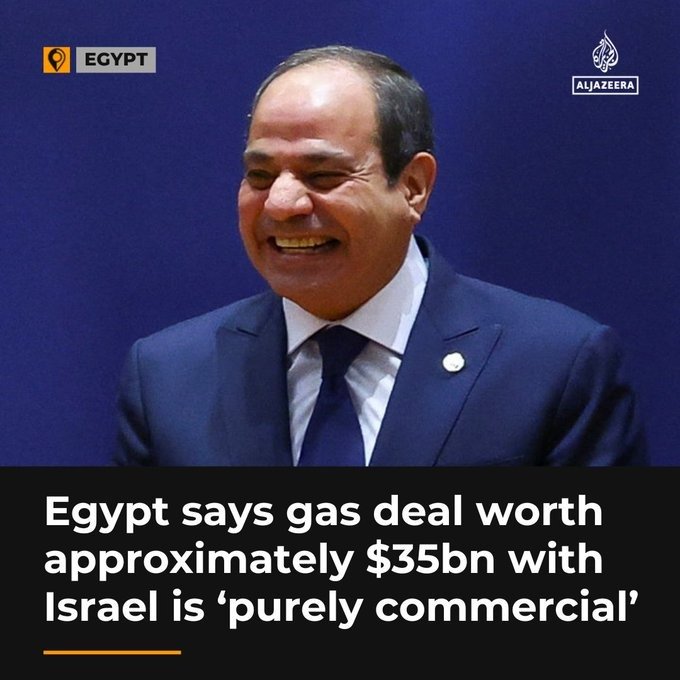
Egypt’s $35 Billion Gas Deal with Israel: Profits Over Palestinian Lives
UN Special Rapporteur Francesca Albanese condemns historic agreement as violation of international law amid ongoing genocide in Gaza
As Israel continues its devastating assault on Gaza—with over 45,000 Palestinians killed and much of the territory reduced to rubble—Egypt has finalized a $35 billion natural gas deal with the occupying power, drawing sharp condemnation from UN Special Rapporteur Francesca Albanese. “Egypt can say what it wants but purchasing $35bn of gas from Israel violates international law, including the ICJ advisory opinion of 2024,” Albanese stated, adding that the agreement represents “an incredible sign of support to Israel during the genocide of the Palestinians.”
Albanese’s intervention points to a fundamental question that Egypt’s government has attempted to sidestep: Can economic transactions be divorced from their political and legal context when one party is actively engaged in what international bodies have determined to be genocide? Egypt’s official response—that the deal is “a purely commercial transaction concluded exclusively on the basis of economic and investment considerations, and does not involve any political dimensions or understandings whatsoever”—rings hollow in light of international legal obligations and the ICJ’s landmark 2024 advisory opinion.
On July 19, 2024, the International Court of Justice issued a historic advisory opinion declaring Israel’s occupation of Palestinian territories—including the West Bank, East Jerusalem, and Gaza—unlawful under international law. The Court found that Israel’s settlement policy, exploitation of natural resources, and discriminatory practices violate international humanitarian law and constitute violations of the prohibition on racial segregation and apartheid. Critically, the Court ruled that all states have legal obligations not to recognize the illegal situation and to refrain from providing aid or assistance in maintaining it. The UN General Assembly subsequently adopted a resolution in September 2024 demanding Israel end its unlawful presence within 12 months—a deadline that expires in September 2025.
The exploitation of natural resources in occupied territories is specifically prohibited under international law. The ICJ’s 2024 opinion explicitly addressed this issue, finding that Israel’s use of natural resources in the Occupied Palestinian Territory “is inconsistent with its obligations under international law and breaches its duty to act as an administrator.” When Egypt purchases gas extracted from fields in Israel’s exclusive economic zone—fields developed and operated during and in the context of Israel’s unlawful occupation—it becomes complicit in the economic exploitation that the ICJ has declared illegal.
The timing of the deal makes Egypt’s claims of political neutrality even more difficult to sustain. The agreement was finalized as Israel prosecutes what South Africa—in its case before the ICJ—has characterized as genocide in Gaza. Since October 2023, Israeli forces have killed over 45,000 Palestinians, displaced nearly two million people, destroyed vast swathes of civilian infrastructure, and created conditions that international humanitarian organizations describe as deliberate starvation and ethnic cleansing. Egypt, which shares a border with Gaza and has positioned itself as a mediator in ceasefire negotiations, is now providing Israel with $35 billion in economic support through this gas deal—support that will directly bolster the Israeli state’s financial capacity to continue its military operations.
The ICJ’s advisory opinion goes beyond declaring Israel’s occupation unlawful—it establishes affirmative obligations for third states. The Court determined that all UN member states are obligated to “not render aid or assistance in maintaining” the illegal situation created by Israel’s occupation. This includes refraining from economic transactions that provide material support to Israel’s occupation apparatus or that legitimize its control over Palestinian territories and resources. Legal experts argue that purchasing natural gas—a strategic resource generating billions in state revenue for Israel—falls squarely within the category of prohibited aid and assistance.
Egypt’s defense of the deal as serving its “strategic interest by strengthening its position as the sole regional hub for gas trading in the Eastern Mediterranean” reveals the prioritization that Albanese critiques: economic self-interest over legal and moral obligations. Egypt has indeed faced energy challenges in recent years, transitioning from net exporter to net importer as domestic production declined. But energy needs do not override international legal obligations, particularly when the supplier is engaged in what multiple UN bodies, international human rights organizations, and legal experts have characterized as crimes against humanity.
The deal also exposes the limitations of Egypt’s role as a supposed neutral mediator in Gaza ceasefire negotiations. How can Egypt credibly position itself as an honest broker between Palestinians and Israelis when it has just agreed to provide Israel with $35 billion in economic benefits over the next 15 years? Palestinian civil society organizations have condemned the agreement, with many arguing that Egypt has betrayed the Palestinian cause for economic gain. The Palestinian Authority has remained conspicuously silent, highlighting its own political weakness and inability to challenge Arab states’ normalization with Israel.
Egypt’s gas deal with Israel is part of a broader pattern of Arab states normalizing relations with and providing economic support to Israel despite its ongoing occupation and human rights violations. The Abraham Accords, signed in 2020 between Israel and several Arab states including the UAE and Bahrain, opened the floodgates for increased economic cooperation. While Egypt made peace with Israel in 1979, recent years have seen warming of ties, particularly in the energy sector. This normalization occurs even as Israel’s policies toward Palestinians have become increasingly severe, with settlement expansion accelerating and Gaza subjected to what many describe as collective punishment amounting to genocide.
The U.S. role in facilitating the deal cannot be overlooked. American energy giant Chevron, a key owner of the Leviathan gas field, is central to the agreement. Israeli sources indicated that “official approval of the deal was delayed for months under pressure from the U.S.,” suggesting Washington played an active role in pushing the agreement forward. The Trump administration’s efforts to broker a summit between Netanyahu and Egyptian President Abdel Fattah el-Sisi—who have not met publicly since 2017—appear linked to securing this lucrative energy deal, demonstrating how great power interests drive regional arrangements that disregard Palestinian rights.
This is not the first time the international community has failed to enforce ICJ rulings regarding Israel. In 2004, the Court issued an advisory opinion finding that Israel’s construction of the separation wall inside the Occupied Palestinian Territories violated international law and should be removed. Twenty years later, the wall still stands, and Israel has faced no meaningful consequences for ignoring the ruling. The 2024 advisory opinion risks suffering the same fate unless states like Egypt take their legal obligations seriously and refuse to provide economic support to Israel’s unlawful occupation.
Francesca Albanese’s statement—”States must stop placing profits above humanity”—encapsulates the moral crisis at the heart of international relations. The ICJ has provided clear legal guidance: Israel’s occupation is unlawful, its exploitation of Palestinian resources is illegal, and states are obligated not to assist in maintaining this situation. Yet Egypt proceeds with a $35 billion gas deal that will enrich Israel’s state coffers, strengthen its economy, and by extension, enable the continuation of policies that the ICJ has declared violations of international law.
The question now is whether the international community—particularly Arab and Muslim-majority states that have historically championed the Palestinian cause—will continue to allow economic interests to trump human rights and international law. Egypt’s decision sends a chilling message: that even as Israel prosecutes what many characterize as genocide in Gaza, business can continue as usual. Palestinian lives, it seems, are worth less than natural gas revenues and regional energy hub ambitions.
- Not recognize Israel’s unlawful presence in occupied Palestinian territories
- Not render aid or assistance in maintaining the illegal situation
- Distinguish in their dealings between Israel proper and occupied Palestinian territories
- Review all diplomatic, political, and economic ties with Israel to ensure compliance
- Support Palestinian self-determination and cooperate to end the occupation
Albanese’s intervention serves as a crucial reminder that international law exists not merely as an abstract framework but as a binding system that requires compliance—particularly when the stakes are as high as they currently are in Palestine. The Special Rapporteur’s mandate includes monitoring Israel’s compliance with international human rights law in the Occupied Palestinian Territory, and her assessment that Egypt’s gas deal violates international law carries significant weight within the UN system.
As the September 2025 deadline approaches for Israel to end its unlawful presence in Palestinian territories—as demanded by the UN General Assembly following the ICJ opinion—the international community faces a choice. Will it enforce international law and hold Israel accountable, or will it continue to allow economic interests and geopolitical considerations to override fundamental principles of human rights and justice? Egypt’s gas deal represents a choice to prioritize the latter, and unless that choice is challenged and reversed, the ICJ’s advisory opinion will join the long list of international legal pronouncements that Israel has ignored with impunity.
Francesca Albanese is right: states must stop placing profits above humanity. The lives of Palestinians—and the integrity of the international legal system—depend on it.










Be First to Comment