

Al-Jazari: The Muslim Genius Who Invented Robots
800 Years Before Modern Science Claimed the Discovery
The greatest engineering mind in human history was not Leonardo da Vinci. It wasn’t Isaac Newton. It was a Muslim polymath who lived during an era when Europe languished in the Dark Ages, while he designed self-operating machines that resembled modern robots—inventions so advanced that they continue to astound Western scientists today, eight centuries after his death.
His name was Badi’ al-Zaman Abu al-Izz ibn Ismail ibn al-Razzaz al-Jazari (1136-1206 CE), and he accomplished what modern engineers would consider impossible without electricity, computers, or advanced materials: he created the world’s first programmable robots, pioneered cybernetics, invented the crankshaft, designed sophisticated automated machines, and documented it all in a masterpiece of engineering literature that predated the European Renaissance by centuries.
“Al-Jazari was the greatest mechanical engineer of the Middle Ages. The importance of his work is impossible to over-emphasize.”
Born in 1136 CE in Jazirat ibn Umar (modern-day Cizre in southeastern Turkey), al-Jazari served as chief engineer at the Artuqid Palace during the Islamic Golden Age—a period when Muslim civilization led the world in science, mathematics, medicine, and engineering while Europe struggled through feudalism and ignorance. For over 25 years, he dedicated himself to innovation, combining the precision of an engineer with the vision of an artist and the curiosity of a scientist. The result? A catalog of inventions so revolutionary that they laid the groundwork for modern robotics, automation, and mechanical engineering.
The Book That Changed Engineering Forever
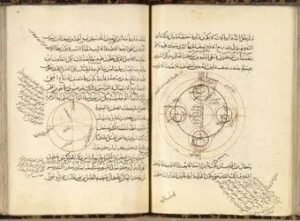
In 1206, at the request of the Artuqid Sultan Nasiruddin Mahmud, al-Jazari compiled his life’s work into a masterpiece: “Kitab fi ma’rifat al-hiyal al-handasiyya” (The Book of Knowledge of Ingenious Mechanical Devices). This wasn’t just a collection of ideas—it was a detailed engineering manual complete with intricate illustrations, step-by-step construction instructions, and mathematical calculations for over 50 mechanical devices.
What made al-Jazari’s book revolutionary was its approach. Unlike his predecessors who left sparse records, al-Jazari meticulously documented every aspect of his inventions with stunning visual detail. His colorful miniature paintings didn’t just show what the machines looked like—they revealed how they worked, with cutaway views displaying gears, levers, valves, and hydraulic systems. It was the world’s first comprehensive engineering textbook, centuries before such concepts existed in Europe.
Al-Jazari’s book was so significant that it remained a primary engineering reference for centuries. When it was finally translated into European languages in the 19th century, Western engineers were astounded. Components they thought Leonardo da Vinci had invented—like conical valves and segmental gears—appeared in al-Jazari’s work more than 250 years earlier. In 2016, UNESCO included al-Jazari in its “Global Treasures” series, officially recognizing his monumental contributions to human civilization.
The World’s First Robots
Al-Jazari created what historians now recognize as the first programmable robots in history. These weren’t simple mechanical toys—they were sophisticated automated machines capable of performing complex sequences of actions independently.
The Magnificent Water Clocks
Al-Jazari’s clocks weren’t simple timekeeping devices—they were spectacular entertainment machines that combined precise engineering with artistic beauty. His water clocks featured moving figures, musical sounds, and elaborate astronomical displays.
Pioneering Inventions That Changed the World
Beyond his robots and clocks, al-Jazari invented fundamental components that became essential to modern engineering:
The Practical Genius: Machines for the People
While some of al-Jazari’s elaborate creations entertained the wealthy, he also designed practical machines that improved ordinary people’s lives. His water-raising machines helped farmers irrigate their fields for centuries. These devices used ingenious gear systems and hydraulic principles to lift water from rivers and wells with minimal human effort.
His “Saqiya” machines and modified Archimedean screws revolutionized agriculture across the Islamic world. Unlike entertainment devices, these machines were built to last and to serve—and they did, remaining in use in some regions until the 20th century.
Al-Jazari’s automated ablution (wudu) machine provided clean water for ritual washing at mosques—an early example of automated hygiene systems. His designs prioritized cleanliness, efficiency, and accessibility, demonstrating that Islamic engineering excellence served both spiritual and practical purposes.
The Scientific Method: Documentation and Transparency
What set al-Jazari apart wasn’t just his inventions—it was his commitment to knowledge sharing. He believed that engineering knowledge should be documented, preserved, and transmitted to future generations. His book wasn’t meant to guard secrets but to enable others to learn, replicate, and improve upon his work.
Each device in his book included: detailed technical drawings with measurements, step-by-step construction instructions, explanations of operating principles, and notes on materials and costs. This approach to engineering documentation was revolutionary—and it’s the same methodology used in modern engineering today.
“Al-Jazari should inspire today’s engineers and, even more so, the young engineers of the future: schoolchildren who are thinking of engineering as a career.”
Leonardo da Vinci’s Islamic Inspiration
The Renaissance genius Leonardo da Vinci (1452-1519) is often credited with pioneering mechanical engineering. Yet Leonardo lived 250 years after al-Jazari, and evidence suggests he was familiar with Islamic engineering treatises. Renaissance Europe eagerly studied Arabic scientific texts, and the mechanical marvels described in Islamic sources deeply influenced European inventors.
According to the Encyclopedia Britannica, Leonardo may have been directly influenced by al-Jazari’s automata. Components that appear in Leonardo’s notebooks—conical valves, segmental gears, and elaborate mechanical linkages—all appear in al-Jazari’s work centuries earlier. The “Renaissance genius” built upon centuries of Islamic engineering excellence.
Scholar Mark E. Rosheim notes a crucial difference: “Unlike the Greek designs, these Arab examples reveal an interest, not only in dramatic illusion, but in manipulating the environment for human comfort.” Islamic engineers weren’t just creating spectacles—they were solving real problems and improving human welfare.
The Islamic Golden Age: Context Matters
Al-Jazari didn’t work in isolation. He operated during the Islamic Golden Age (8th-14th centuries), when Muslim civilization led the world in virtually every field of knowledge. While Europe stagnated in feudal ignorance, the Islamic world fostered scientific inquiry, preserved ancient knowledge, and pioneered new discoveries.
The House of Wisdom (Bayt al-Hikma) in Baghdad collected manuscripts from Greek, Persian, Indian, and Chinese sources, translating and building upon them. Muslim scholars advanced chemistry, mathematics, astronomy, medicine, and philosophy. Al-Jazari stood on the shoulders of giants like al-Khwarizmi (algebra), Ibn al-Haytham (optics), and the Banu Musa brothers (mechanical engineering).
This collaborative, knowledge-hungry civilization enabled al-Jazari’s genius to flourish. He freely acknowledged his debt to predecessors—a sign of intellectual humility and respect for accumulated knowledge that characterized Islamic scientific culture.
Modern Recognition: Too Little, Too Late
For centuries, Western academia ignored or downplayed Islamic contributions to science and engineering. Al-Jazari’s name was virtually unknown outside specialist circles until the 20th century. British engineer Donald R. Hill’s 1974 translation of al-Jazari’s book finally brought his genius to wider attention—but even today, most engineering students graduate without learning about the man who invented fundamental components they use daily.
Today, al-Jazari’s legacy is experiencing a renaissance. The Istanbul al-Jazari Museum displays reconstructions of his inventions, attracting thousands of visitors. Engineering programs increasingly acknowledge his contributions. But he deserves more than belated recognition—he deserves his rightful place as one of history’s greatest engineers.
Al-Jazari’s story isn’t just about one brilliant man. It’s about what human civilization achieves when it values knowledge over ignorance, innovation over tradition, and collaboration over conquest. The Islamic Golden Age produced al-Jazari because it created the conditions for genius to flourish: intellectual freedom, multicultural exchange, state support for science, and respect for accumulated knowledge.
When we honor al-Jazari, we honor a civilization that chose enlightenment when others chose darkness. We acknowledge that the foundations of modern technology rest on contributions from every corner of human civilization—contributions that deserve recognition regardless of the inventor’s religion, ethnicity, or era.
The Muslim engineer who programmed robots 800 years ago reminds us that true progress is built on the accumulated wisdom of all humanity. His story challenges Eurocentric narratives of scientific history and demands we ask: how many other geniuses have we forgotten simply because they didn’t fit our preferred narratives?









Be First to Comment