
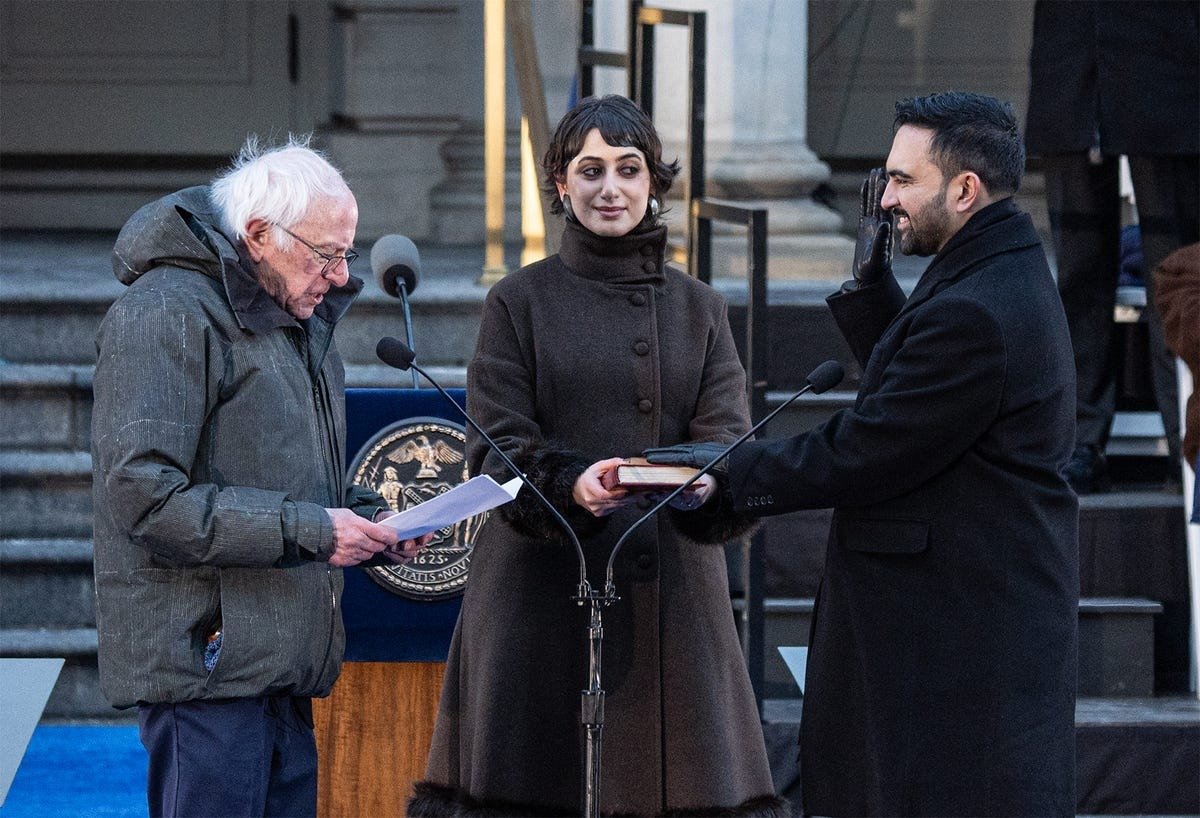
Zohran Mamdani’s oath of office as mayor of New York City marked a symbolic turning point in the city’s political history. In a ceremony that blended humility with bold resolve, he publicly pledged to serve “all New Yorkers” and framed the oath not as a personal triumph but as a covenant with the city’s diverse communities. Standing in a line that he linked to earlier mayors who spoke of New York as a “gorgeous mosaic,” Mamdani emphasized that his administration would answer to ordinary residents rather than wealthy power brokers, and that the promise contained in his oath was to protect, celebrate, and stand with New Yorkers regardless of whether they had supported him politically. By tying his swearing‑in to themes of inclusion, social justice, and higher expectations of what government can do, he used the moment of taking the oath not just as a legal formality, but as a public statement of values and a vision for a more equitable city.
Zohran Mamdani Sworn In as NYC’s 112th Mayor in Historic Ceremony
Just after midnight on New Year’s Day 2026, Zohran Kwame Mamdani was sworn in as New York City’s 112th mayor in a modest ceremony held in a historic subway station under City Hall, marking a dramatic turning point in American urban politics. The 34-year-old democratic socialist immigrant from Uganda makes history as the city’s first Muslim mayor, first South Asian mayor, and the youngest mayor to hold the office in more than a century.
A Midnight Ceremony Steeped in Symbolism
The oath was administered by New York Attorney General Letitia James, whom Mamdani has described as a political inspiration, in the now-decommissioned original City Hall subway station, known for its ornate arches and tiled ceiling. The location choice was deliberate, underscoring Mamdani’s emphasis on the importance of public transit to the vitality, health, and legacy of the city.
Mamdani placed his left hand on two copies of the Quran: one that belonged to his grandfather and a historic 200-year-old copy on loan from the New York Public Library. The library’s Quran once belonged to Arturo Schomburg, a Black historian and writer who sold his collection of 4,000 books to the library in 1926, which became the Schomburg Center for Research in Black Culture.
The Historic Quran
The small size of the Quran and its black and red ink suggest it was designed for everyday use. Its minute naskh script and binding, featuring a gilt-stamped medallion filled with a floral composition, suggest it was produced in Ottoman Syria in the 19th century.
According to the New York Public Library, Mamdani’s selection of Islam’s holy book marks a significant moment in the city’s history—the first time a Quran has been used in a mayoral inauguration.
Standing beside his wife, Rama Duwaji, Mamdani delivered brief remarks after James congratulated him. “This is truly the honor and the privilege of a lifetime,” he said. The intimate ceremony marked the official start of what Mamdani has promised will be a transformative administration.
A Public Inauguration Before Thousands
Hours later, as the sun rose on 2026, thousands of supporters gathered in the bitter cold outside City Hall for a public inauguration ceremony. An estimated 4,000 people attended inside City Hall Park, with tens of thousands more watching on screens lined up and down Broadway.
The atmosphere was jubilant. Supporters danced in frigid temperatures before the ceremony as a DJ played music. Actor Mandy Patinkin performed “Somewhere Over the Rainbow” with the PS 22 student chorus from Staten Island. Singer Lucy Dacus performed the labor anthem “Bread and Roses,” and Bubulicious performed “Gaddi Red Challenger,” a Bhangra song rewritten for Mamdani.
For the public ceremony, Mamdani was sworn in by Vermont Senator Bernie Sanders, a Brooklyn-born independent and fellow democratic socialist who has been Mamdani’s ideological ally and political mentor. Before administering the oath, Sanders thanked the tens of thousands of volunteers who took on the Democratic and Republican establishments and “defeated them in the biggest political upset in modern American history”.
“Demanding that the wealthy and large corporations start paying their fair share of taxes is not radical, it is exactly the right thing to do,” Sanders declared, as the crowd loudly chanted “tax the rich!”
Representative Alexandria Ocasio-Cortez, who won her own upset primary for Congress in New York in 2018, touted Mamdani as a mayor “relentlessly dedicated to making life not just possible, but aspirational for working people”.
“My Fellow New Yorkers, Today Begins a New Era”
In his inaugural address, which lasted approximately 30 minutes, Mamdani struck a tone that was simultaneously unifying and unapologetically progressive. “My fellow New Yorkers, today begins a new era,” he said. “I stand before you, moved by the privilege of taking this sacred oath, humbled by the faith that you have placed in me, and honored to serve as either your 111th or 112th Mayor of New York City”—a line that drew laughs as it referenced recent historical debates about how the city counts its mayors.
Mamdani pledged that “regardless of whether we agree, I will protect you, celebrate with you, mourn alongside you and never—not for a second—hide from you”. This promise to be a mayor for all New Yorkers came alongside a firm declaration that he would not moderate his progressive vision.
“I was elected as a democratic socialist, and I will govern as a democratic socialist,” Mamdani declared. “I will not abandon my principles for fear of being deemed radical”.
Mamdani said he had been advised to use the inauguration to “reset expectations” and encourage New Yorkers “to ask for little and expect even less.” He rejected this counsel outright. Instead, he outlined an ambitious agenda centered on what he called three pillars: safety, affordability, and abundance.
An Ambitious Progressive Agenda
Mamdani pledged that “we will return the vast resources of this city to the workers who call it home. Not only will we make it possible for every New Yorker to afford a life they love once again, we will overcome the isolation that too many feel, and connect the people of the city to one another”.
Using the occasion to underscore his transportation agenda, Mamdani announced Michael Flynn as his Department of Transportation commissioner, describing him as “someone who’s experienced, who is fluent in the landscape as it is, and who is ambitious and imaginative towards the landscape as it could be”.
Key Campaign Promises
During his campaign, Mamdani ran on an extensive platform that included:
- Universal rent control and protections against evictions
- Major investments in public transit, including free subway and bus fares
- Expanding public housing and social housing programs
- Comprehensive universal childcare
- Municipal public banking and broadband
- Aggressive climate action including building electrification
- Criminal justice reform and police accountability measures
Most of these initiatives would require significant new revenue, which Mamdani has proposed raising through taxes on the wealthy and large corporations—measures that would need approval from the state legislature and Governor.
Mamdani invoked Frank Sinatra’s famous lyric about New York, saying, “If what Sinatra said is true, let us prove that anyone can make it in New York, and anywhere else, too. Let us prove that when a city belongs to the people, there is no need too small to be met, no person too sick to be made healthy, no one too alone to feel like New York is their home”.
From Backbench Lawmaker to Mayor: An Astonishing Rise
Mamdani’s rise over the last year took him from a marginal role as a backbench New York state lawmaker to the pinnacle of power in the largest city in the United States. His victory in November 2025 shocked political observers who had dismissed his candidacy as quixotic.
A member of the Democratic Socialists of America and the son of Ugandan immigrants of Indian descent, Mamdani represented a district in Queens in the state assembly before launching his mayoral bid. His campaign focused relentlessly on the city’s affordability crisis, arguing that only bold, progressive policies could address the crushing cost of living that has driven working-class families out of New York.
An immigrant born in Uganda to parents with roots in India, Mamdani’s political triumph came at a time when President Trump and his advisors were rapidly reshaping U.S. policy to sharply limit immigration, especially for Muslims and people from African countries.
A Complicated Relationship With the National Stage
Mamdani’s identity as a Muslim immigrant and democratic socialist made him a controversial figure throughout the campaign. Critics, including Trump but also many leaders in the Democratic Party, raised concerns about his membership in the Democratic Socialists of America as well as his frequent criticism of Israel and the war in Gaza.
Yet in a surprising development, Trump met with Mamdani after his November win and promised to support him, despite his harsh rhetoric during the campaign. “I expect to be helping him, not hurting him—a big help, because I want New York City to be great,” Trump said.
During his campaign, Mamdani refused to downplay his background or identity. “I will not change who I am, how I eat, or the faith that I’m proud to call my own,” he said. “I will no longer look for myself in the shadows”.
Building a Management Team
Mamdani has drawn praise for building a management team that includes experienced veterans—including his decision to keep NYPD Commissioner Jessica Tisch in his cabinet. This choice surprised some of his progressive supporters but was seen as an effort to maintain continuity and credibility on public safety issues.
However, the transition has not been without challenges. Last month, one of Mamdani’s top appointments withdrew amid controversy, highlighting the scrutiny his administration will face as it attempts to implement its ambitious agenda.
The Political Context
The dawn of Mamdani’s administration comes as the national Democratic Party wrestles with its identity and struggles to energize a divided base. Mamdani’s win has fueled debate about whether the party should move further to the left and focus on affordability as its primary issue in upcoming elections.
The Challenges Ahead
Achieving Mamdani’s ambitious campaign promises won’t be easy. Many of his proposals require corporate and personal tax hikes for the wealthy, which won’t happen without support from more centrist Democrats in Albany and the governor.
While Mamdani is taking office at a time of general economic strength in the city, the high cost of living continues to squeeze working-class New Yorkers. Housing costs remain prohibitively expensive, subway service is frequently unreliable, and many neighborhoods lack adequate social services.
Mamdani will also need to navigate complex relationships with powerful actors including the real estate industry, which has historically wielded enormous influence in New York politics, and labor unions, which supported his campaign but will expect tangible results. His relationship with the business community and Wall Street—sectors that view his tax proposals with alarm—will be particularly delicate.
Public Safety and Police Reform
One of the most politically fraught issues Mamdani will face is balancing his commitment to police accountability and criminal justice reform with public concerns about safety. His decision to retain Commissioner Tisch suggests a pragmatic approach, but progressive activists will be watching closely to ensure he follows through on campaign promises to address police misconduct and reduce incarceration.
The Housing Crisis
Perhaps no issue is more central to Mamdani’s agenda than housing. New York faces a severe shortage of affordable housing, with median rents in Manhattan exceeding $4,000 per month. Mamdani has proposed an aggressive expansion of social housing—publicly owned apartments available to all income levels—along with stronger rent regulations and tenant protections.
However, implementing these policies will require overcoming opposition from landlords and real estate developers, as well as securing funding and navigating complex zoning regulations. The success or failure of his housing agenda may ultimately determine how his mayoralty is judged.
A Symbolic Moment for American Politics
Beyond the policy debates, Mamdani’s inauguration represents a symbolically powerful moment in American political history. The sight of a Muslim mayor taking the oath on a Quran in the nation’s largest city sends a message about pluralism and inclusion, particularly at a time of heightened political polarization around issues of immigration and religious identity.
The choice to hold the midnight ceremony in a historic subway station, rather than a more conventional venue, reflected Mamdani’s commitment to celebrating public infrastructure and working-class New Yorkers. Every detail of the inauguration appeared calculated to reinforce his political brand as an outsider committed to structural change.
“The world continues, the work endures, the work, my friends, has only just begun,” Mamdani concluded his inaugural address.
What Comes Next
As Mamdani begins his term, all eyes will be on whether he can translate his soaring rhetoric and ambitious promises into concrete policy achievements. His success will depend not only on his political skills but also on his ability to build coalitions, negotiate with skeptical lawmakers in Albany, and maintain support from the diverse coalition that elected him.
The coming months will test whether a democratic socialist can govern effectively in a global financial capital, whether progressive policies can address the real challenges facing working-class New Yorkers, and whether the excitement of the campaign can be sustained through the hard work of governance.
For now, Mamdani’s supporters are celebrating a historic victory and the promise of a new direction for New York City. As the crowd chanted “Zohran” and confetti fell on the steps of City Hall, the mood was one of hope and determination.
The work of building the New York that Mamdani has promised—a city that truly belongs to all who live in it—has begun. Whether that vision can become reality remains to be seen, but for millions of New Yorkers, the possibility alone represents something worth fighting for.







Be First to Comment