
Building Bridges Through Technology
An Editorial on the Achievements of the Da’wah, Media, and Technology Committee
In an era where information travels at the speed of light and questions about faith can be asked—and answered—within seconds, the work of da’wah has evolved beyond the mosque’s walls and into the boundless realm of cyberspace. The Da’wah, Media, and Technology Committee has been at the forefront of this digital revolution, recognizing that effective outreach in the 21st century requires not just good intentions and knowledge, but also sophisticated platforms, accessible content, and a deep understanding of how people seek truth in the modern age.
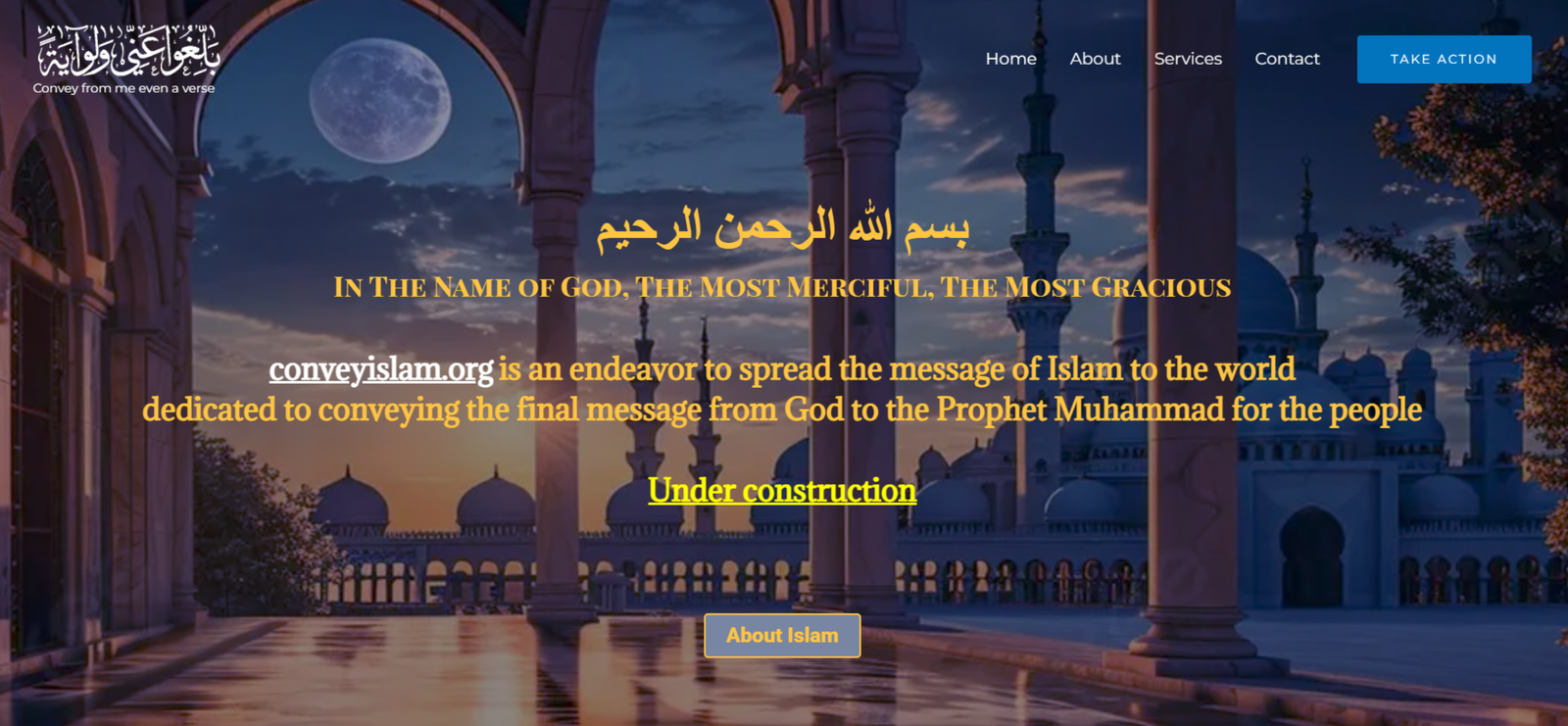
Among the committee’s most significant achievements is the launch and development of ConveyIslam.org—a comprehensive Islamic educational platform designed to become an internationally recognized beacon for anyone seeking authentic answers about Islam.
A Domain Name That Was Meant to Be
Sometimes, the path forward reveals itself in unexpected ways. When the committee set out to create a comprehensive da’wah website, the challenge of finding an appropriate domain name seemed daunting. In today’s saturated internet landscape, meaningful domain names—especially those ending in .org and .com—are increasingly difficult to secure. Premium domains often sell for thousands, sometimes tens of thousands of dollars. Simple, memorable names that capture the essence of a mission are rare treasures in the digital world.
Yet, in what can only be described as a fortunate blessing, both ConveyIslam.org and ConveyIslam.com were available—and at the standard registration price. The name itself is perfect: clear, direct, and immediately communicating the site’s purpose. “Convey Islam” encapsulates the entire mission in two words. It speaks to the Qur’anic command to deliver the message, to share knowledge, to invite with wisdom and beautiful preaching.
Several colleagues and community members expressed genuine amazement when they learned that such an ideal domain was still available. In an internet where even obscure combinations of words have been claimed, finding “conveyislam” unregistered felt like discovering an open door that had been waiting for someone to walk through it. Some saw it as a sign—a small indication that this work was blessed from its inception.
The acquisition of both the .org and .com versions ensures that whether visitors type one or the other, they arrive at the same destination. This seemingly small detail matters greatly in the world of digital outreach, where consistency and accessibility can mean the difference between someone finding answers and giving up in frustration.
Depth Over Breadth: Comprehensive Coverage of Core Topics
What truly distinguishes ConveyIslam.org from many other Islamic websites is its commitment to depth. Rather than providing superficial overviews or scattered articles on hundreds of topics, the site focuses on core subjects and explores them with thoroughness and rigor. Each main subject area contains more than 20 dedicated pages, ensuring that visitors don’t just get quick answers—they gain genuine understanding.
The Subject of Allah: From Pronunciation to Divine Attributes
Consider the subject of Allah, the Most High. A casual website might offer a single page defining the name and perhaps listing the 99 Names of Allah. ConveyIslam.org takes an entirely different approach, recognizing that understanding the Creator is the foundation of Islamic faith and deserves comprehensive treatment.
The site begins with what might seem like a basic question: How do you pronounce the Noble Name “Allah”? For non-Arabic speakers, this is not trivial. The emphatic ‘L’ sounds, the proper articulation of the Arabic letters—these details matter to those who want to speak the Name with respect and accuracy. The site provides clear phonetic guidance, audio examples, and explanations of why pronunciation matters in Arabic.
From there, the exploration deepens. What does “Allah” mean? Is it simply “God” in Arabic, or does it carry deeper significance? The site explains that while Allah is indeed the Arabic word for God, it is more specific—referring exclusively to the One True God, with no plural form, no gender, and no equivalent in linguistic construction. It is the proper name of the Creator, used by Arabic-speaking Christians and Jews as well as Muslims.
The discussion continues through the attributions of Allah—His Names and Attributes as revealed in the Qur’an and authentic Hadith. Each of the 99 Names receives careful explanation, not just translation but contextualization. What does it mean that Allah is Ar-Rahman (The Most Merciful)? How does this attribute manifest in creation, in providence, in daily life? What does it mean that He is Al-Adl (The Just)? How do we reconcile divine justice with human suffering?
The pages explore questions both simple and profound: Why does Allah refer to Himself in the plural “We” in the Qur’an? What is the Islamic understanding of divine transcendence? How do Muslims understand Allah’s relationship to time, to space, to His creation? Can we see Allah? What is the significance of the verse of the Throne (Ayat al-Kursi)?
Each question opens doorways to deeper understanding. The content is structured so that a complete beginner can start with the basics and gradually progress to more sophisticated theological concepts, while someone with existing knowledge can dive directly into specific areas of interest. References to Qur’anic verses and authentic Hadith ground every explanation in primary sources, ensuring that visitors receive authentic Islamic teachings rather than personal opinions or cultural interpretations.
The Qur’an: A Complete Educational Journey
The treatment of the Qur’an on ConveyIslam.org follows the same comprehensive model. Rather than assuming visitors already understand what the Qur’an is, the site begins with foundational questions and builds systematically toward advanced topics.
What is the Qur’an? The site explains that it is the literal word of Allah, revealed in Arabic to Prophet Muhammad (peace be upon him) over a period of 23 years. It is not Muhammad’s words about God, not inspired poetry or wisdom literature, but direct divine revelation—a critical distinction that shapes how Muslims approach the text.
When was the Qur’an revealed? The site provides historical context, explaining the circumstances in Makkah in the 7th century CE, the social and religious environment into which the revelation came, and the gradual nature of its revelation. Why was it revealed over 23 years rather than all at once? The site explores the wisdom in gradual revelation—how it allowed the early Muslim community to absorb, implement, and embody the teachings progressively, how it addressed specific events and questions as they arose, and how it provided comfort and guidance during times of difficulty.
How did Muhammad (peace be upon him) receive the message? The pages describe the first revelation in the Cave of Hira, the role of the Angel Jibreel (Gabriel), the different modes of revelation described in Hadith literature, and the Prophet’s experience of receiving divine communication. This isn’t presented as mythology but as historical testimony, with references to authentic narrations and scholarly explanations.
How is the Qur’an preserved? This question receives particularly detailed treatment, as preservation is one of the Qur’an’s most distinctive features. The site explains the oral tradition—how thousands of companions memorized the entire Qur’an during the Prophet’s lifetime and how this tradition of memorization continues unbroken to this day. It describes the written compilation under Caliph Abu Bakr and the standardization under Caliph Uthman. It explains the science of Qur’anic manuscripts, the discovery of early manuscript evidence (including the Birmingham Qur’an manuscript dated to within decades of the Prophet’s death), and how modern technology has confirmed the remarkable consistency of Qur’anic texts across centuries and geographies.
The site addresses modern questions: Are there different versions of the Qur’an? What are the Qira’at (variant readings), and how do they relate to preservation? How can Muslims claim perfect preservation when there are differences in vowel markings or pronunciation? These are questions that skeptics often raise, and ConveyIslam.org addresses them honestly and thoroughly, distinguishing between minor variations in recitation styles (all of which trace back to the Prophet himself) and the actual text, which remains unchanged.
Beyond these foundational topics, the Qur’an section explores themes within the Qur’an: What does it say about previous prophets? How does it address science and the natural world? What is the Qur’anic view of human nature, of free will, of divine justice? What are the stories and lessons contained in its chapters? How should a non-Muslim approach reading the Qur’an for the first time?
Each of these areas branches into multiple pages, creating a web of interconnected knowledge that allows visitors to learn at their own pace and according to their own interests, while ensuring that the information they receive is accurate, well-sourced, and presented with clarity.
To be continnued…





Be First to Comment