
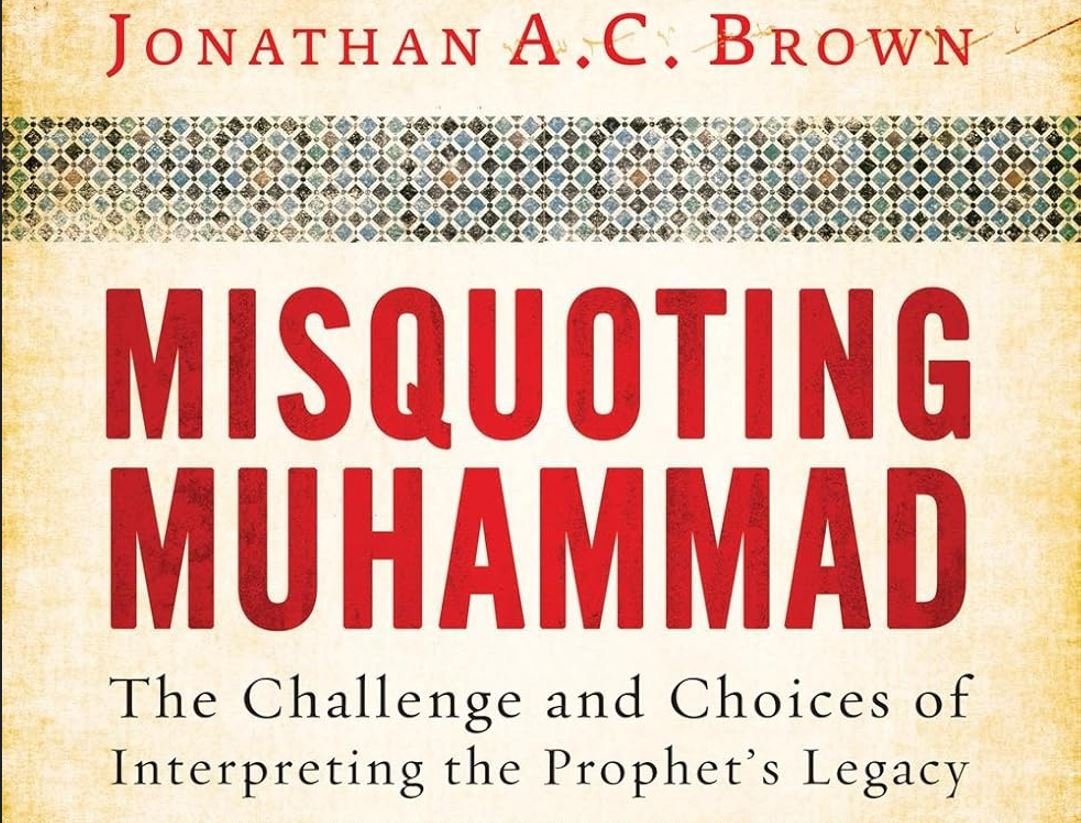
Misquoting Muhammad: The Challenge and Choices of Interpreting the Prophet’s Legacy
A Comprehensive Analysis
Overview
In an era when Islam provokes fierce controversy in the modern world—with debates over jihad, Shariah law, and gender relations dominating headlines—Jonathan A.C. Brown’s “Misquoting Muhammad” emerges as an indispensable guide for anyone seeking to understand the complexities behind these contentious issues. Brown, the Alwaleed bin Talal Chair of Islamic Civilization at Georgetown University and a practicing Muslim himself, brings both scholarly rigor and insider knowledge to this ambitious project.
The book’s central thesis challenges a common assumption: that Islamic tenets were fixed at the religion’s founding. Instead, Brown demonstrates that Islamic law and dogma developed over centuries by Muslim scholars, similar to other world religions. This revelation alone reshapes how we should approach Islamic teachings and contemporary debates within Muslim communities.
The Author’s Credentials and Approach
Brown has established himself as one of the foremost scholars of Hadith (the sayings and actions of Prophet Muhammad), combining rigorous Western academic methodology with deep immersion in classical Islamic scholarship. His previous works include “The Canonization of al-Bukhari and Muslim,” “Hadith: Muhammad’s Legacy in the Medieval and Modern World,” and “Muhammad: A Very Short Introduction,” establishing his scholarly credentials beyond question.
What sets Brown apart is his unique position: he is himself a Muslim who makes no apologies for the Sunni tradition, yet he approaches it with scholarly honesty that acknowledges both its strengths and limitations. He correctly argues that regardless of one’s personal beliefs, Islam deserves study as one of humanity’s greatest intellectual and cultural achievements.
Brown accomplishes something far more fruitful than easy platitudes. He is a model of honesty, openness, and accuracy, refusing to limit his defense of Islam to simplistic statements while engaging deeply with the most challenging questions facing the religion.
Structure and Journey Through Islamic Civilization
The book takes readers on a geographical and historical journey through Islamic civilization. The introductory chapter starts in Egypt during the 2011 revolution, following questions of Shariah, politics, and authority through the 2013 coup. Subsequent chapters move through India (examining the life of eighteenth-century scholar Shah Wali Allah), the fall of the Ottoman Empire, mid-twentieth-century Egypt, the Indian Ocean world of Sufism, and finally to Muslim Student Associations in American universities.
Chapter Overview
-
Chapter 1The Problem(s) with IslamSets the stage by examining contemporary controversies and their historical roots.
-
Chapter 2A Map of the Islamic Interpretive TraditionUses the life of Shah Wali Allah to trace the history of pre-modern Islamic intellectual tradition.
-
Chapter 3The Fragile Truth of ScriptureExplores how modern Muslims grapple with apparent contradictions between scientific understanding and certain Hadiths, examining the “Qur’an Only” movement.
-
Chapter 4Clinging to the Canon in a Ruptured WorldExamines how Muslims maintain textual authority while adapting to changing circumstances.
-
Chapter 5Muslim Martin Luthers and the Paradox of TraditionAddresses why calls for an “Islamic Reformation” misunderstand that such a reformation has been underway for over a century.
-
Chapter 6Lying About the Prophet of GodInvestigates the complex issue of Hadith authentication and fabrication.
-
Chapter 7When Scripture Can’t Be TrueUses Qur’anic verse 4:34 about domestic relations as a case study, examining how modern scholars navigate difficult scriptural passages.
Central Themes and Insights
A major theme running throughout the book traces how Muslim scholars have endeavored to reconcile truth in their scriptures (the Qur’an and Sunnah) with truth outside it—reason, empirical observation, and changing social contexts. This is not a modern problem but one that has engaged the greatest minds in Islamic history for over a millennium.
Brown takes readers through the fascinating story of how orthodox consensus formed around the centrality of the Hadith corpus, providing a highly readable and pedagogically agile account of Islamic jurisprudence (fiqh) history. He explains why the Sunnah (custom of Muhammad) is the very core of Sunnism, and how it comes down to us through Hadith.
The book discusses everything, including controversial topics like Hadiths about masturbation, debates about who is entitled to zakat (charity), the relevance of Qur’anic verses and Hadiths in modern times, whether women can lead congregational prayer, extensive analysis of Islamic banking, and the alleged “72 virgins” promised to martyrs. Brown doesn’t shy away from difficulty.
Brown makes an important distinction: a Hadith used for determining practice (especially legal practice) must be more carefully examined than one that simply contains a good moral lesson. For some Muslim scholars, an exhortation to good behavior can be attributed to Muhammad without much harm, while others worry that accepting any weak Hadith might undermine the entire structure.
Brown clearly admires the flexibility that Hadith interpretation provides for people living in changing circumstances. He is gently impatient with modern Western readers who think they can simply pick up the Qur’an or a Hadith and know “the real meaning.” Context, methodology, and scholarly tradition matter immensely.
The Book’s Approach to Difficult Questions
Brown demonstrates that apparently flawed or contradictory texts—like the works of Shakespeare, the Bible, or Homer’s epics—contain “blank spots” when read in isolation. However, when read holistically, the big picture makes sense. He applies this same charitable reading to Islamic scripture.
At the same time, Brown is refreshingly honest in the book’s final chapter about points where it might not be possible for a modern person to reinterpret certain Qur’anic passages or Hadiths in ways that align with contemporary values—and what a genuine quandary this presents. This intellectual honesty distinguishes his work from both uncritical apologetics and hostile criticism.
The book’s conclusion uses the issue of domestic violence as a lens, examining various interpretative strategies modern scholars like Amina Wadud employ when dealing with Qur’anic verse 4:34. This practical application shows both the possibilities and limitations of reinterpretation.
Strengths and Weaknesses
Strengths
- Accessible yet erudite—bridges academic scholarship and public understanding without sacrificing rigor
- Written by an insider with both traditional Islamic training and Western academic credentials
- Offers oceanic depth of knowledge in Muslim textual traditions with awareness of political contentiousness
- Models honesty, openness, and accuracy rather than offering easy platitudes
- Contains original research on Hadith, Islamic law, and Sufism, including unpublished manuscript sources
- Refreshingly honest about interpretive limitations and genuine dilemmas facing modern Muslims
Considerations
- For Western converts, the reading is fascinating, but detailed Hadith examinations might become tedious for general readers
- The audiobook version suffers from poor Arabic pronunciation, which can be distracting for those familiar with the language
- The book is dense and requires sustained attention—not light reading
- Some critics argue it presents the Sunni narrative without sufficient critical examination of traditional claims
- Readers without background in Islamic history or terminology may find the learning curve steep
Critical Reception
The book received widespread acclaim upon publication. Karen Armstrong, writing in the Sunday Times, called it “lucid, learned and engaging.” The Washington Post noted that it “sheds light on the considerable dynamism and sophistication within the Sunni tradition.”
Pacific Standard magazine summarized its ultimate lesson: “Authenticity is elusive in religion, and those who claim it tend not to be searching for the truth but grasping for power.” This insight resonates far beyond Islamic studies.
One reviewer described it as “a riveting narrative of the Islamic scholarly tradition and its rich history, a deftly depicted and well-conceived endeavor” by someone “quite at home in razor-sharp analysis of both classical juristic tradition and the modern Islamic world.”
The Jesuit journal Thinking Faith praised Brown’s work, noting that “religious illiteracy among the commentariat is so endemic that calls for an Islamic Reformation have been coming thick and fast at a time when the religion has already spent the best part of a century engulfed in an agonizing crisis analogous to that which beset Christendom in the early 1500s.”
Comparative Value for Non-Muslim Readers
The book holds particular interest for those studying Christian and Jewish traditions, as Brown places the Islamic interpretive tradition in comparative light. Anyone familiar with debates over biblical interpretation will recognize parallel struggles in Islamic scholarship.
For readers acquainted with rabbinic traditions of interpretation, the questions Brown addresses will feel familiar: How do you interpret a sacred text when parts seem to contradict what you know? How do you live by ancient commands in modern contexts? The answers differ, but the questions unite people of faith across traditions.
The book is ideal for anyone who reads today’s headlines and wants to understand what lies behind the controversy. It provides both specific answers to common questions and a framework for thinking about Islamic tradition differently.
Who Should Read This Book?
Essential Reading For:
Muslims seeking to understand their own interpretive tradition more deeply
Non-Muslims wanting to move beyond stereotypes and headlines to genuine understanding
Students of religious studies, comparative religion, or Middle Eastern studies
Anyone interested in how religious communities negotiate between tradition and modernity
Scholars and practitioners of interfaith dialogue
Policymakers and journalists covering Muslim communities and Islamic affairs
Final Verdict
“Misquoting Muhammad” stands as a landmark contribution to Islamic studies and public understanding of Islam. It is a masterfully manipulated and deftly narrated book that manages the rare feat of being both academically rigorous and publicly accessible.
Brown’s work serves as an indispensable guide for anyone bewildered by enigmatic transnational Sunni debates, depicting complexities that would otherwise remain obscure. In an era of soundbites and simplified narratives about Islam, this book offers nuance, depth, and intellectual honesty.
The book doesn’t claim to solve all problems facing contemporary Muslims. Brown stays true to his promise not to provide simple solutions for the challenges Muslims face. Nevertheless, it introduces readers to various interpretive approaches and their historical development. This educational mission is perhaps more valuable than any prescriptive agenda.
Whether you are Muslim or non-Muslim, scholar or layperson, this book will transform how you think about Islamic tradition. It demonstrates that Islamic thought is not a fixed entity but a complex product of utterly human efforts to understand and apply divine guidance across changing times and circumstances.
For anyone serious about understanding Islam in the twenty-first century, “Misquoting Muhammad” is essential reading. It earns its place among the most important works on Islamic studies published in recent decades.
Rating: 5/5 — A masterful, honest, and accessible exploration of Islamic interpretive tradition that challenges assumptions, provides historical depth, and offers frameworks for understanding contemporary debates. Required reading for anyone seeking genuine understanding of Islam beyond headlines and stereotypes.





Be First to Comment