
Carbon-Absorbing Concrete: How Building Materials Are Becoming Carbon Sinks
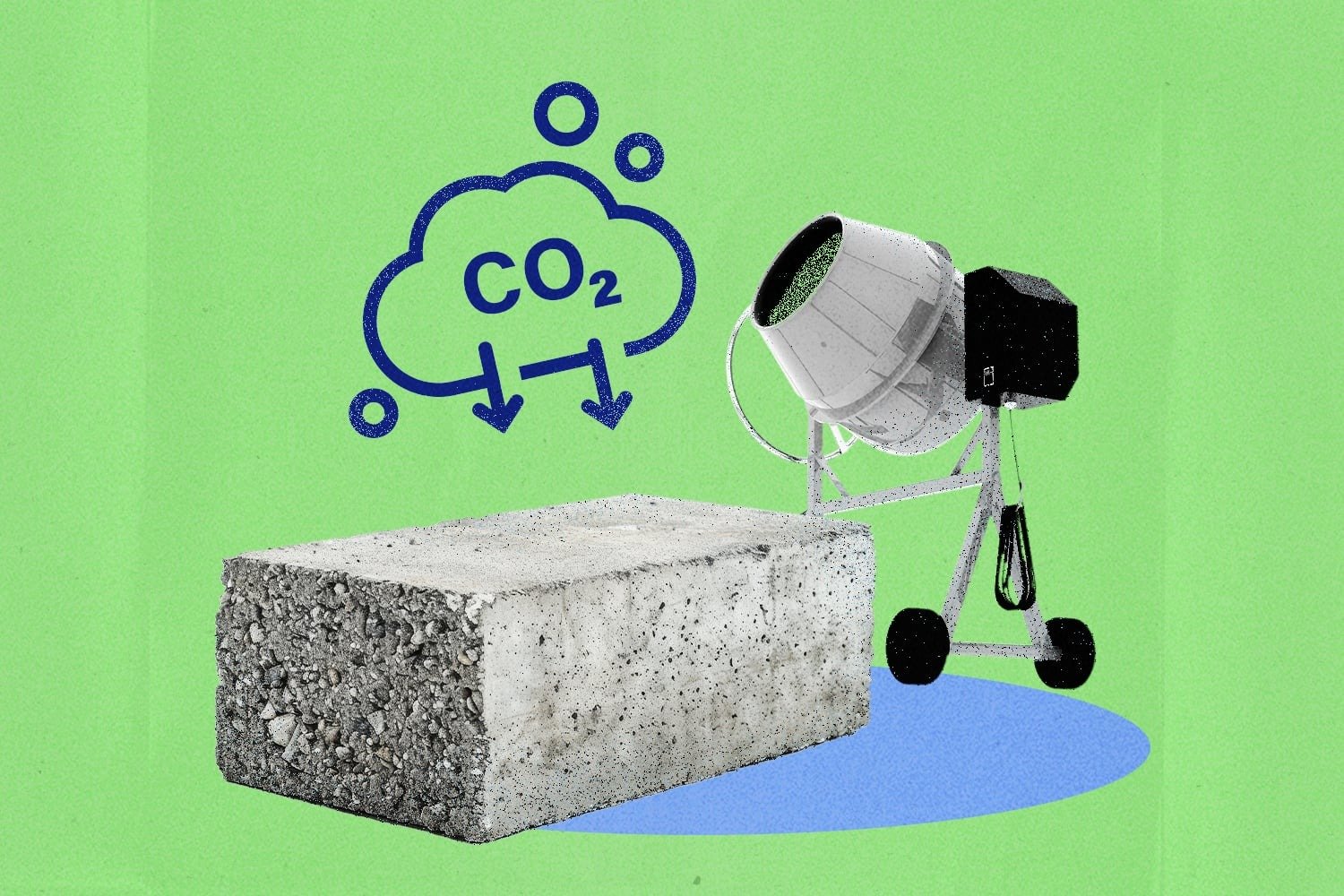
The concrete industry has long been considered one of the world’s largest contributors to climate change, responsible for approximately 7-8% of global CO₂ emissions. But a revolution is underway—one that could transform this climate villain into a surprising ally. Multiple companies and research institutions are now developing concrete technologies that don’t just reduce emissions during production, but actually capture and permanently store carbon dioxide.
The Problem: Concrete’s Massive Carbon Footprint
Concrete is the most widely used building material on Earth—second only to water as the most consumed substance globally. With three tons used annually for every person on the planet, its environmental impact is enormous. The primary culprit is cement, concrete’s key binding ingredient.
Cement manufacturing involves burning limestone in kilns at temperatures reaching 2,300° to 3,000° F (1,260° to 1,650° C). This process typically uses powdered coal or natural gas as fuel, consuming massive amounts of energy and releasing carbon dioxide from both combustion and the chemical breakdown of limestone itself. One ton of Portland cement produces roughly one ton of CO₂ emissions.
If the concrete industry were a country, it would be the third-highest emitter of CO₂ after China and the United States.
The Breakthrough: Mineralization Technology
Several companies are pioneering technologies that inject captured CO₂ directly into concrete during the mixing process, where it undergoes a chemical transformation called mineralization—permanently converting the carbon dioxide into solid calcium carbonate minerals.
CarbonCure Technologies: Leading the Commercial Charge
CarbonCure Technologies, founded in 2012 in Halifax, Canada, has commercialized scalable technologies that reduce carbon emissions while providing economic advantages to concrete producers in more than two dozen countries. Their process is elegantly simple yet scientifically profound.
CarbonCure pioneered the mineralization of captured carbon dioxide in concrete by injecting it during the mixing process. Immediately upon injection, the carbon dioxide chemically converts into a mineral and becomes permanently embedded in the concrete. The mineralized CO₂ also enables concrete producers to adjust the amount of cement content in their mixes while maintaining the concrete’s strength.
The technology has achieved remarkable scale. By November 2025, more than 83.6 million cubic yards of CarbonCure concrete had been produced—equivalent to 10 million truckloads, or enough concrete to build all 30 NFL stadiums twice over. The company is currently approaching 700,000 metric tons of carbon savings, with operations in hundreds of plants across nearly 30 countries.
Real-World Applications
This isn’t theoretical technology confined to laboratories. CarbonCure concrete has been used in major construction projects worldwide:
- Amazon’s HQ2 building in Arlington, Virginia, was constructed with CarbonCure concrete, achieving a 20% reduction in the building’s concrete carbon footprint through extensive collaboration between designers, contractors, and concrete producers.
- The 1072 West Peachtree skyscraper in Atlanta—a 60-story tower built by Turner Construction and supplied by Thomas Concrete—became the tallest residential building in the city and the tallest tower in the world built with carbon-mineralized concrete when it topped out in late 2025.
- The 725 Ponce building became the first structure made entirely with CO₂-mineralized concrete, earning recognition from CNN and climate advocate Bill Gates.
Other Players in Carbon-Negative Concrete
Paebbl, another innovator in the space, captures carbon from the atmosphere and combines it with ground olivine rock to create a rock powder or slurry that can be used as an ingredient in concrete. The process, known as accelerated mineralization, can be completed within an hour and potentially reduce concrete’s carbon footprint by up to 70%—a process that in nature would take centuries.
CarbiCrete takes a different approach, replacing cement entirely with steel slag—an industrial waste product—and then curing the concrete with CO₂ instead of water, creating a cement-free, carbon-negative product.
Nature’s Hidden Helper: Concrete Already Absorbs CO₂
Remarkably, scientists have discovered that regular concrete has been quietly absorbing atmospheric carbon for decades through a natural process called carbonation.
According to research cited in the IPCC climate report, around half of the carbon emissions from cement production are later reabsorbed by the material used in buildings and infrastructure through natural mineral carbonation. This means carbonation reabsorbs approximately one-quarter of all cement industry emissions.
According to one estimate, concrete sequestered 4.5 billion tons of CO₂ from 1930 to 2013—offsetting roughly 43% of the cement industry’s carbon emissions over that period. Forests aren’t the only carbon sinks; the massive amounts of exposed concrete from decades of construction continue to absorb CO₂ throughout their lifetimes.
Different types of concrete absorb CO₂ at different rates. Concrete blocks carbonate quite quickly, and crushed concrete has even greater potential since it has a larger surface area exposed to the atmosphere. This means properly managing concrete demolition—crushing it rather than burying it—could significantly accelerate carbon absorption.
The Economics: Making Green Concrete Affordable
One of the biggest barriers to adopting new sustainable technologies is cost. Surprisingly, carbon-mineralizing concrete has proven economically competitive.
CarbonCure’s success in scaling to two dozen countries has been driven largely by the fact that their technologies are cost-neutral. The reduced material costs from cement efficiency, combined with revenue from carbon credit sales shared with concrete producers, offset the licensing fees and CO₂ costs.
This economic viability has attracted major support. In the United States, the Federal Buy Clean Initiative has allocated more than $2 billion for the procurement of lower-carbon construction materials, including cement, for federally funded projects.
The Partnership with Academia
CarbonCure Technologies and MIT’s Masic Lab have joined forces to explore the intricacies of CO₂ injection and mineralization within concrete. Professor Admir Masic of MIT’s Civil and Environmental Engineering department is leading this joint effort, with his lab specializing in the nanochemomechanics of mineralization. The research leverages resources from MIT’s Concrete Sustainability Hub, a collaborative platform uniting academic, industry, and government leaders focused on creating sustainable infrastructure solutions.
This academic-industry partnership aims to deepen the scientific understanding of how mineralization affects concrete properties and to innovate on behalf of concrete producers worldwide.
The Path Forward
While these technologies represent significant progress, complete decarbonization of the concrete industry remains a challenge requiring multiple solutions working together.
According to CarbonCure’s leadership, achieving the industry’s net zero commitment by 2050 will require “all hands on deck and all the tools in our toolbox, with CarbonCure stacked on top of a variety of technologies, materials, and methods.” Solution strategies will likely vary from region to region, combining carbon mineralization with supplementary cementitious materials, alternative fuels, and improved efficiency.
With 100,000 concrete plants operating worldwide, the opportunity for impact remains enormous. Current adoption represents only a fraction of the industry, meaning the potential for carbon savings could grow exponentially as the technology scales.
Why This Matters
The development of carbon-mineralizing concrete represents more than an incremental improvement—it’s a fundamental shift in how we think about building materials. Instead of viewing construction as inherently destructive to the environment, these technologies suggest a future where every building, bridge, and sidewalk could serve as a permanent carbon storage facility.
As Paebbl’s co-CEO Andreas Saari notes, “We need to find a way to store billions of tons of CO₂. Where can we find a permanent home for that? Construction material is there.”
The concrete revolution is no longer a distant dream—it’s happening now, in hundreds of plants, in dozens of countries, in buildings rising around the world. Every carbon-mineralized concrete structure represents not just shelter or infrastructure, but a small victory in the fight against climate change. And as the technology continues to scale, those small victories could add up to something transformative: an industry that built the modern world learning to help heal it.
Sources: CarbonCure Technologies, MIT Masic Lab, Paebbl, CarbiCrete, IPCC Climate Report, TIME Magazine, Carbon Herald, For Construction Pros










Be First to Comment