
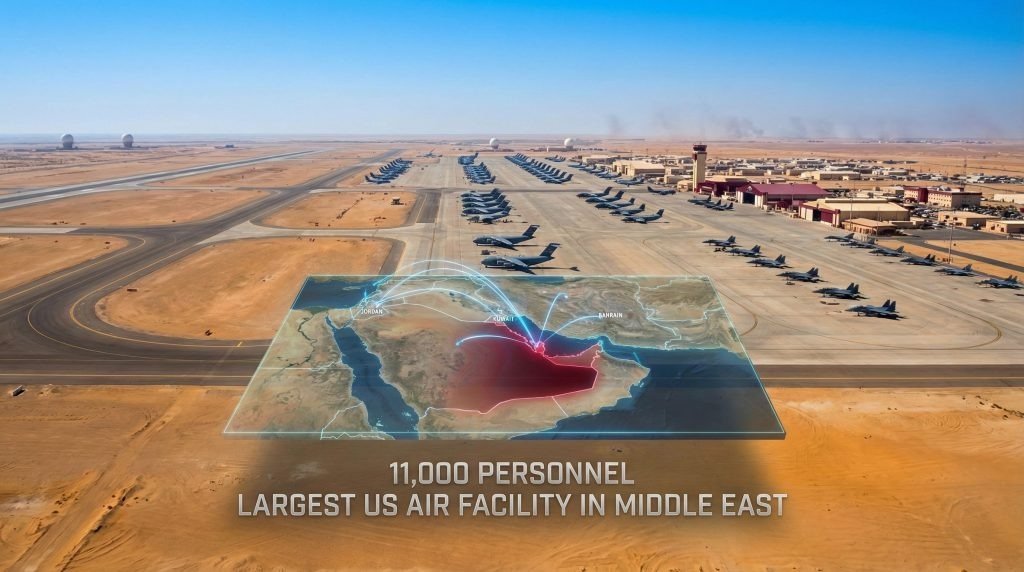
US, UK Withdraw Personnel from Qatar Base Amid Iran Crisis
Partial evacuation from Al-Udeid air base as Trump weighs response to Iran crackdown; Tehran closes airspace, embassies shutter
The United States and the United Kingdom are reducing the number of military personnel at the Al-Udeid air base in Qatar as US President Donald Trump considers whether to take action against Iran over its violent crackdown on anti-government protests.
Officials have told CBS, the BBC’s US partner, that the partial American withdrawal was a “precautionary measure.” The BBC understands some UK military personnel are also being removed from the sprawling desert facility that serves as the largest US military base in the Middle East.

A Qatari government statement said the measures reportedly being taken by the US were “in response to the current regional tensions.”
Embassy Closures and Travel Warnings
The Foreign Office has also temporarily closed the British embassy in Tehran, which will now operate remotely, a government spokesperson said.
The US embassy in Doha has advised its personnel to exercise increased caution and limit non-essential travel to the Al-Udeid air base.
A UK Ministry of Defence spokesperson declined to comment on reports that UK personnel were being withdrawn “due to operational security.” It is not clear how many personnel will be leaving the facility.
Iran Closes Airspace
Iran closed its airspace from 02:45 local time (22:15 GMT) on Thursday to almost all flights, according to the US Federal Aviation Administration’s website.
The closure was initially due to last two hours, but was later extended to 08:00 local time (03:30 GMT), according to the Reuters news agency.
Several airlines announced they will reroute flights around Iran in response, including Air India and Germany’s Lufthansa. Air India warned that passengers could experience delays or cancellations as flights through the region were rerouted. Lufthansa issued a statement confirming its flights would avoid Iranian and Iraqi airspace “until further notice.”
Trump’s Warning and Iran’s Response
Earlier this week, Trump warned the US would take “very strong action” against Iran if the authorities execute protesters. Iran has said it will retaliate if attacked by the US.
On Wednesday, Trump said his administration had been told “on good authority” that “the killing in Iran is stopping, and there’s no plan for executions.”
When questioned by a reporter, Trump said that these were “very important sources on the other side” and that he hoped the reports were true. The US president was also asked whether military action was now off the table, to which he replied: “We’re going to watch and see what the process is.”
Iranian Foreign Minister’s Warning
Speaking to Fox News on Wednesday, Iran’s Foreign Minister Abbas Araghchi warned Donald Trump to “not repeat the same mistake that you did in June,” adding: “You know, if you try a failed experience, you will get the same result.”
He also responded to reports of a 26-year-old man whose family say he had been sentenced to death in Iran, saying that “hanging is out of the question” and there would be “no hanging today or tomorrow.”
Regional Security Measures
Regarding the removal of military personnel, the Qatari government said it would continue to “implement all necessary measures to safeguard the security and safety of its citizens and residents as a top priority, including actions related to the protection of critical infrastructure and military facilities.”
As well as the temporary closure of the British embassy in Tehran, the US Mission to Saudi Arabia has advised its personnel and citizens to “exercise increased caution and limit non-essential travel to any military installations in the region.”
Iran Accuses US of Seeking Pretext
Iran’s government has accused the US of seeking to “manufacture a pretext for military intervention,” with the parliament speaker warning that if the US attacked, both Israeli and US military and shipping centres in the region would become legitimate targets.
The Protest Crisis
The latest protests in Iran began at the end of December following the collapse of the currency and as the country deals with soaring living costs.
They quickly widened into demands for political change and became one of the most serious challenges to the clerical establishment since the 1979 Islamic revolution.
Amnesty International said there were “mass unlawful killings committed on an unprecedented scale,” citing “verified videos and credible information from eyewitnesses in Iran.”
The organisation urged UN member states to recognise the “crimes committed by security forces” in the protests.






Be First to Comment