
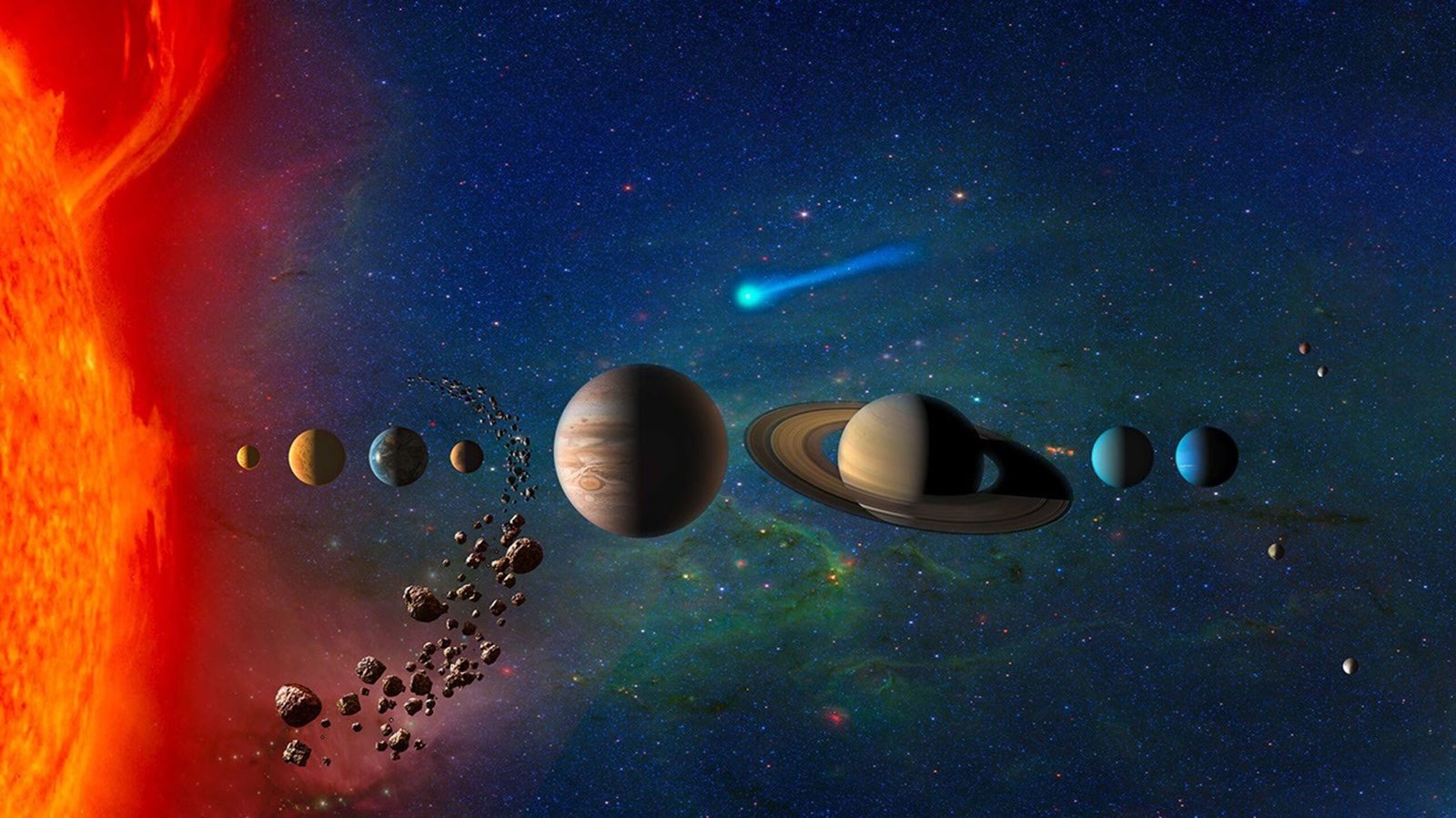
Why Do Planets Born From the Same Dust Become So Different?
The Four Cosmic Switches That Determine a Planet’s Fate
If planets form from the same dusty disc, why don’t they end up as the same kind of world? How does one sibling become Earth and another becomes Venus, a planet hot enough to crush and cook anything we know? The answer lies not in different ingredients, but in four critical switches that flip differently for every world, turning identical raw materials into radically diverse outcomes.
In this exploration, we’ll examine the exact set of switches that decide whether a planet becomes an ocean world, a desert, a furnace, or a frozen rock. The twist is brutal: the biggest differences often come from tiny timing and location changes early on, like missing a deadline by a cosmic hair.
The Planet Divergence Switchboard
Let’s give this idea a name: the planet divergence switchboard. Four switches. Flip them differently and you get totally different worlds. This framework helps us understand why the Webb telescope’s early results are already challenging our assumptions about what rocky worlds can hold onto and how they evolve.
A 2025 overview of rocky planet work by Webb makes it clear the progress is real, but definitive atmosphere detections for many rocky planets are still extremely hard. Which is exactly why every new clue matters.
Switch One: Location in the Disc
If you imagine the planet-forming disc like a pizza, most people picture it as evenly loaded—same ingredients everywhere. But that’s not how it works. The disc has structure, temperature zones, and chemical boundaries that make certain regions far more favorable for planet building than others.
The disc is not uniform. It contains pressure bumps, ice lines, and dust traps—invisible architectural features that control where and how fast planets can grow. These structures act like cosmic construction zones, determining which embryonic planets get a head start and which struggle to gather mass.
The disc has structure, rings, and traps that change where growth happens fastest. Form in the right spot, and you’re on the fast track to becoming a giant. Form elsewhere, and you might stay small forever.
Temperature gradients create distinct zones. Beyond certain distances from the star, water can freeze into ice, dramatically increasing the available solid material for planet formation. This “snow line” or “frost line” is one of the most important boundaries in the disc, effectively doubling or tripling the building material available to growing planets.
Pressure bumps in the disc act like natural dams, causing dust and pebbles to pile up. These concentrations become the seeds of future planets. Without these structures, material would simply drift inward toward the star, never accumulating into planetary bodies.
Switch Two: Timing and the Gas Deadline
Here’s where things get dramatic. The gas in the protoplanetary disc doesn’t stick around forever. It has a deadline—typically a few million years—after which stellar winds and radiation blow it away. This creates a cosmic race against time.
If a growing planet reaches a critical mass before the gas disappears, it can capture a thick atmosphere of hydrogen and helium, becoming a gas giant or a puffy sub-Neptune. Miss that deadline by even a little, and you’re stuck as a rocky world, unable to gravitationally hold onto the gas that’s no longer there.
Beat the gas deadline, and you can become a puffy world. Miss it, and you stay mostly rock. The difference between becoming Jupiter or becoming Mars could come down to growing just a bit faster or slower.
This timing constraint explains one of the great mysteries of planetary systems: why do we see such a stark divide between rocky planets and gas giants, with relatively few intermediate cases? It’s because there’s a threshold—roughly ten Earth masses—that a planet needs to reach while gas is still present. Cross that threshold in time, and runaway gas accretion begins. Arrive late, and you’re forever rocky.
The disc’s lifetime varies from system to system, influenced by factors like the star’s radiation output and the presence of nearby massive stars. Some discs survive for ten million years; others dissipate in just one million. This variability means that identical planet embryos growing in different systems can end up as completely different types of worlds simply because they faced different deadlines.
Switch Three: Orbital Disruption
Once planets start forming, they don’t exist in isolation. Giant planets, if they form, can completely rearrange the architecture of the entire system. They act like gravitational bulldozers, scattering smaller bodies, triggering collisions, and sometimes ejecting planets entirely from the system.
This process, known as dynamical instability, can turn an orderly, regularly spaced planetary system into chaos. Giant planets can migrate inward or outward, their gravity reshaping the orbits of everything around them. Rocky planets that were forming peacefully can suddenly find themselves on collision courses or flung into the outer darkness.
Giant planets can rearrange or destroy the building process, and debris discs preserve evidence of that messy era. Your neighbors determine your fate as much as your own growth does.
Evidence for these violent upheavals comes from debris discs—rings of dust and small bodies that survive long after planet formation is complete. The structure of these discs, including gaps, warps, and clumps, tells the story of gravitational battles that shaped the system.
In our own solar system, the Nice model suggests that Jupiter, Saturn, Uranus, and Neptune formed closer together than they are today, then migrated outward through gravitational interactions, triggering the Late Heavy Bombardment that scarred the Moon and inner planets. This kind of orbital chaos is likely the norm, not the exception.
For rocky planets, giant planet migration can be catastrophic. A rocky world that formed in a comfortable, temperate zone can be scattered into a scorching close orbit or frozen outer region. Conversely, migration can clear out dangerous populations of asteroids and comets, making a system safer for life. The presence and behavior of giant planets is one of the most powerful forces shaping planetary systems.
Switch Four: Atmospheric Survival
Even after a planet forms with an atmosphere, the story isn’t over. Atmospheres can be stripped away or rebuilt through secondary processes, and this fourth switch often determines habitability.
Several mechanisms can strip a planet’s atmosphere. Intense stellar radiation, particularly from young, active stars, can heat the upper atmosphere until gases escape into space. Close-in planets are especially vulnerable to this photoevaporation process. Additionally, the stellar wind—a stream of charged particles flowing from the star—can physically blow away atmospheric gases, particularly if the planet lacks a strong magnetic field to deflect them.
Atmospheres can be stripped or rebuilt. The Webb telescope is starting to reveal cases that challenge the assumption that close-in rocky equals bare rock. Some planets defy the odds.
Giant impacts can also blow off atmospheres. The collision that formed Earth’s Moon likely vaporized much of Earth’s early atmosphere. Venus and Mars, too, may have lost thick early atmospheres to impacts or solar wind stripping.
But atmospheres can regenerate. Volcanic outgassing can slowly rebuild an atmosphere from gases trapped in the planet’s interior. Comet impacts can deliver water and volatile compounds. Some planets may lose their primary hydrogen-helium atmospheres but later develop secondary atmospheres of heavier gases like carbon dioxide, nitrogen, and water vapor—exactly what happened on Earth.
The Webb telescope is proving invaluable here. Its infrared capabilities can detect atmospheric molecules around rocky exoplanets, revealing which worlds have held onto their air and which have been stripped bare. Early results show surprising diversity: some close-in rocky planets that should be barren appear to retain atmospheres, while others in more favorable locations have lost theirs. The rules are more complex than we thought.
Water retention is another critical aspect. A planet can have the right temperature for liquid water, but if it can’t hold onto that water—either because it’s stripped away by solar radiation or lost through chemical reactions with the surface—it will never be habitable. Earth’s magnetic field, generated by its liquid iron core, plays a crucial role in protecting our atmosphere and water from solar wind erosion.
The Webb Telescope Revolution
Why should we care about this framework now? Because the Webb telescope is starting to test rocky planets in ways we could not do before. For the first time, we can probe the atmospheres of small, Earth-sized worlds orbiting other stars, checking which ones have air, what it’s made of, and how thick it is.
The early results are already messing with our assumptions about what rocky worlds can hold onto and how they evolve. Some planets that theory suggested should be airless have detectable atmospheres. Others that should have retained thick atmospheres appear stripped.
This observational revolution will test the planet divergence switchboard. We’ll see which switches matter most, which combinations produce habitable worlds, and which lead to dead rocks. We’re moving from theory to data, from models to measurements.
Progress is real, but definitive atmosphere detections for many rocky planets are still extremely hard. The signals are faint, the observations time-consuming, and the interpretation complex. But every new detection, every spectrum analyzed, adds a piece to the puzzle of why planets diverge.
Closing the Mystery
So why do planets born from the same dust become different worlds? Because dust is just the raw material. The final world depends on four switches.
Switch one: Location. The disc has structure, rings, and traps that change where growth happens fastest.
Switch two: Timing. Beat the gas deadline, and you can become a puffy world. Miss it, and you stay mostly rock.
Switch three: Disruption. Giant planets can rearrange or destroy the building process, and debris discs preserve evidence of that messy era.
Switch four: Survival. Atmospheres can be stripped or rebuilt. And the Webb telescope is starting to reveal cases that challenge the assumption that close-in rocky equals bare rock.
Planets are not defined by their ingredients. They’re defined by their history. Same dust, different timeline, different world. Each planetary system is a unique outcome of these four switches flipping in different sequences, at different times, with different intensities.
The implications are profound. When we search for habitable worlds, we’re not just looking for planets in the right location—we need to understand their entire formation history. Did they form at the right time? Were they disrupted by giants? Did they keep their atmospheres?
Earth’s habitability is not inevitable. It’s the result of fortunate switch settings: forming beyond the frost line where water ice was abundant, reaching sufficient size before the gas disc dispersed, avoiding catastrophic disruption from Jupiter’s migration, and retaining our atmosphere thanks to a protective magnetic field. Change any one of these, and Earth could have been Venus, or Mars, or something we’ve never seen.
A Question to Consider
Here’s a thought experiment: If you could rewind our solar system and change only one switch, which one would you change to make Earth’s outcome even more stable?
Would you adjust our location, moving Earth slightly farther from or closer to the Sun? Would you change the timing, making sure we formed faster or slower? Would you alter Jupiter’s migration path to reduce or increase its influence? Or would you strengthen Earth’s magnetic field to better protect our atmosphere?
Each choice has consequences. There’s no obviously right answer. But asking the question forces us to understand which factors matter most for habitability, which is exactly what we need to know as we search for life among the stars.
The planet divergence switchboard isn’t just a framework for understanding planetary diversity. It’s a tool for predicting which worlds to study, which systems to search, and where we’re most likely to find another Earth. Because now we know: it’s not about finding the right dust, it’s about finding the right sequence of cosmic switches.











Be First to Comment