
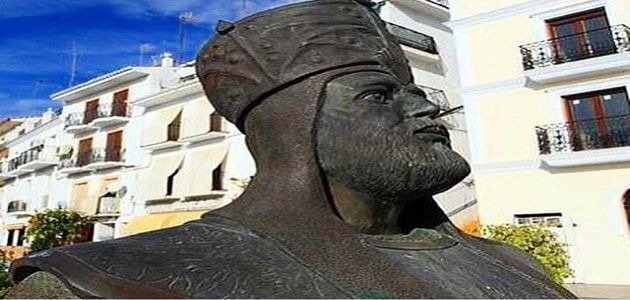
Al-Hajib Al-Mansur
327–392 AH | 938–1002 CE | Al-Andalus
Abu Amir Muhammad ibn Abi Amir, known to history as Al-Hajib Al-Mansur (The Victorious Chamberlain), stands as one of the most remarkable figures of medieval Islamic civilization. Born in a village on the outskirts of Tarsh from a family of Yemeni origins, he rose from humble beginnings to become the de facto ruler of the Umayyad Caliphate in Al-Andalus—never once defeated in battle across 57 military campaigns.
Soldier, statesman, administrator, and builder, Al-Mansur expanded the frontiers of Islamic Andalusia to their greatest extent, transforming Córdoba into one of the most magnificent cities in the medieval world. This is his story.
From Student to Power
As a young man, Al-Mansur traveled to Córdoba to study Islamic jurisprudence. His early beginnings were modest, but his intelligence, ambition, and ability to read people and situations set him apart. He entered the royal court and advanced steadily through its ranks during the reign of Caliph Al-Hakam II al-Mustansir billah.
He gained the crucial trust of the Caliph’s wife, Subh al-Baskunsiyya, the mother of the future Caliph Hisham al-Mu’ayyad billah. After the death of her husband al-Hakam, Subh served as regent for her young son, and her patronage proved decisive in Al-Mansur’s ascent. Under this protection, combined with his own formidable competence, he rapidly accumulated positions of power.
During the reign of al-Hakam II, he served as director of the mint, then as trustee for Abd al-Rahman—the Caliph’s first son—and later as trustee for Hisham after Abd al-Rahman’s death. He also held the position of inheritance administrator, and then served as judge over Seville and Niebla.
Regent of Al-Andalus
As chamberlain of the Caliphate, Al-Mansur exercised extraordinary authority across the Iberian Peninsula and parts of North Africa. He effectively founded a state within a state, known as the Aamiri State—a period of his regency over Caliph al-Mu’ayyad billah, and subsequently his sons Abd al-Malik al-Muzaffar and Abd al-Rahman Sanjul.
He laid the foundations of governance for his sons after him. However, their control over Al-Andalus would not last long—ending less than a decade after his death, when the land descended into the turbulent period of competing Caliphate claimants, ultimately leading to the fragmentation of Umayyad power.
Once firmly in control, Al-Mansur turned his attention northward. His military campaigns pushed the borders of the Christian kingdoms beyond the Duero River, bringing the Umayyad Caliphate in Al-Andalus to the peak of its power. His campaigns against the Christian kingdoms temporarily halted their southward advance. Yet despite his overwhelming military victories, he barely recovered conquered lands—his genius lay in domination, not permanent annexation.
Military Dominance: 57 Battles, Zero Defeats
The scale of Al-Mansur’s military machine was staggering for its era. He invested deeply in his armed forces, relying heavily on Berber troops and Christian Iberian mercenaries, and built one of the most formidable professional armies the medieval world had seen.
His military workshops operated year-round to sustain this force. The Dar al-Tarrasin (Shield Factory) produced annually: 13,000 shields, 12,000 bows, 20,000 arrows, and 3,000 tents. He even established a new naval shipyard at Qasr Abi Danis to reinforce his maritime power.
By the end of his reign, his professional standing army was so powerful that he no longer needed to resort to conscription even during major campaigns—a remarkable achievement for any medieval ruler.
Managing the Maghreb
Al-Mansur’s authority extended well beyond Iberia. In 375 AH, he dispatched a great army against Al-Hasan ibn Kannon, who had rebelled against Umayyad authority in the Maghreb and gathered many followers around him. Finding no option but surrender, al-Hasan capitulated—but Al-Mansur ordered his execution en route to Córdoba and expelled the Idrisids from the Maghreb.
Then in 387 AH, Ziri ibn Atiyya al-Maghrawy rebelled against Umayyad rule in the Maghreb. Al-Mansur sent an army under the commander Wadih al-Amiri, but the Andalusian force was defeated in the ensuing battles. He then dispatched his son Abd al-Malik with a second army, while Al-Mansur himself moved to Algeciras to oversee the campaign and supply his commanders in the Maghreb.
Abd al-Malik’s army ultimately prevailed over Ziri—though Ziri had come close to victory—due to a betrayal arranged by Al-Mansur himself: Ziri’s own cousin, al-Khayr ibn Muqatil, stabbed him in the back with a lance during the battle. The wound threw Ziri’s forces into disarray, leading to their defeat and the flight of part of his army. After recovering from his wounds, Ziri showed remorse and expanded eastward into Sanhaja tribal territory loyal to the Fatimids, acting in the name of Caliph Hisham al-Mu’ayyad billah.
Monuments of a Civilization
In 368 AH, as part of his drive to complete his political independence in governing Al-Andalus, Al-Mansur began constructing his own city: Al-Zahira. He transferred the government’s administrative departments to it, and built within it a palace of extraordinary magnificence—so lavish that its daily consumption reached 12,000 ratls of meat daily, not counting poultry and fish. Construction took approximately two years.
In 370 AH, Al-Mansur relocated there with his household, then the public followed. He stocked it with weapons, granted surrounding lands to his ministers, commanders, and senior officials until its urban expansion connected with the suburbs of Córdoba. Markets spread throughout it and it became a thriving hub of commerce and governance.
In 377 AH, Al-Mansur added a major new extension to the east wing of the Grand Mosque of Córdoba, bringing its total columns to 1,417 pillars. He also enhanced its illumination, adding candle lighting to supplement the existing oil lamps. He was scrupulous in compensating property owners whose homes were acquired for the expansion—generously, even beyond what was asked.
A remarkable account survives: a woman who lived in a house near the mosque, which contained a palm tree, refused to sell unless she was given another home with a similar palm tree. Al-Mansur ordered exactly that to be found for her—regardless of the cost to the treasury—and only then added her house to the mosque’s boundaries.
In 387 AH, Al-Mansur began the restoration of Córdoba’s great bridge, completing it in 389 AH at a cost of 140,000 dinars. He also added another bridge over the Genil River.
Under his rule, Córdoba expanded into one of the largest and most prosperous cities in the medieval world. A census of his state’s administrative records counted in his era:
Death and Legacy
Al-Hajib Al-Mansur died on 27 Ramadan, 392 AH (1002 CE) in the city of Medinaceli, returning from a campaign against Burgos in which he had sustained wounds. True to his character, he had requested to be buried where he died, and his tomb remains there to this day, known as the Tomb of Al-Hajib Al-Mansur. He had long suffered from gout.
He left behind two sons: Abd al-Malik and Abd al-Rahman—besides his son Abdullah, whom he himself had executed in 380 AH. Historians record at least four of his wives: Asma bint Ghalib al-Nasiri; al-Dhulfa, mother of his son Abd al-Malik; Teresa, daughter of Bermudo II, King of León; and Urraca, daughter of Sancho II, King of Navarra, whom he married in 371 AH. Urraca embraced Islam, and Al-Mansur named her Abda—she became the mother of his son Abd al-Rahman.
He left behind 54 treasuries in his city of Al-Zahira. His son Abd al-Malik succeeded him and followed his father’s path until his own death in 399 AH, after which his brother Abd al-Rahman succeeded him—but his reign was short-lived. Al-Andalus fell into years of turmoil beginning with Abd al-Rahman’s assassination, ending ultimately in the collapse of the Umayyad Caliphate and the rise of the Taifa kingdoms.
As though you see him with your very eyes.
By Allah, time will not bring his like again,
Nor will any other guard the frontiers as he did.”
Al-Hajib Al-Mansur stands as a complex, towering figure of Islamic history. He was a man of extraordinary administrative ability, unmatched military genius, and remarkable civic vision—who expanded an empire, beautified its capital, and left behind infrastructure that endured for centuries.
Yet he was also a man of his era’s politics—ruthless when necessary, calculating in his rise, willing to eliminate rivals without hesitation. His legacy is therefore neither purely heroic nor purely cautionary, but profoundly human: a brilliant mind navigating the turbulent intersection of power, faith, and civilization in medieval Al-Andalus.
The 57 campaigns he personally led—in none of which he suffered defeat—remain one of the most extraordinary military records in medieval history.
Ibn Hazm, Ali (1987). Rasa’il Ibn Hazm al-Andalusi. Al-Mu’assasa al-Arabiyya lil-Dirasat wal-Nashr. Edited by Ihsan Abbas.
Al-Maqqari, Abu al-Abbas Ahmad (1968). Nafh al-Tib min Ghusn al-Andalus al-Ratib — Vols. 1 & 3. Dar Sadir, Beirut.
Al-Maqqari, Abu al-Abbas Ahmad (1980). Azhar al-Riyad fi Akhbar Iyad. Islamic Heritage Revival Fund, UAE.
Ibn al-Khatib, Lisan al-Din (1988). Al-Ihata fi Akhbar Gharnata — Vol. 2. Maktabat al-Khanji, Cairo.
Ibn al-Khatib, Lisan al-Din (1956). A’mal al-A’lam. Beirut.
Al-Adhri, Ahmad ibn Umar. Nusus an al-Andalus min Kitab Tarsi al-Akhbar.








Be First to Comment