
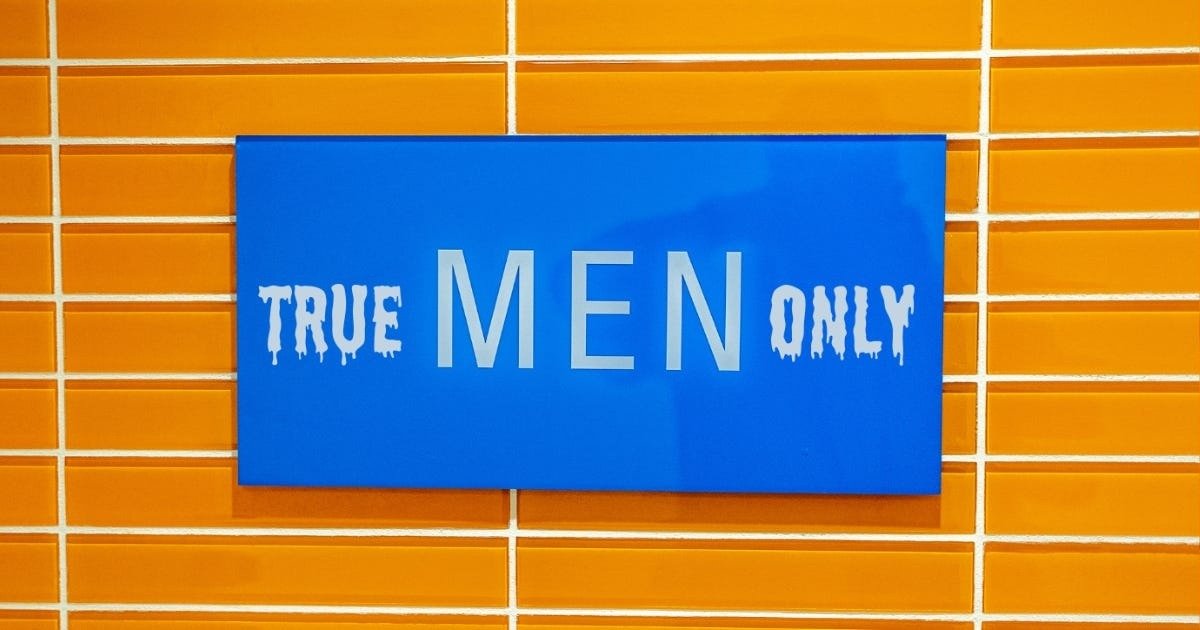
The Difference Between
“Man” and “Male”
A reflection on character, responsibility, and faith
In an age where appearances often outshine substance, it has become necessary to revisit what it truly means to be a man. Manhood is not measured by muscle or dominance, but by principle, restraint, and righteousness. The line between being a male and being a man is not drawn by birth, but by behavior — by the character that rises above instinct and by the faith that steadies the soul.
The Moral Dimension
In every era, humanity has known males in abundance but men in scarcity. The difference between the two is not one of anatomy but of character, not of physical strength but of moral stature. Every male is born by nature, but a man is forged by principles, discipline, and virtue.
A male is defined by his body — his voice, his strength, and his instincts. He grows as nature wills, eats, speaks, and walks as others do, yet may remain enslaved to his impulses. He may have the form of a man but not the essence. His identity is confined to his desires, and his worth is measured by what he owns, not by what he gives. The world is full of such males who confuse manhood with dominance, and power with respect.
A man, however, is another being entirely. A man is one whose heart is greater than himself; who lives not for his own comfort but for a principle higher than his own needs. He embodies muruʾah (honorable conduct), karam (generosity), and ḥilm (forbearance). He knows that the noblest strength lies in restraint, that dignity dwells in humility, and that true power is the mastery of one’s soul.
In the Arab tradition, a man is called rajul, and rujūlah is not something given — it is something earned. It is shown in how he protects the weak, honors his word, and bears hardship without complaint. It is in how he treats women, elders, and strangers; how he forgives when capable of vengeance; how he gives without seeking repayment. A man is one who stands upright when others bend, whose sense of justice outlives popularity, and whose honor cannot be bought or broken.
The male seeks possession; the man seeks protection.
The male boasts of what he has done; the man is silent — for his deeds speak for him.”
In truth, manhood is a moral station, not a biological one. It is what prophets and sages called us to when they said: “The strongest among you is the one who controls his anger.” Such a man may be poor yet still noble, obscure yet still radiant, gentle yet still courageous.
The world does not weep for the absence of males — for they are born every day. But it grieves for the scarcity of men: those whose presence ennobles others, whose honor uplifts the community, and whose character restores faith in humanity.
To be a male is a matter of birth.
To be a man is a matter of choice.
The Religious Dimension of Manhood
In the light of Islam, manhood (rujūlah) is not a worldly title — it is a spiritual and moral station. The Qur’an and Sunnah describe true men not by their gender, but by their faith, courage, and steadfastness. Allah says:
“Among the believers are men who have been true to their covenant with Allah. Some of them fulfilled their vow, and some are still waiting — but they never changed in the least.”
Surat al-Aḥzāb 33:23
Here, rijāl refers to those whose faith made them sincere, loyal, and firm — men who stood when others fled, who remained faithful when others faltered.
The Prophet ﷺ further defined true strength:
“The strong man is not the one who overpowers others, but the one who controls himself when angry.”
Agreed upon – al-Bukhārī and Muslim
This hadith captures the core of rujūlah: mastery over one’s desires, not mastery over others. True manhood flows from taqwā (God-consciousness), patience, humility, and responsibility.
The Messenger of Allah ﷺ also said:
“Each of you is a shepherd, and each of you will be asked about his flock.”
Narrated by al-Bukhārī and Muslim
A true man does not define himself by wealth, lineage, or prestige, but by his obedience to Allah and service to creation. Leadership to him is not prestige but trust — a weight to bear with justice and compassion.
As Allah describes in another verse:
“Men whom neither trade nor sale distracts from the remembrance of Allah, from establishing prayer, and from giving zakah. They fear a Day when hearts and eyes will be overturned.”
Surat al-Nūr 24:37
These are men whose hearts remain firm amidst distraction — whose commerce never clouds their conscience, and whose worldly duties never eclipse their devotion.
In the end, the difference between a male and a man is the difference between existence and purpose. The male lives for himself; the man lives for truth. The male follows instinct; the man follows principle.
A true man in Islam is both humble before Allah and noble before people — gentle with the weak, firm against injustice, generous in giving, and steadfast in belief. His manhood is a reflection of faith, a mirror of mercy, and a legacy of goodness.
Such men are the pillars of homes, the guardians of honor, and the quiet lights that keep faith alive amid the storm.









Be First to Comment