
Stillwater mayor warns property tax cuts could threaten city’s bond obligations
FY27 budget projects growth on historic manufacturing and trade activity, but mayor warns property tax proposals could put Stillwater’s bonds at risk
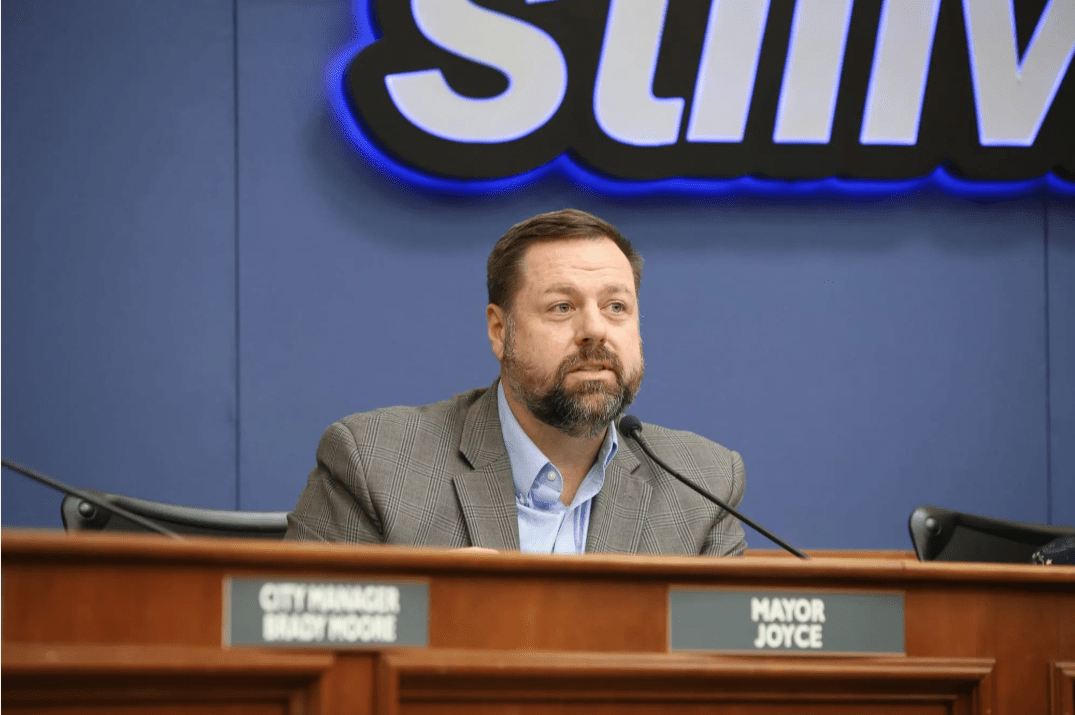
Stillwater Mayor Will Joyce raised concerns Monday about state-level efforts to restrict property tax collections, warning that cuts to that revenue stream could leave the city unable to repay bonds already issued to fund city projects.
“It certainly sounds like they’re getting close to making decisions that they don’t fully understand the consequences,” Joyce said.
Christy Cluck, the assistant city manager and chief financial officer, confirmed the exposure. If ad valorem revenue — the property tax collections that back the city’s general obligation bonds — were eliminated, she said, “it would be very, very difficult for us to find a way to fund those existing bonds.” She added that it is “a question that many cities are going to have to answer on how to navigate that.”
The exchange came during the council’s first look at the proposed Fiscal Year 2027 operating budget Monday evening.
General obligation bonds are backed by the city’s taxing authority and repaid through ad valorem — property tax — collections. Stillwater voters approved an $8.75 million general obligation bond last April to fund a new animal welfare facility, with 74 percent voting in favor. The city has also issued GO bonds for other capital projects. A reduction in property tax authority at the state level could affect the city’s ability to repay those obligations.
Reform, or elimination: Two paths at the Legislature
Joyce’s remarks came days after the Oklahoma House advanced Senate Joint Resolution 39, a proposed constitutional amendment that would cap how much property values can increase annually for tax purposes. Under the current system, assessed values for homesteads and agricultural land can increase no more than 3 percent per year; SJR 39 would lower that cap to 1.75 percent beginning in tax year 2027. Commercial property caps would fall from 5 percent to 4 percent. The House passed the resolution 85-9, according to Oklahoma Voice reporter Emma Murphy. If the Senate concurs, the measure would go before voters on Aug. 25, 2026.
House Speaker Kyle Hilbert, R-Bristow, said the measure would give Oklahoma “the lowest cap on growth in the entire country on an individual homestead,” Murphy reported. But Rep. Ellen Pogemiller, D-Oklahoma City, warned that the tradeoff falls directly on local governments and the bonds they have issued.
- Current homestead/agricultural cap: 3% annual increase
- Proposed cap (SJR 39): 1.75% annual increase
- Current commercial property cap: 5% annual increase
- Proposed commercial cap: 4% annual increase
“Lower caps will mean slower growth, which means less revenue for schools, CareerTechs and roads, but with the same debt obligation,” Pogemiller said, according to Murphy’s reporting. “And that reduces their capacity to take on, or even support existing bonds.”
The cap proposal has been positioned as a moderate alternative to a more aggressive citizen-initiated effort. State Question 843, an initiative petition currently facing a legal challenge in the Oklahoma Supreme Court, would phase out property taxes on primary residences entirely — ending them permanently beginning in 2029.
Oklahoma Voice reporter Barbara Hoberock reported that 10 Oklahoma residents, including school board members and local emergency officials, filed suit to block the measure from circulating for signatures, arguing it would eliminate $1.52 billion in annual revenue, 68 percent of which flows to schools.
Cities that have issued general obligation bonds backed by ad valorem collections — including Stillwater — face particular risk under either scenario, as those bonds carry legal repayment obligations regardless of what happens to the underlying revenue source.
Budget projects growth, with water debt driving expenditure increase
Finance staff presented the proposed FY27 operating budget, which projects overall revenue growth alongside a significant increase in expenditures tied to debt service on Stillwater’s $112.9 million water infrastructure loan.
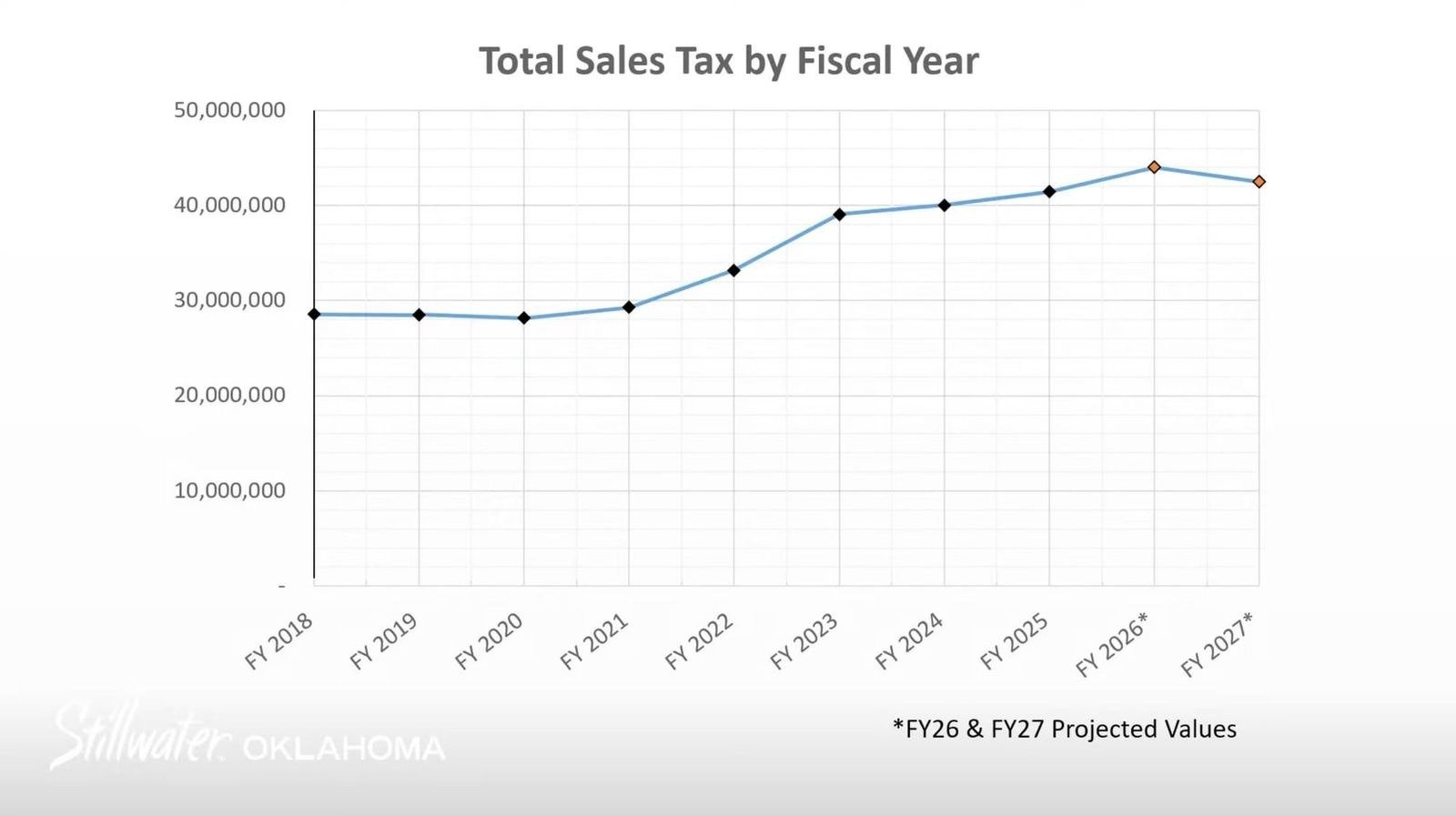
The city’s general fund is projected to grow by approximately $3.8 million. Sales tax accounts for $1.8 million of that increase and use tax for $1.1 million. Budget Manager Seth Hughes attributed the growth to continued construction activity, a growing labor pool in Stillwater, and manufacturing and wholesale trade activity he described as exceeding “any historic level that we’ve seen before.”
Utility revenues are projected to rise by $3.6 million as the council-approved five-year rate increase continues. Water and wastewater revenues are expected to climb approximately $2.5 million, waste management approximately $1.2 million, and electric revenues by $1 million.
Total expenditures are projected to increase by $10.5 million, driven primarily by debt service payments on the $112.9 million loan the city secured last year from the Oklahoma Water Resources Board’s Financial Assistance Program to fund water and wastewater infrastructure improvements — including a new raw water line from Lake McMurtry. The city’s annual payments on that loan are approximately $7.2 million. The loan was approved by the council in August 2025.
The proposed budget includes $500,000 for new vehicle purchases and $250,000 in software upgrades, with all service levels projected to remain unchanged. Emergency reserve balances are proposed to stay intact.
The city’s Transportation Sales Tax Fund carries approximately $26.5 million in its beginning balance, with $10.6 million in additional revenue projected for FY27. Deputy Chief Financial Officer Jared Thulin said those funds are allocated to capital projects being prepared for bidding and will be appropriated as individual projects move forward.
When Joyce asked what would happen if sales tax revenues outperformed conservative projections, Thulin said excess revenue would be directed to the capital fund to address outstanding infrastructure needs, as was done in FY26.
A public hearing on the proposed budget is scheduled for May 18. Final adoption is set for June 1, with the new fiscal year beginning July 1.
Voter-approved animal shelter on track for fall groundbreaking
The new animal welfare facility that Stillwater voters approved in April 2025 is moving toward a fall groundbreaking, Councilor Tim Hardin announced Monday.
City staff are working with Barrett L. Williamson Architects and Animal Arts on building design while contractor Nabholz works on construction and cost estimates. Hardin did not provide a specific groundbreaking date.
The facility is funded by the $8.75 million general obligation bond voters approved with 74 percent in favor — the same type of bond Joyce warned could be threatened by state property tax changes. The planned 12,200-square-foot building near Stillwater Regional Airport would nearly quadruple the size of the current 37-year-old shelter and double its animal capacity, housing up to 47 dogs and 42 cats.








Be First to Comment