

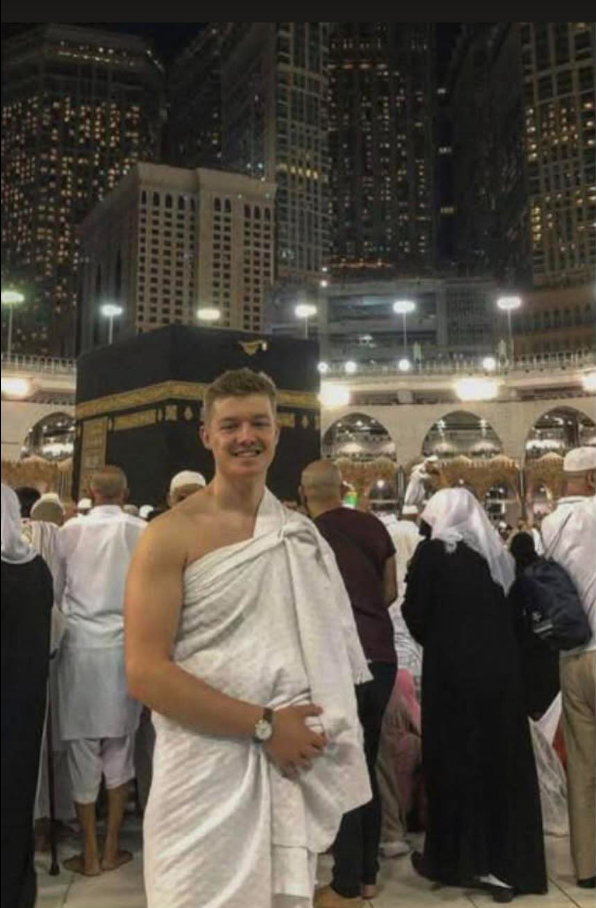
Belgian researcher and journalist Stijn Ledegen embraced Islam and kept his faith private for a full year before openly announcing his conversion and commitment to defending Islam. He later chose to speak publicly about his journey and to support others who become Muslim in similarly challenging circumstances.
His journey to Islam
Stijn Ledegen, a Belgian researcher in the European Union with a Master’s degree in International and European Law, accepted Islam after a long period of questioning life’s purpose and struggling to find convincing answers. He explains that he “could not ignore the questions that no one had answers to” and that he only found satisfying answers in Islam.
For an entire year, he kept his Islam secret, reflecting on his new faith and its implications before revealing it to his family and society. After that period, he declared his Islam publicly, resolved to defend the religion, and to speak about the realities facing new Muslims in Europe.
Challenges new Muslims face
Ledegen emphasizes that many new Muslims are left on their own immediately after saying the testimony of faith, as if they can instantly adapt without guidance or community support. In reality, the post‑conversion phase is often poorly supported, which can lead to confusion, misinterpretation of beliefs, or even drifting away from practice.
He notes that converts frequently face painful reactions from family members: a mother may weep, a father may react with shock or anger, and some parents even expel their children from the home because they embraced Islam. In his own case, Ledegen delayed telling his father for more than a year, and when he finally did, his father responded with anger and incomprehension, while his mother was stunned.
Social pressures and stereotypes
Ledegen highlights how ordinary lifestyle choices are judged differently when they are linked to religion. For example, abstaining from alcohol is widely respected if it is for sport or health, but considered strange or “ridiculous” when done for religious reasons; similarly, growing a beard is acceptable for fashion, yet may be labeled “extreme” if connected to faith.
He points out that such double standards are reinforced by negative media portrayals of Islam, which make it even harder for converts to explain their beliefs to families who already reject religion in general. This environment contributes to misunderstanding, fear, and the perception that becoming Muslim is an act of rebellion rather than a sincere spiritual choice.
His work and contributions
Professionally, Stijn Ledegen has worked as a researcher for the European Parliament and conducted research on religious influence in Europe in 2019. He remains active in public discourse, writing articles and studies that criticize the rise of Islamophobia in Belgium and across Europe.
He is the author of the book “Islam in the Eyes of the Convert” (also published as “Islam through the Eyes of a Convert”), where he discusses the experiences of new Muslims and the practical and emotional challenges they face after embracing Islam. Through his activism and writing, he strives to create a fairer, more understanding environment for Muslims and converts in Europe, while encouraging converts to maintain strong, respectful ties with their non‑Muslim families.
A brief duʿāʾ for him
We ask Allah, the Most High, to keep him firm upon the truth and to reward his efforts in supporting Islam and its new followers. Ameen.






Be First to Comment