
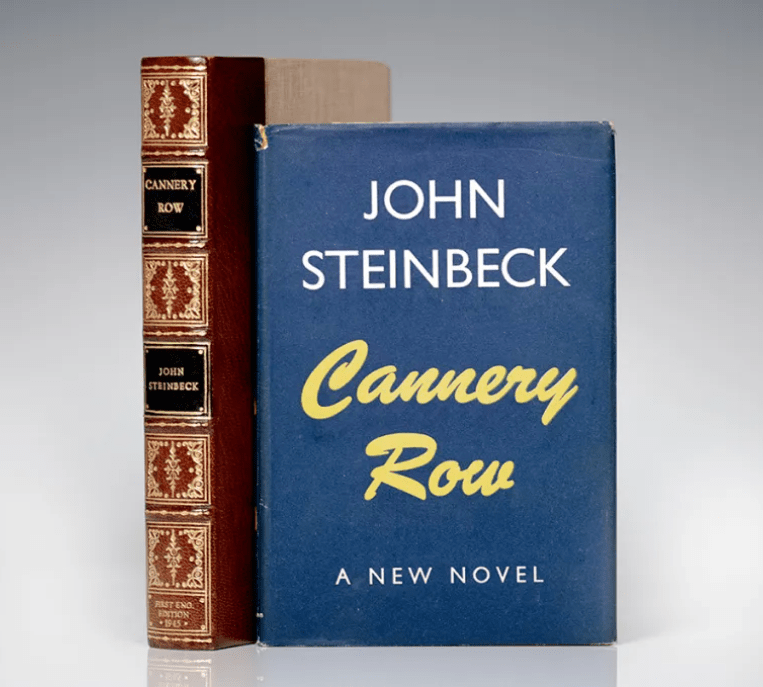
Cannery Row: Steinbeck’s Timeless Ode to Human Connection
A poetic celebration of community, imperfection, and the quiet dignity of society’s misfits
A Timeless Portrait of Life’s Outcasts
Published in 1945 during the final stages of World War II, Cannery Row emerged as John Steinbeck’s deliberate departure from the stark social realism that defined his earlier masterpieces. Written in response to soldiers’ requests for “something funny that isn’t about the war,” this novel became one of Steinbeck’s most beloved and distinctive creations—a poetic celebration of community, imperfection, and the quiet dignity of society’s misfits.
Set in the gritty sardine-canning district of Monterey, California (where Ocean View Avenue was later renamed Cannery Row in the book’s honor), the novel captures a slice of life among working-class poor, eccentrics, and outcasts still living in the lingering shadow of the Great Depression. What makes Cannery Row extraordinary is not its plot but its heart—a tapestry of human connection that continues to resonate nearly eight decades after its publication.
A Novel Without a Plot, But Full of Life
Steinbeck defies conventional narrative structure in Cannery Row, crafting instead a series of interconnected vignettes, character sketches, and episodic adventures. The book reads like a symphony of human experiences rather than a linear story, blending humor, philosophy, and quiet observation in a way that feels both timeless and immediate.
At the center of this world is Doc, the novel’s moral and intellectual anchor. Based on Steinbeck’s real-life friend Ed Ricketts, Doc is a marine biologist who runs the Western Biological Laboratory on the Row. His gentle wisdom, scientific curiosity, and quiet acceptance of life’s complexities make him the heart around which the community revolves.
The real magic of Cannery Row lies in its characters—each one a masterclass in humanizing the marginalized, showing that true richness lies not in wealth but in human connection.
Unforgettable Characters Who Define the Row
The inhabitants of Cannery Row form a community unlike any other in literature. Each character is vividly drawn with depth and humanity:
- Mack and the boys: A group of happy-go-lucky bums living in a discarded boiler they call the Palace Flophouse. They represent freedom from societal ambition, living simply yet displaying profound loyalty and generosity.
- Lee Chong: The pragmatic Chinese store owner whose shrewdness masks a deep well of compassion.
- Dora Flood: The madam of the Bear Flag Restaurant (a brothel), who challenges stereotypes with her warmth, business acumen, and genuine care for her “girls” and the community.
- The Chinaman: An enigmatic figure whose quiet presence adds depth to the Row’s cultural tapestry.
- Frankie: A tragic figure whose struggles highlight the novel’s themes of loneliness and resilience.
The loose narrative arc follows the group’s repeated attempts to throw a surprise party for Doc—a gesture of gratitude that first ends in hilarious disaster but ultimately succeeds in a heartfelt, if imperfect, celebration. These episodes are interspersed with poetic interludes, including Steinbeck’s vivid descriptions of tide pools as metaphors for human society, where organisms coexist in delicate, beautiful balance.
Enduring Themes That Resonate Today
Cannery Row explores profound themes through the lens of its marginalized community, each one as relevant today as in 1945:
- Community and Human Connection: Despite poverty and isolation, the residents of Cannery Row form a tight-knit, supportive network. Steinbeck suggests that true community arises not from social status or material success, but from shared humanity and mutual care.
- The Nature of Virtue: The novel challenges conventional morality. The “bums” and sex workers often display more genuine kindness than the so-called respectable world, forcing readers to question what it truly means to live virtuously.
- Loneliness and Isolation: Many characters grapple with existential solitude, yet find solace in moments of connection. The tide pool metaphor—where all creatures live, struggle, and die together—beautifully illustrates the interdependence that defines human existence.
- Ambition vs. Contentment: In stark contrast to capitalist striving, the inhabitants of Cannery Row find happiness in simple survival and fellowship. Steinbeck romanticizes their rejection of materialism, suggesting that true richness lies in human bonds rather than wealth.
- The Duplicity of Life: Beauty and ugliness, joy and sorrow coexist in Cannery Row. Steinbeck celebrates life’s contradictions, presenting them not as flaws but as essential elements of its richness.
A Style That Blends Realism with Utopian Idealism
Steinbeck’s prose in Cannery Row is a masterclass in lyrical beauty, sharp humor, and ecological awareness. His descriptions of Monterey’s coastline, marine life, and the quirks of human nature remain vivid and evocative. While some early reviewers dismissed the book as sentimental—especially given the gravity of its wartime publication—it has endured as a beloved classic precisely because of its warmth, compassion, and celebration of ordinary lives.
The novel’s tone is a unique blend of realism and utopian idealism—what some critics have called a “realistic utopian novel.” Steinbeck idealizes the warmth and fellowship among the dispossessed without sugarcoating their struggles. This balance makes Cannery Row feel both grounded and aspirational, a testament to the author’s range and depth.
“It has always seemed strange to me,” Doc says, “that the things we admire in men—kindness and generosity, openness, honesty, understanding, and feeling—are the concomitants of failure in our system. And those traits we detest—sharpness, greed, acquisitiveness, meanness, egotism, and self-interest—are the traits of success.”
— John Steinbeck, Cannery Row
Legacy and Why It Still Matters
Published as the war ended, Cannery Row offered readers escapism and hope. Its sequel, Sweet Thursday (1954), continues the story, but the original remains the more celebrated work. The real Cannery Row became a tourist destination, with its street officially renamed in 1958—a fitting tribute to the novel’s cultural impact.
What makes Cannery Row timeless is its gentle rebellion against judgment. Steinbeck reminds us that paradise can exist in the most unexpected places—not in wealth or perfection, but in the messy, generous bonds between imperfect people. It is a love letter to the overlooked, a quiet affirmation that even in hardship, life can be joyful, connected, and profoundly human.
Who Should Read This Book?
- Fans of character-driven narratives and richly drawn settings
- Readers who appreciate poetic prose and philosophical depth
- Those interested in stories of community and human resilience
- Anyone who believes that beauty can be found in life’s imperfections
- Book clubs looking for thought-provoking discussions about morality and society










Be First to Comment