
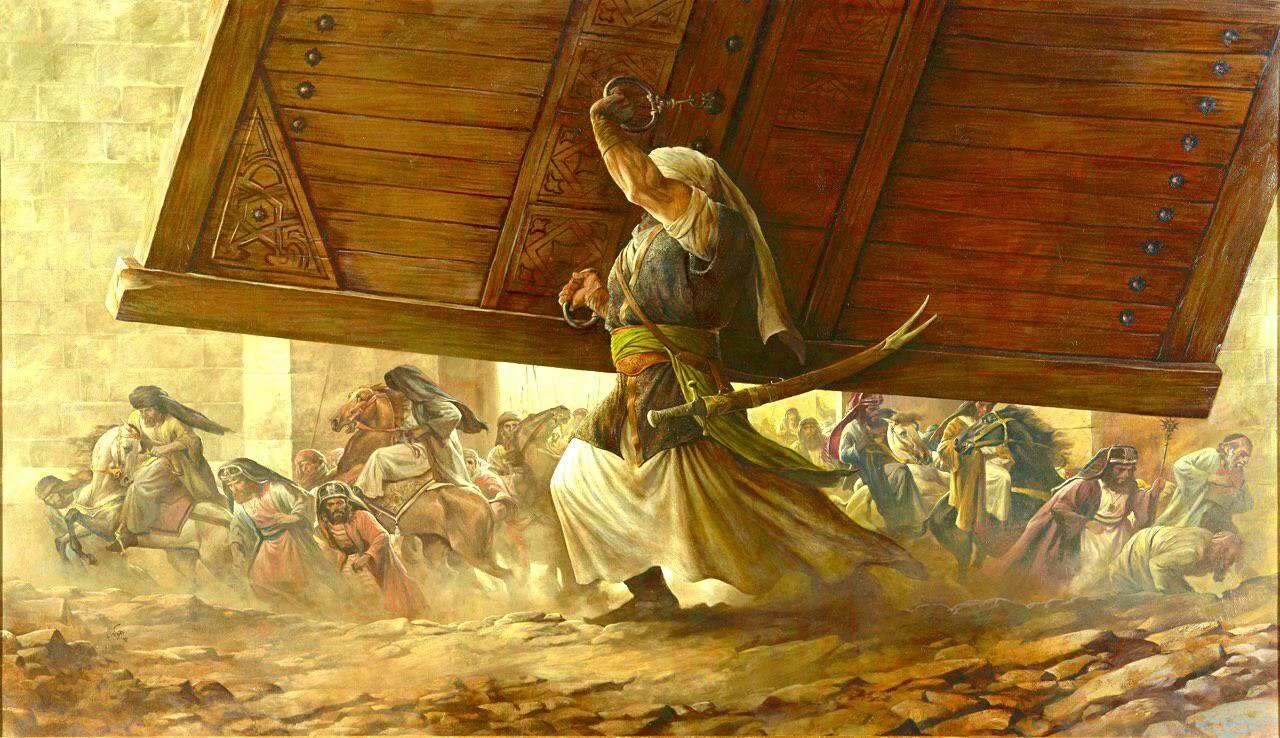
The Martyrdom of Ali ibn Abi Talib
And the Brief, Noble Caliphate of Hassan ibn Ali
When: 29 Ramadan 40 AH (29 January 661 CE)
Where: The Great Mosque of Kufa, Iraq
Victim: Ali ibn Abi Talib رضي الله عنه, Fourth Caliph of Islam (656-661 CE)
Assassin: Abd al-Rahman ibn Muljam, a Kharijite extremist
Successor: Hassan ibn Ali رضي الله عنه, Fifth Caliph (661 CE, six months)
Sources: Tarikh al-Rusul wa al-Muluk (al-Tabari), Tarikh al-Khulafa (al-Suyuti)
Who Was Ali ibn Abi Talib?
To understand the magnitude of this tragedy, we must first understand who Ali ibn Abi Talib was—not merely as a historical figure, but as a pillar of Islam whose very life was intertwined with the Prophet Muhammad ﷺ from childhood until death.
The Turbulent Caliphate (656-661 CE)
Ali’s caliphate was marked by fitna (civil strife) from its very beginning. He inherited a Muslim community deeply divided over the assassination of Uthman and the question of who should lead.
1. The Battle of the Camel (656 CE): Fought against Aisha, Talha, and Zubayr, who demanded immediate punishment for Uthman’s killers. Ali argued that the situation was too unstable and that premature action would cause greater chaos. The battle ended with Ali’s victory but cost thousands of Muslim lives—a tragedy that grieved him deeply.
2. The Battle of Siffin (657 CE): Against Muawiyah ibn Abi Sufyan, the governor of Syria who refused to recognize Ali’s caliphate until Uthman’s killers were punished. The battle lasted months, with tens of thousands killed on both sides. When Ali’s forces were on the verge of victory, Muawiyah’s army raised Qurans on spears, calling for arbitration.
3. The Kharijite Rebellion (658 CE onwards): A faction that had initially supported Ali turned against him after he accepted arbitration at Siffin. They declared “judgment belongs to Allah alone” and viewed both Ali and Muawiyah as apostates for agreeing to human arbitration. This extreme group would ultimately produce Ali’s assassin.
The Kharijites: Ideology of Extremism
The Kharijites (literally “those who went out”) represented the first major extremist movement in Islamic history. Their ideology was dangerously simplistic:
• Any Muslim who commits major sin becomes an apostate
• Such “apostates” must be killed, along with their families
• Only their interpretation of Islam is correct
• All others—including the Prophet’s companions—are misguided
• Violent rebellion against “corrupt” leaders is obligatory
Ali tried reasoning with them, sending his closest companions including Abdullah ibn Abbas to debate them. Many returned to the fold after understanding their errors, but a hardcore extremist element remained, viewing Ali as the greatest traitor to Islam for accepting arbitration.
At the Battle of Nahrawan (658 CE), Ali was forced to fight them after they began massacring Muslims they deemed “apostates.” Though Ali’s forces won decisively, some Kharijites escaped—and among them was Abd al-Rahman ibn Muljam.
The Conspiracy of Three Assassins
Three Kharijites who survived Nahrawan met in Makkah during the pilgrimage season of 40 AH. Consumed by hatred and convinced that the Muslim ummah’s problems stemmed from its leaders, they hatched a plot that would shock the Islamic world.
The three conspirators were:
1. Abd al-Rahman ibn Muljam – Assigned to kill Ali ibn Abi Talib in Kufa
2. Al-Burak ibn Abdullah – Assigned to kill Muawiyah ibn Abi Sufyan in Damascus
3. Amr ibn Bakr al-Tamimi – Assigned to kill Amr ibn al-As in Egypt
They reasoned that if they killed all three leaders simultaneously, the Muslim ummah would be forced to choose new leadership and—in their deluded thinking—would turn to their Kharijite ideology.
They agreed to strike on Friday, 19 Ramadan 40 AH, during the Fajr prayer when the leaders would be most vulnerable. Each swore to carry out his mission or die trying, coating their swords with poison to ensure that even a minor wound would prove fatal.
The Night Before the Attack
Historical sources preserve haunting details from the night of 18 Ramadan—Ali’s last night on earth:
Ali spent the night in worship, as was his custom. His daughter Umm Kulthum later recalled that he seemed unusually contemplative, as if he knew something momentous was approaching. He visited his sons Hassan and Husayn, speaking with them at length about matters of faith and leadership.
That night, Ali saw geese in his house (some narrations say it was a cat that knocked over items). He remarked: “These are cackling geese, followed by a cry of death.” His household tried to convince him to stay home the next morning, but he refused, saying: “There is no escaping what Allah has decreed.”
Before dawn, he went to wake people for Fajr prayer, as was his duty as Caliph and Imam. He called out: “Prayer is better than sleep! Prayer is better than sleep!”—words that would be his last public proclamation.
Friday, 19 Ramadan 40 AH: The Attack
As Ali led the Fajr prayer in the Great Mosque of Kufa, Abd al-Rahman ibn Muljam positioned himself strategically. Some narrations say he hid behind a pillar; others that he stood in the rows as if praying.
As Ali prostrated in sujud—the position of ultimate humility before Allah—ibn Muljam struck him on the head with a poisoned sword. The blade, coated with deadly venom, cleaved through Ali’s skull.
The congregation erupted in chaos. Ibn Muljam attempted to flee but was immediately captured by Ali’s companions. The wounded Caliph, bleeding profusely, was carried to his home while the prayer continued under the leadership of another companion.
The Two Days of Agony
For two days, Ali lingered between life and death as the poison worked its way through his system. During this time, he demonstrated the nobility and wisdom that had characterized his entire life:
On Treatment of the Assassin: When his companions wanted to torture and kill ibn Muljam immediately, Ali forbade it, saying: “He is my prisoner. Feed him what I eat, give him what I drink. If I live, I will decide his fate. If I die, then deal with him justly—one wound for one wound. Do not mutilate him, for I heard the Prophet ﷺ forbid mutilation even with a rabid dog.”
On His Sons: He called Hassan and Husayn to his bedside and gave them extensive advice about piety, prayer, caring for the poor, maintaining family ties, and avoiding oppression. He told Hassan: “I advise you to fear Allah, and that you do not seek the world even if it seeks you.”
On Governance: He counseled whoever would succeed him to rule with justice, to avoid accumulating wealth while the people were poor, to judge fairly between the strong and weak, and to remember that leadership is a trust from Allah.
On His Burial: He instructed that his grave should not be marked or made into a monument, fearing that people might exaggerate his status. To this day, while there are traditional sites associated with his burial, the exact location remains uncertain—fulfilling his wish for humility even in death.
29 Ramadan 40 AH: The Martyrdom
On the morning of Friday, 29 Ramadan (29 January 661 CE), Ali ibn Abi Talib departed this world at approximately 63 years of age, having lived a life entirely devoted to Islam.
His last words are reported differently in various sources, but the most authentic narrations record him reciting: “In the name of Allah, and by Allah, and upon the religion of the Messenger of Allah.” Then he recited verse 23 from Surah al-Muzzammil: “Indeed, your Lord knows that you stand [in prayer] almost two thirds of the night, or half of it, or a third of it…”
He was washed and prepared for burial by his sons Hassan and Husayn, along with his brother Abdullah ibn Ja’far. The prayer over him was led by his son Hassan. Then, according to his wishes, he was buried secretly, with only his closest family knowing the exact location.
The Fate of the Assassins
The triple assassination plot succeeded only partially:
• Abd al-Rahman ibn Muljam succeeded in mortally wounding Ali in Kufa. After Ali’s death, Hassan ordered that he be executed, but only with one strike—matching the wound he had inflicted. The execution was carried out.
• Al-Burak ibn Abdullah attacked Muawiyah in Damascus during Fajr prayer, but the sword struck Muawiyah’s buttocks instead of his head. Muawiyah survived and had the assassin executed. Muawiyah would later joke grimly: “Had ibn Muljam’s aim been as poor as his companion’s, the Islamic world would be very different today.”
• Amr ibn Bakr al-Tamimi’s attempt on Amr ibn al-As failed completely. On the morning of the planned attack, Amr ibn al-As was ill and sent his deputy Kharijah ibn Hudhafah to lead the prayer. The assassin killed the deputy, not realizing his mistake. When he was captured and learned he had killed the wrong man, he reportedly said: “I intended Amr, but Allah intended Kharijah.”
The Succession: Hassan ibn Ali
With Ali’s death, the question of succession arose immediately. The people of Kufa and Iraq turned to Hassan ibn Ali, the elder grandson of the Prophet ﷺ and the rightful heir according to many.
Born: 15 Ramadan 3 AH (March 625 CE) in Madinah
Parents: Ali ibn Abi Talib and Fatimah bint Muhammad
Grandparents: The Prophet Muhammad ﷺ and Khadijah bint Khuwaylid
Status: Elder grandson of the Prophet, “Leader of the Youth of Paradise”
Character: Known for generosity, knowledge, patience, and resemblance to the Prophet ﷺ
Death: 49 AH (669 CE), possibly poisoned, buried in Jannat al-Baqi
The Prophet ﷺ had said about Hassan and his brother Husayn: “These two sons of mine are leaders (sayyids). Perhaps Allah will reconcile two great factions of Muslims through them.” This prophecy would prove true in ways the Muslims of that time could not have imagined.
The Pledging of Allegiance
Muhammad ibn Jarir al-Tabari preserves the account of what happened in the year 40 AH:
“In the year 40 Hijri, allegiance was rendered to al-Hasan ibn Ali for the Caliphate. The first to render allegiance to him is said to have been Qays ibn Sa’d who said to him:
“Hold out your hand, and I will pledge allegiance to you on condition that you follow the Book of Allah, Almighty and Great, and the example (sunnah) of His Prophet, and fight the violators.”
Al-Hasan answered him:
“…on condition that I follow the Book of Allah and the example of His Prophet, for that includes every stipulation.”
So Qays rendered allegiance to him and was silent, and the people also pledged their allegiance to him.”
This exchange reveals Hassan’s wisdom. Rather than making specific promises about warfare and politics, he committed himself to the two eternal sources of guidance: the Quran and the Sunnah. Everything else—including military campaigns—would be decided based on what these sources required, not on political pressures or personal desires.
The Brief Caliphate
Hassan’s caliphate would last only about six months (some sources say eight months), from Ramadan 40 AH to Rabi’ al-Awwal 41 AH. During this brief period, he faced an impossible situation:
The Military Reality: Muawiyah controlled Syria, Egypt, and much of the western territories with a unified, well-organized army. Hassan’s forces in Iraq were divided, demoralized by years of civil war, and infiltrated by spies and opportunists.
The Political Reality: Many of Hassan’s supposed supporters were more interested in wealth and position than in Islamic principles. Some had already been bought by Muawiyah’s agents. Others were simply exhausted by conflict.
The Spiritual Reality: Hassan recognized that continuing the war would mean more Muslim blood spilled, more widows and orphans created, and potentially the complete fragmentation of the Muslim ummah. The Muslims were fighting each other while their external enemies waited to exploit their weakness.
The Treaty of Peace
After careful deliberation, consultation with advisors, and much prayer, Hassan made the decision that would define his legacy: he would abdicate the caliphate in favor of Muawiyah, ending the civil war and uniting the Muslims under one leadership.
This decision fulfilled his grandfather’s prophecy: “Perhaps Allah will reconcile two great factions of Muslims through them.” The year 41 AH became known as ‘Am al-Jama’ah (the Year of Unity), when the Muslim ummah was reunited after years of devastating conflict.
Many criticized Hassan for “giving up” the caliphate. But his decision demonstrated profound wisdom:
He prioritized unity over power. Rather than clinging to leadership at the cost of Muslim blood, he chose to step aside for the greater good.
He valued peace over pride. He could have fought on, defending his rightful claim, but he recognized that the ummah’s welfare mattered more than his personal honor.
He trusted in Allah’s wisdom. He knew that leadership was not the ultimate measure of success in Allah’s eyes. Living according to the Quran and Sunnah mattered more than holding political power.
He fulfilled prophecy. His grandfather had foretold that he would bring unity—and so he did, even at great personal cost.
Lasting Legacy
Ali ibn Abi Talib’s martyrdom and Hassan ibn Ali’s brief caliphate mark a pivotal moment in Islamic history. They represent both tragedy and wisdom, loss and foresight, violence and peace.
Ali’s legacy lives on in:
• His unparalleled bravery and military genius
• His profound knowledge and eloquent sermons (compiled in Nahj al-Balagha)
• His absolute justice and incorruptibility as a leader
• His deep spirituality and devotion to worship
• His unique relationship with the Prophet ﷺ as cousin, son-in-law, and trusted companion
Hassan’s legacy lives on in:
• His wisdom in choosing peace over endless conflict
• His generosity—he was known for giving away half his wealth multiple times
• His embodiment of prophetic character and physical resemblance to his grandfather ﷺ
• His fulfillment of the Prophet’s prophecy about reconciliation
• His patient endurance of criticism for a decision that saved countless lives
Lessons for All Times
From these events, we derive timeless lessons:
1. Extremism destroys from within. The Kharijites believed they were serving Islam by killing Ali—but they were actually attacking one of its greatest defenders. Beware of those who claim to speak for Islam while violating its most basic principles.
2. True leadership requires sacrifice. Hassan could have fought for power, but he chose peace. Sometimes the greatest strength lies in knowing when to step back.
3. Character matters more than position. Ali and Hassan are revered not because they held power, but because of who they were as human beings—their knowledge, piety, and noble character.
4. Unity is precious. The fitna of Ali’s era shows how easily the ummah can fracture. Hassan’s abdication reminds us that unity sometimes requires painful compromise.
5. Allah’s decree cannot be avoided. Ali knew danger was coming but faced it with courage, saying “There is no escaping what Allah has decreed.” This is tawakkul—trusting in Allah while taking appropriate precautions.
May Allah be pleased with Ali ibn Abi Talib, Hassan ibn Ali, and all the noble companions who sacrificed everything for Islam. May we learn from their examples and embody their noble qualities.
رضي الله عنهم أجمعين







Be First to Comment