
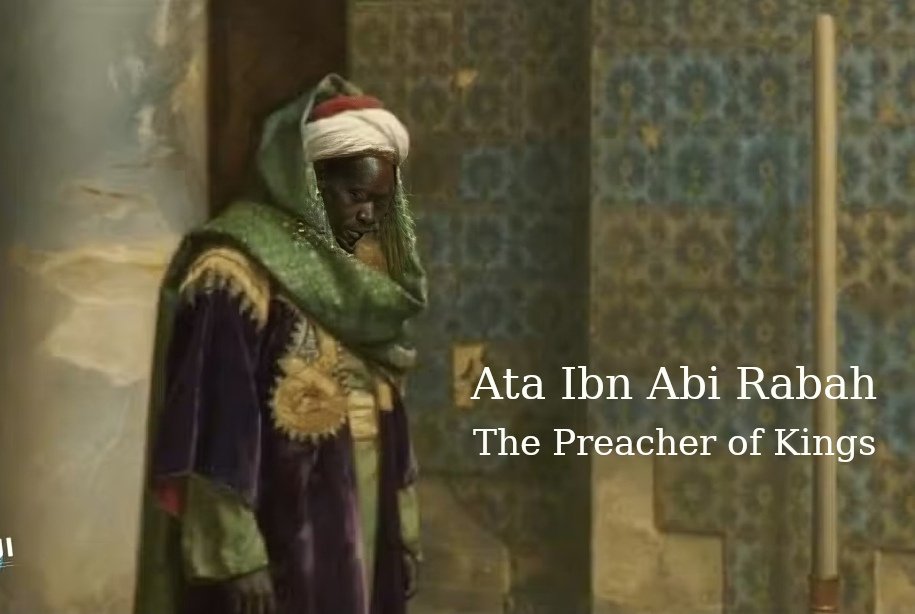
Ata ibn Abi Rabah was a prominent early Muslim jurist and hadith transmitter of Nubian origin, serving as the mufti of Mecca in the late seventh and early eighth centuries. He is considered a leading figure of the early Meccan school of fiqh.
The Scholar Who Taught a King
When a Humble Man in Worn Clothes Changed an Empire’s Heart
The Journey to the Palace
Uthman ibn Ata al-Khurasani رحمه الله narrates a story from his youth that would forever change how he understood wisdom, power, and true nobility. He was traveling with his father to meet with Hisham ibn Abd al-Malik, the Umayyad Caliph who ruled the Islamic Empire from Damascus.
As they approached the palace, young Uthman noticed an elderly man riding a black donkey. The man’s appearance was striking—but not in a way that inspired respect in the young man’s eyes. He wore a dirty shirt, a stained cloak, a worn-out cap pressed flat against his head, and his stirrups were made of simple wood.
Uthman couldn’t help himself. He laughed mockingly and turned to his father: “Who is this Bedouin?”
Immediately, Uthman’s father dismounted from his fine mule, and Ata descended from his humble donkey. The two men embraced warmly, exchanged greetings, and inquired about each other’s well-being. Then they both remounted and continued together until they reached the palace gates of Caliph Hisham.
The Door That Opened for Knowledge
Something remarkable happened when they arrived. The moment they reached the palace entrance, they were immediately granted permission to enter—no waiting, no delays, no bureaucratic formalities. In a court where nobles and officials often waited for hours or days to see the caliph, this immediate access was extraordinary.
Later, when they had left the palace, young Uthman couldn’t contain his curiosity. He asked his father to tell him what had transpired inside.
His father explained: “When the guard announced to Hisham that ‘Ata ibn Abi Rabah is at the door,’ the caliph immediately granted permission for him to enter. By Allah, I only gained entry because of him—because I was in his company.”
The greatest honor is not in fine clothes or prestigious lineage, but in knowledge, wisdom, and the fear of Allah. A scholar in worn garments commands more respect at the gates of power than a thousand nobles in silk.
When the Caliph Met the Scholar
When Hisham saw Ata enter, his reaction was immediate and profound. He stood up—a gesture of immense respect from a ruler who held absolute power over millions—and repeatedly said: “Welcome, welcome! Come here, come here!”
He kept repeating these words of welcome until he seated Ata beside him on his own throne, their knees touching. Around them sat the nobles and aristocrats of the empire, the wealthy and powerful who had come to curry favor with the caliph. They had been engaged in conversation, but when Ata arrived, they fell silent.
The caliph, showing genuine respect and concern, asked directly: “What is your need, O Abu Muhammad?” (This was Ata’s kunyah, his honorific name.)
Seven Requests That Changed an Empire
What happened next is a masterclass in leadership, advocacy, and speaking truth to power. Ata didn’t come seeking personal benefit. He didn’t ask for wealth, position, or favors for himself. Instead, he made seven requests on behalf of the people—each one a lesson in justice and responsibility.
The caliph immediately responded: “O servant, write that the people of Mecca and Medina shall receive their stipends and provisions for a full year.”
Then he asked: “Is there anything else you need, O Abu Muhammad?”
“Yes. O servant, write that the surplus of their charitable donations shall be returned to them.”
“Is there anything else you need, O Abu Muhammad?”
“O servant, write that provisions shall be transported to them.”
“Is there anything else you need, O Abu Muhammad?”
“Yes. O servant, write that the people of dhimma shall not be burdened with what they cannot bear.”
“Is there anything else you need, O Abu Muhammad?”
Notice the breadth of Ata’s concern: He spoke for the people of the holy cities, ensuring their spiritual role was supported. He advocated for the heartland Arabs who formed Islam’s core. He demanded care for soldiers defending the borders. And remarkably—in an age when religious tolerance was rare—he insisted on fair treatment for non-Muslim citizens under Islamic rule.
This is leadership that transcends self-interest. This is advocacy that embraces all of society’s vulnerable and essential members.
The Final Request: The Hardest Truth
After addressing the needs of the people, Ata prepared to deliver his most important message—not a request for resources, but a reminder about ultimate accountability.
The effect was immediate and profound. The caliph—the Commander of the Faithful, the ruler of an empire stretching from Spain to Central Asia—bent his head down and began to weep, scratching at the ground with his finger.
All the power in the world, all the wealth, all the armies, all the palaces—none of it would accompany him to the grave. None of it would answer for him on the Day of Judgment. He would stand alone before his Creator, just like the poorest beggar, the simplest shepherd, the most humble servant.
“You were created alone, you will die alone, you will be resurrected alone, and you will be held accountable alone. By Allah, none of these people you see around you will be with you!”
— Ata ibn Abi Rabah to Caliph Hisham
Seeing that his message had reached the caliph’s heart, Ata stood up to leave. His mission was complete. He had spoken truth to power, advocated for the people, and reminded the ruler of his ultimate accountability.
The Ultimate Refusal
As Ata reached the palace door, a servant rushed after him carrying a bag—no one knew exactly what was inside, but it was clearly filled with gold or valuable gifts.
“The Commander of the Faithful has ordered this for you,” the servant announced.
Ata’s response was immediate and unequivocal. He quoted the words of the prophets from the Quran:
“And I ask you for no reward for it. My reward is only from the Lord of the Worlds.”
— Surah Ash-Shu’ara (26:109)
Uthman’s father concluded the story with emphasis: “By Allah, he did not even drink a drop of water in that palace.”
Ata came seeking nothing for himself. He accepted nothing from the caliph. He didn’t even accept the basic hospitality of water. His mission was pure advocacy for others, and his reward was sought only from Allah.
Lessons That Echo Through the Ages
This story, recorded by the great historian Imam Ibn al-Jawzi in his monumental work “Al-Muntazam fi Tarikh al-Muluk wal-Umam” (The Organized History of Kings and Nations), offers profound lessons for every generation:
Young Uthman saw a man in dirty clothes riding a donkey and laughed dismissively. His father saw one of the greatest scholars of the Islamic world. The caliph saw someone worthy of sitting on the throne beside him. True nobility isn’t measured by external appearances but by knowledge, character, and piety.
Ata’s poverty and humble appearance didn’t diminish his standing. The palace doors opened immediately for him. The caliph stood to greet him. The nobles fell silent in his presence. Why? Because genuine knowledge and wisdom transcend material wealth and social status. In a just society, scholars are honored above princes.
Ata could have asked for anything—wealth, position, favors. Instead, he advocated for: the people of the holy cities who needed support, the Arabs who formed Islam’s foundation, the soldiers defending borders, and even the non-Muslim minorities under Islamic protection. This is leadership—using your access to power not for personal gain but to speak for those who have no voice.
The most crucial moment came when Ata reminded the caliph of his mortality and accountability. This wasn’t comfortable or easy. Speaking truth to absolute power requires tremendous courage. But it’s necessary. Those in authority need people who will remind them that power is temporary, accountability is certain, and justice is non-negotiable.
Ata refused the caliph’s gift, wouldn’t even drink water in the palace, and quoted the prophets’ words about seeking reward only from Allah. His advocacy wasn’t a transaction. His counsel wasn’t for sale. His integrity wasn’t negotiable. This purity of intention gave his words their power and his mission its legitimacy.
Questions for Our Time
This story from over 1,300 years ago poses uncomfortable questions for our modern world:
Do we judge people by their appearance or their character? How often do we dismiss wisdom because it comes in an unexpected package? How frequently do we respect titles and wealth more than knowledge and integrity?
Who speaks for the voiceless in our societies? Do we use whatever influence we have to advocate for others, or only for ourselves? When we have access to decision-makers, do we think about those who don’t?
Are we willing to tell hard truths to those in power? Or do we only say what they want to hear? Do we remind leaders of their accountability, or do we flatter them for favors?
Can we remain incorruptible? When offered rewards for doing what’s right, can we refuse and say, like the prophets, that our reward is only from Allah? Or are we always calculating what we can gain?
The test of integrity is not how we act when there’s nothing to gain, but how we act when great rewards are offered for compromising our principles. Ata walked away from the caliph’s wealth as easily as he walked in—because he never came for it in the first place.
The Scholar’s Legacy
Ata ibn Abi Rabah lived simply and died humbly. He left no great wealth, no political position, no monuments bearing his name. Yet his legacy endures through the generations. Students traveled from across the Islamic world to learn from him. Caliphs sought his counsel. His opinions shaped Islamic jurisprudence.
More importantly, he left us this example: of a man who understood that true power lies not in thrones and titles, but in knowledge, character, and fearless commitment to truth and justice.
When you study his life, you find consistency. This wasn’t a performance for the caliph. This was who Ata was—a man who lived his principles whether in the presence of kings or in the company of the poor, whether observed or alone, whether rewarded or ignored.
A Challenge for Us
The story of Ata and the caliph isn’t just history—it’s a mirror held up to our own choices and character. It asks us:
If you had access to power, would you use it to serve others or yourself?
If you possessed knowledge, would you share it freely or sell it for profit?
If you were offered wealth for doing right, would you refuse it to keep your intention pure?
If you saw injustice from those in authority, would you have the courage to speak?
The world desperately needs people like Ata ibn Abi Rabah—people who cannot be bought, who will not be silenced, who advocate for others while seeking nothing for themselves, who remind the powerful of their accountability, and who measure success not by wealth or status but by integrity before Allah.
When you stand before Allah—alone, as Ata reminded the caliph—what will matter? Not the clothes you wore, not the titles you held, not the wealth you accumulated. What will matter is: Did you speak truth? Did you serve justice? Did you advocate for the vulnerable? Did you use whatever power or knowledge you had in service of what’s right?
These are the questions that defined Ata’s life. May they also define ours.
Published in All, Biography Of the Companions and Islam







Be First to Comment