
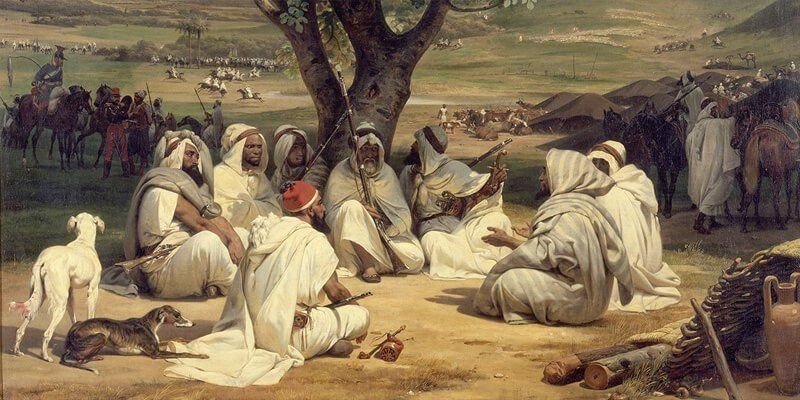
The Ten Great Markets of Pre-Islamic Arabia
Centers of Commerce, Culture, and Poetry in the Jahiliyyah Era
In the pre-Islamic era known as the Jahiliyyah, the Arabs possessed ten great and famous markets that served as major annual gathering points. These were not ordinary marketplaces, but grand commercial, cultural, and social hubs where tribes from all corners of the Arabian Peninsula—and even merchants from Persia, India, Sind, China, and beyond—would converge.
Unlike modern markets that operate year-round, these ancient markets opened only during specific, predetermined times of the year. Once their season ended, they would close, and people would not return until the following year at the same appointed time. This cyclical nature made them all the more significant as annual milestones in Arabian life.
These markets had distinctive features that set them apart. Access to most markets required khifārah (protection)—a form of safe passage granted by a powerful tribe. No one left these markets empty-handed; every attendee carried away something of value: profitable trade, news of great events, poetry, boasts of tribal prowess, or newly forged alliances and covenants.
Two Types of Markets
The markets were divided into two categories based on their timing:
Markets held during the Sacred Months (Al-Ashhur al-Hurum): During these months, fighting was forbidden, and people could travel and trade in safety without fear of warfare.
Markets held outside the Sacred Months: These required more stringent security arrangements and tribal protection, as warfare was permissible during these times.
The Ten Markets in Chronological Order
What follows is a detailed account of these ten markets, arranged in the order that Arabs would travel between them throughout the year:
Market of Dumat al-Jandal
The first and greatest of these markets to open each year was the Market of Dumat al-Jandal. The ruler of this market was al-Ukaydir al-‘Ibādī, one of the Arab kings in that region. Arabs from all corners of the peninsula would converge upon this market.
Market of al-Mushaqqar (in Hajar)
After Dumat al-Jandal closed, people would travel to the Market of al-Mushaqqar, located in Hajar (eastern Arabian Peninsula). This market was particularly notable for Persian merchants who would cross the sea in their ships laden with goods.
1. Al-Mulāmasah (Silent Trading): Gestures and signals without speech. When both parties agreed, they would signal to each other, completing the transaction.
2. Al-Hamhamah (Hushed Speech): Low, unclear speech intended to avoid making oaths, so that if a buyer claimed he wanted to return the goods, the seller wouldn’t have sworn falsely.
Market of Ṣuḥār
People would then travel to the Market of Ṣuḥār without needing tribal protection. Those who missed earlier markets due to business or lack of need would attend this one.
Market of Dibā
From Ṣuḥār, traders would journey to the Market of Dibā, where merchants from Sind, India, and China would gather alongside traders from both the East and West.
Market of al-Shiḥr
Both land and sea travelers would then proceed to the Market of al-Shiḥr (Shiḥr Mahrah). This market held special spiritual significance.
Market of ‘Adan (Aden)
After al-Shiḥr, people would travel to the Market of Aden, except for sea merchants who remained there permanently.
Market of Ṣan’ā’
From Aden, traders would proceed to the Market of Ṣan’ā’, the capital city of Yemen.
The Grand Finale: Two Simultaneous Markets
After Ṣan’ā’, the Arabian trading season reached its climax with two magnificent markets that operated simultaneously, drawing together the threads of commerce, culture, and pilgrimage.
Market of al-Rābiyah and Market of ‘Ukāẓ
Two great markets would open simultaneously:
Market of al-Rābiyah in Ḥaḍramawt
Market of ‘Ukāẓ in upper Najd, near ‘Arafah
Access required tribal protection (khifārah)
The most magnificent of all Arab markets! No taxes were collected and no tribal protection was needed. It was a free, open market where Arabs gathered in massive numbers. When the new moon of Dhū al-Ḥijjah appeared, all people would disperse from ‘Ukāẓ simultaneously. This market was legendary as a center for poetry contests, where the greatest Arab poets would compete and recite their masterpieces.
Market of Dhū al-Majāz
After ‘Ukāẓ dispersed, all people would proceed to the Market of Dhū al-Majāz, located near ‘Ukāẓ. This was the final market before the Hajj pilgrimage.
The Cultural and Economic Significance
These ten markets were far more than commercial venues. They were the arteries of pre-Islamic Arabian life—economic, cultural, political, and social. Through these markets:
◆ Trade flourished across vast distances, connecting Arabia to Persia, India, China, and beyond
◆ Poetry was exchanged and immortalized, with the greatest Arab poets competing for recognition
◆ Alliances were forged between tribes, shaping the political landscape of Arabia
◆ Leadership was established, as successful merchants and eloquent speakers gained influence
◆ News and information spread across the peninsula, as these markets served as information hubs
Islam’s Impact on the Markets
When Islam arrived, it did not completely abolish these ancient institutions. Instead, it reformed them with characteristic wisdom. The Prophet Muhammad ﷺ and the early Islamic leadership:
Preserved the beneficial aspects: legitimate trade, cultural exchange, and social gathering
Abolished the harmful practices: unjust trading methods like mulāmasah and hamhamah, exploitative contracts, and practices involving uncertainty (gharar) or deception
Regulated commerce according to Islamic principles of justice, honesty, and mutual consent
The markets continued to function under Islamic rule, but now operated according to principles that protected both buyers and sellers, eliminated deception, and promoted fair trade.
Historical Source
This information has been compiled from “Al-Mustakhraj min Kutub al-Nās lil-Tadhkirah wal-Mustaṭraf min Aḥwāl al-Rijāl lil-Ma’rifah” (The Extracted from the Books of People for Remembrance and the Pleasant from the Conditions of Men for Knowledge), a classical Arabic historical text that documented the customs, practices, and institutions of pre-Islamic and early Islamic Arabia.
These ten markets stand as testament to the sophisticated commercial networks and vibrant cultural life of pre-Islamic Arabia. They remind us that even before the advent of Islam, the Arabs had developed complex economic systems and social structures. Islam’s approach was not to destroy these institutions wholesale, but to purify them, regulate them according to divine law, and channel their energy toward justice and the common good.
Today, as we study these ancient markets, we gain insight into the world into which Islam was revealed—a world of commerce and poetry, of tribal alliances and seasonal gatherings, of sophisticated trade networks spanning continents. Understanding this context enriches our appreciation of how Islam transformed and elevated Arabian society while preserving its beneficial traditions.





Be First to Comment