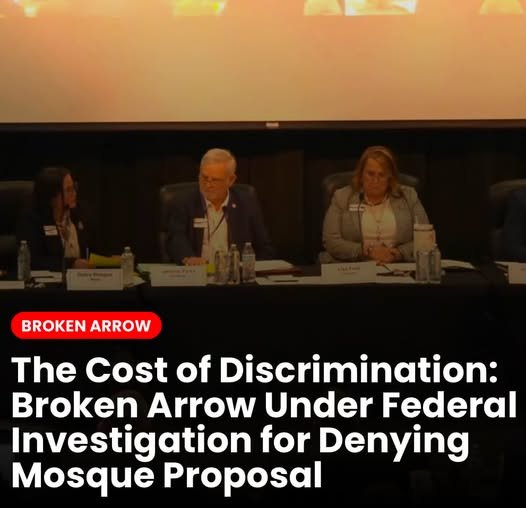
DOJ Opens Federal Investigation Into Broken Arrow Over Rejected Mosque Project
Federal officials are examining whether the City Council’s 4-1 vote to deny the Islamic Society of Tulsa’s proposed mosque and community campus amounted to religious discrimination under federal zoning law.
BROKEN ARROW, OKLA. — The U.S. Department of Justice has opened a federal investigation into the City of Broken Arrow following the City Council’s decision earlier this year to deny a proposed mosque and commercial development submitted by the Islamic Society of Tulsa. Investigators are now examining whether the city unlawfully discriminated against a religious organization in violation of federal law.
The proposed development called for a mosque, commercial space, a medical clinic and other community facilities spread across roughly 15 acres near South Olive Avenue. Before the plan reached the City Council, it had already been recommended for approval by the Broken Arrow Planning Commission, and city staff had concluded it met the requirements for the requested zoning changes.
Despite those recommendations, the City Council voted 4-1 to reject the project after a packed public meeting that drew hundreds of residents and hours of emotional testimony.
City Cites Zoning Concerns, Not Religion
City officials have maintained that the denial had nothing to do with religion, pointing instead to concerns over traffic, stormwater drainage, sewer access, floodplain issues and the overall intensity of the proposed development. The city has continued to insist that those factors alone drove its decision.
The Department of Justice, however, appears to be asking a broader question: were those same standards applied equally to everyone?
- City Council voted 4-1 to reject the mosque and development proposal.
- Planning Commission and city staff had recommended approval before the council vote.
- DOJ has requested records on churches, event centers, schools and other large-assembly properties since 2021.
- Investigators are also seeking emails, texts, social media posts and public comments tied to the proposal.
- Federal officials have requested communications from organizers of a pre-vote strategy meeting held by opponents.
Comparing How Similar Projects Were Treated
As part of the investigation, federal officials have demanded records involving churches, event centers, schools and other locations where large groups gather. Investigators are comparing how Broken Arrow has handled similar zoning requests since 2021 in order to determine whether the mosque proposal was treated differently from comparable secular or Christian developments.
The DOJ has also requested emails, text messages, social media posts, resident complaints, public comments and internal communications related to the proposal. Investigators specifically requested records involving nearby religious and commercial properties, an indication they are examining whether the city consistently enforced its zoning standards or whether the mosque faced a different level of scrutiny.
Investigation Extends Beyond City Hall
The inquiry also reaches beyond city government itself. Federal officials have requested communications involving organizers of a public strategy meeting held before the council vote, where opponents coordinated their efforts against the proposal.
Although many residents raised concerns about traffic and infrastructure, others made comments linking Islam to terrorism and warning against allowing a mosque in the community. Those statements became part of the public record before the council cast its votes.
The Law at the Center of the Case
The investigation falls under the Religious Land Use and Institutionalized Persons Act (RLUIPA), a federal law that protects religious organizations from discriminatory zoning practices. The law does not exempt religious institutions from local regulations; instead, it requires cities to apply those regulations equally and prohibits governments from treating one religion differently from another without a compelling legal justification.
Do you believe Broken Arrow denied the proposal because of legitimate zoning concerns, or do you think discrimination played a role? Let us know your thoughts in the comments.








Be First to Comment