
“Surely Your Lord is Allah”
Reflecting on Surah Yūnus (10:3): Allah’s Lordship, His Throne, and the Call to Worship Him Alone
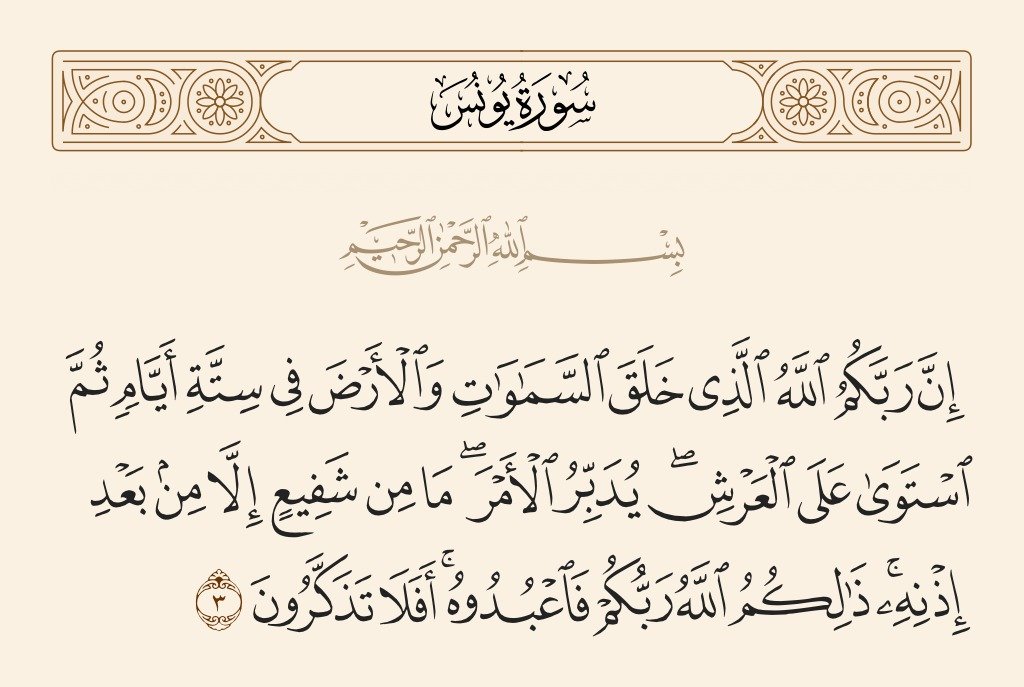
“Indeed, your Lord is Allah, who created the heavens and the earth in six days, then established Himself above the Throne, arranging every matter. There is no intercessor except after His permission. That is Allah, your Lord, so worship Him. Will you not then take heed?”
— Surah Yūnus (10:3)
This majestic verse from Surah Yūnus introduces Allah ﷻ to the hesitant and doubting hearts of Makkah—and to every heart after them—as the One who creates, governs, and alone deserves worship. In a few brief phrases, Allah gathers together the truths of creation, His Throne, His management of all affairs, the reality of intercession, and the call to serve Him sincerely.
“Your Lord is Allah”: A Clear Beginning
The verse opens with a firm declaration: “Surely your Lord is Allah”—not “a” god among many, but the only true Lord who nurtures, owns, and directs everything in existence. By calling Him “your Lord,” the verse speaks personally to the listener: the God being described is not distant; He is the One who has always cared for you, even before you knew His name.
This opening also refutes every claim that other powers—idols, saints, stars, or “forces of nature”—share in running the universe. If your Lord is Allah alone, then no one else owns you, and no one else has the right to your ultimate dependence and trust.
Creation in Six Days and the Throne
Allah tells us that He “created the heavens and the earth in six days, then established Himself above the Throne,” a phrase that appears in several places in the Qur’an. The early commentators explain that these “days” are phases or periods whose length is known only to Allah, and that He could have created everything in an instant but chose a gradual process to teach His servants wisdom, order, and deliberation.
Immediately after mentioning the Throne, Allah says He “arranges every matter,” reminding us that His greatness is not passive; He actively manages every detail of the cosmos. No affair distracts Him from another, no large concern makes Him forget the smallest need of any creature.
“He Arranges Every Matter”: Divine Management
The phrase “yudabbiru-l-amr” means that Allah plans, directs, and governs all affairs—from the orbits of galaxies to the quiet movement of a leaf in the wind. For a believer, this is not an abstract doctrine; it is a source of deep tranquility. If the same Lord who manages the rise and fall of nations is managing your personal worries and hopes, then no dua is too small, and no problem is too tangled for Him to unravel.
Intercession Only by His Permission
After describing His creative power and absolute rule, Allah adds: “There is no intercessor except after His permission.” This responds to the people who took idols or “holy figures” as intermediaries, hoping they would speak to Allah on their behalf and shield them from punishment.
The verse does not deny intercession altogether; other verses and hadiths confirm that prophets, angels, and righteous believers will intercede by Allah’s leave on the Day of Judgment. Rather, it corrects the idea that anyone can intercede independently or force Allah’s hand, stressing that every intercession is under His control, based on His knowledge and justice.
Scholars explain that this verse and similar ones teach Muslims to seek Allah directly while hoping to be among those whom He allows to benefit from the intercession of His beloved servants. The heart turns to Allah first, asking Him to forgive, to accept, and to include it among those who receive the Prophet’s ﷺ intercession, instead of imagining that anyone can “bypass” Allah’s will.
— Summarized from classical discussions on intercession
“That is Allah, Your Lord: So Worship Him”
After laying out these truths—creation, the Throne, divine management, and controlled intercession—Allah concludes: “That is Allah, your Lord, so worship Him.” It is as if the verse is saying: once you know who truly created and controls everything, the only reasonable and dignified response is to direct your worship, love, fear, and hope to Him alone.
The final question—“Will you not then take heed?”—is a gentle but urgent invitation to reflect. It suggests that the evidence has already been laid out; what remains is for the listener to let these truths sink in and reshape how they see themselves, their life, and their destiny.
Bringing the Verse Into Daily Life
When a believer recites this verse regularly, it can become a compass for their inner world. In moments of anxiety, remembering that Allah “arranges every matter” calms the heart and restores trust. In times of spiritual laziness, recalling “That is Allah, your Lord, so worship Him” rekindles the sense of purpose and accountability.
• When you are tempted to seek help in ways displeasing to Him, recall that no intercessor can help without His permission.
• When you feel insignificant in a vast universe, remind yourself that the Lord of the Throne is also “your Lord,” who knows your name, your needs, and your tears.
Surah Yūnus, verse 3, gathers the believer’s attention and gently turns it upward—from the chaos of worldly events to the calm certainty of Allah’s Lordship. It reminds us that creation has a wise Creator, history has a sovereign Author, and every soul has a Lord who invites it to know Him and worship Him.
By reflecting on this verse, a Muslim renews their trust in Allah’s plan, purifies their worship from dependence on created things, and finds courage to face the future under the shade of His Throne. And each time the words are recited—“Surely your Lord is Allah…”—the heart is invited once again to answer: “Then I will worship You alone, and I will remember.”
May Allah make us among those who reflect, remember, and respond to His call. Āmīn.





Be First to Comment