

The Lame Chief Who Limped Into Paradise
How Amr ibn al-Jamuh Transformed From Idol Worshiper to Martyr — And Why His Disability Became His Greatest Strength
Imagine being the chief of your tribe—wealthy, respected, powerful. Now imagine discovering that everything you’ve worshiped your entire life is a lie. And then imagine, after finding the truth, being told you’re too disabled to serve it. This is the story of Amr ibn al-Jamuh: a man who broke his idol, found his faith, and refused to let anyone—not his sons, not his tribe, not even the Prophet ﷺ—tell him he couldn’t die for what he believed in.
The Chief and His Wooden God
Amr ibn al-Jamuh was no ordinary man in pre-Islamic Medina. He was a sayyid—a chief—of Bani Salama, one of the most prominent tribes of the Ansar. Wealthy, generous, and respected, he had everything the world could offer. And like all the elite chiefs of his time, he had his own private idol: a wooden statue he named Manaf, kept in a special place in his home.
He would perfume it. Polish it. Speak to it before making important decisions. To him, Manaf wasn’t just wood—it was divine. It was his connection to the unseen, his intermediary with the gods, his spiritual anchor.
There was just one problem: his son and his son’s best friend thought it was ridiculous.
The Night Raids Begin
When Islam came to Medina, young men were among the first to embrace it. Mu’adh ibn Amr (Amr’s own son) and his close friend Mu’adh ibn Jabal were among the seventy who pledged allegiance to the Prophet ﷺ at the Second Pledge of Aqaba. They had tasted the truth of monotheism. And they couldn’t stand watching Amr—this great, intelligent, generous man—bow to a piece of carved wood.
So they hatched a plan.
Night after night, the two young men would sneak into Amr’s house in complete darkness. They’d grab the idol, carry it outside, and throw it face-first into a pit filled with human waste.
Morning would come. Amr would wake up, ready to consult his god—and find Manaf missing. “Woe to you! Who attacked our gods last night?!” he’d roar, searching frantically until he found his idol covered in filth, upside down in a cesspit.
He’d fish it out, wash it, perfume it, return it to its place. The next night? Same thing. And the next. And the next.
Finally, fed up and confused, Amr had an idea. He took his sword—a symbol of power and protection—and hung it around Manaf’s neck. Then he spoke to the idol:
That night, the two Mu’adhs came again. They didn’t just throw Manaf in the pit this time. They took the sword, found a dead dog, tied Manaf and the carcass together with a rope, and dumped both into the well.
When Amr found his “god” the next morning—bound to a rotting dog, covered in waste, utterly powerless to defend itself despite the sword he’d given it—something broke inside him.
The Moment of Awakening
It’s one thing to be told your beliefs are wrong. It’s another thing to see it with your own eyes. Amr stood there, staring at the pathetic sight before him, and reality crashed down like a wave.
This… this was what he’d been worshiping? This helpless, powerless, humiliated piece of wood? While he searched the horizon, other Muslim leaders of Medina approached him. They had been waiting for this moment. They spoke to him about the One True God—the God who needs no sword, no perfume, no protection. The God who created the heavens and the earth, who hears, who sees, who responds.
And in that moment, Amr ibn al-Jamuh’s heart opened to Islam.
He didn’t hesitate. He didn’t negotiate. He purified himself, dressed in clean clothes, perfumed his body—not his idol—and went straight to the Prophet Muhammad ﷺ to pledge his allegiance.
Later, he composed poetry about his awakening:
“By Allah, if you were a god, you would not be
You and a dog, in a well, tied together.”
The Prophet’s Testimony
Amr’s transformation was complete. The man who had been generous as a pagan became even more generous as a Muslim. His wealth, his time, his energy—all of it now flowed in service of Allah and His Messenger.
One day, the Prophet ﷺ asked a group from Bani Salama: “Who is your chief, O Bani Salama?” They replied: “Al-Jadd ibn Qays, though we find him stingy.”
The Prophet ﷺ immediately responded:
Generosity had made him a leader among pagans. But it was generosity combined with faith that made him a leader in Islam.
The Battle He Couldn’t Join
There was just one thing standing between Amr and his deepest wish: he was severely disabled. He had a pronounced limp in one leg that made walking difficult, let alone fighting in battle.
When the Battle of Badr came, Amr begged to join. His four sons—Mu’adh, Mu’awwadh, Khallad, and Abd al-Rahman—all strong, brave young men, were going. And Amr wanted nothing more than to stand beside them.
But his sons pleaded with the Prophet ﷺ to keep their father home. The Prophet agreed: “Allah has excused you from jihad. You are not required to fight.”
Amr stayed behind. And it ate at him.
His sons went to Badr. They fought. Mu’adh and Mu’awwadh even participated in killing Abu Jahl—one of Islam’s greatest enemies. They returned as heroes. And their father? He sat at home, watching, burning with the desire to give everything for this faith that had saved him from worshiping wood.
The Battle of Uhud: His Moment Arrives
A year later, the call came for Uhud. And this time, Amr ibn al-Jamuh was not going to be stopped.
His sons tried again: “Father, you’re disabled. Allah has excused you. Stay home.” But Amr refused. He told them:
His wife, Hind bint Amr, knew her husband. She later recalled: “I can still see him, taking up his shield, saying: ‘O Allah, do not return me to my family in disgrace!'”
The sons went to the Prophet ﷺ to intervene. But before the Prophet could speak, he asked Amr directly what he wanted.
Amr’s response was simple and devastating:
The Prophet ﷺ looked at him—this old, disabled, determined man—and his face softened. He turned to the sons and said:
Then he addressed the army before they marched: “Stand up for a Paradise as wide as the heavens and the earth, prepared for the righteous!”
Amr ibn al-Jamuh, despite his limp, stood up and shouted:
The Martyrdom
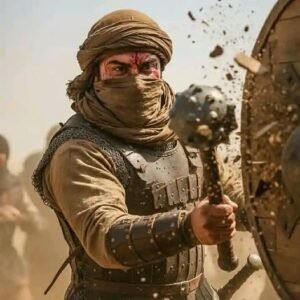
On the day of Uhud, when the battle turned and many Muslims retreated, Amr ibn al-Jamuh was in the front lines. He fought with everything he had. And when the dust settled, he lay among the martyrs—along with his son Khallad, who had fallen beside him.
His brother-in-law, Abdullah ibn Amr ibn Haram—also a martyr—was found next to him. The Prophet ﷺ gave a beautiful instruction:
But the most powerful testimony came from the Prophet ﷺ himself. After Uhud, he said:
The Miracle After Death
Forty-six years later, in the year 46 AH, heavy rains caused a flood that damaged the graves of the martyrs of Uhud. The people of Medina decided to move the bodies to protect them.
When they opened the grave of Amr ibn al-Jamuh and Abdullah ibn Amr ibn Haram, they found their bodies unchanged. Soft. Fresh. As if they had just been buried.
Jabir ibn Abdullah, who witnessed it, said: “My father’s body was soft and pliable. When I looked at him, he still had a smile on his face.”
Amr ibn al-Jamuh’s story demolishes every excuse we make. Too old? He was elderly. Too disabled? He could barely walk. Too late? He spent most of his life worshiping an idol. But when the truth revealed itself, he didn’t waste a single moment justifying why he couldn’t act. He seized it. He lived it. He died for it. And Allah gave him exactly what he asked for: to walk in Paradise, whole and perfected, limping no more.
What This Means for You
You don’t need to be perfect. You don’t need to be young. You don’t need to be strong, fast, or capable by the world’s standards. What you need is sincere conviction and the willingness to act on it.
- Your past doesn’t define your future. Amr worshiped wood for decades. That didn’t stop Allah from elevating him to the ranks of the martyrs.
- Your limitations are not your destiny. His limp was an obstacle in this world. In the next, it became his testimony.
- Desire matters. His sons were stronger, younger, fitter. But they didn’t have his desperation to serve. And that desperation earned him Paradise.
- Allah rewards effort, not ability. He couldn’t fight like a young man. But he showed up anyway. And that’s what counted.
The Companions weren’t superhumans. They were people—flawed, broken, limited—who found something worth giving everything for. And when they gave it, Allah perfected them in ways they could never have imagined.
Amr ibn al-Jamuh didn’t just embrace Islam—he leapt into it. He didn’t just accept his disability—he used it as fuel. He didn’t just die in battle—he walked into Paradise, healed and whole, because he refused to let anyone tell him he wasn’t worthy.
His story asks you a single, uncomfortable question: What are you waiting for?
You’re not too young. You’re not too old. You’re not too broken. You’re not too far gone. The only thing stopping you is you. So stop making excuses. Stop waiting for perfect conditions. Stop convincing yourself you’re not ready.
Amr ibn al-Jamuh limped into Paradise.
What’s your excuse?






Be First to Comment