

Najiyah ibn Jundub al-Aslami
The Keeper of the Prophet’s Sacrificial Camels
ناجية بن جندب الأسلمي رضي الله عنه
Among the noble companions of the Messenger of Allah ﷺ was a man who carried a unique distinction—a title that bound him to one of the most sacred rituals of Islam. His name was Najiyah ibn Jundub al-Aslami (رضي الله عنه), and he was known as Sahib Budn al-Hadi—the Keeper of the Prophet’s Sacrificial Camels.
Though his companionship with the Prophet ﷺ lasted only about five years, he lived every moment of it in devoted service, trusted with missions that required both courage and unwavering loyalty. His story begins not on the battlefield, but on a journey of peace—the journey to Hudaybiyah.
Embracing Islam Before Hudaybiyah
Najiyah accepted Islam before the Treaty of Hudaybiyah, which took place in the sixth year after the Hijrah. When the Prophet ﷺ set out to perform Umrah with his companions, he brought with him the budn—the sacrificial camels that would be offered in accordance with the sacred rites.
The sacrificial camels used in Hajj and Umrah, mentioned in the Quran when Allah says: “And the camels and cattle We have appointed for you as among the symbols of Allah; for you therein is good.” (Surah Al-Hajj, 22:36)
The Prophet ﷺ entrusted Najiyah with the sacred duty of driving these camels—a responsibility he would carry in every subsequent journey with the Messenger of Allah. It was a role of honor, placing him at the heart of the Prophet’s travels, ensuring the fulfillment of one of Islam’s most sacred acts of worship.
The Pledge Under the Tree
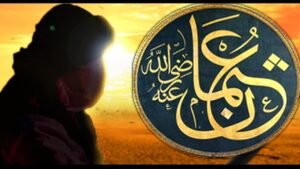
When the Muslims reached Hudaybiyah, the Quraysh prevented them from entering Makkah. Uthman ibn Affan was sent to negotiate, and when rumors spread that he had been killed, the companions gathered beneath an acacia tree and took a solemn oath: they pledged to fight to the death rather than abandon the Messenger of Allah ﷺ.
Najiyah was among the 1,400 companions who gave this pledge, known as Bay’at al-Ridwan—the Pledge of Divine Pleasure. About them, Allah revealed:
“Indeed, Allah was pleased with the believers when they pledged allegiance to you, [O Muhammad], under the tree, and He knew what was in their hearts, so He sent down tranquility upon them and rewarded them with an imminent conquest.”
— Surah Al-Fath (48:18)
The Prophet ﷺ later said of those who took this pledge: “None who pledged beneath the tree will enter the Fire,” and “You are the best people on Earth.” Najiyah was counted among them—a man whom Allah Himself was pleased with.
The Miracle at the Dry Well
During the journey to Hudaybiyah, the Muslim army suffered from severe thirst. They came upon a dry well with no water in sight. The Prophet ﷺ called for Najiyah and handed him a cup containing a small amount of water. The Messenger of Allah ﷺ rinsed his mouth with it, then gave Najiyah an arrow from his quiver.
Without hesitation, Najiyah descended into the dark, empty well. He drove the blessed arrow into the ground—and suddenly, water burst forth, gushing until the entire army drank their fill. It was a miracle witnessed by all, and Najiyah was the instrument through which Allah manifested it.
He would later recall this event with pride, composing poetry to commemorate it:
أنا الذي نزل في القَلِيبِ
بسهمِ ميمونِ اليدِ الحبيبِ
“I am the one who descended into the well,
With the arrow of the blessed and beloved hand.”
The Prophet’s Blessing
On the day of Hudaybiyah, when the Prophet ﷺ first met Najiyah, he asked:
The Prophet ﷺ smiled and said:
“Najiyah ibn Jundub, and Jadd ibn Jundub, and Umayr ibn Jundub—drive them forward, for Allah has saved you and guided you.”
This was a direct supplication from the Messenger of Allah ﷺ—a prayer for Najiyah’s salvation and guidance. It was a treasure he carried with him for the rest of his life.
A Lifetime of Service
Najiyah’s devotion did not end at Hudaybiyah. The following year, he returned with the Prophet ﷺ for Umrat al-Qada—the Compensatory Umrah—once again driving the sacrificial camels. About those who entered Makkah that day, Allah revealed:
“You will certainly enter the Sacred Mosque, if Allah wills, in safety, with your heads shaved and [hair] shortened, not fearing [anyone].”
— Surah Al-Fath (48:27)
His journeys with the Prophet ﷺ continued:
He witnessed the Conquest of Makkah.
He fought in the Battle of Hunayn, leading his tribe.
He marched with the army in the Expedition of Tabuk, known as the Army of Hardship.
He accompanied the Prophet ﷺ on Hajjat al-Wada—the Farewell Pilgrimage—once again as the Keeper of the Sacrificial Camels.
In every journey, he held the same honored role. The Prophet ﷺ trusted him completely, and Najiyah never wavered in his duty.
Courage in the Time of Apostasy
After the death of the Prophet ﷺ, during the caliphate of Abu Bakr al-Siddiq, apostates raided the Muslim treasury and stole the camels of charity (sadaqah). Najiyah, along with his son, pursued the raiders with unwavering courage. They recovered the stolen camels and returned them to Madinah—a heroic act remembered by the scholars of biography.
Narrator of the Prophet’s Teachings
Najiyah is counted among the narrators of hadith. He transmitted several narrations from the Prophet ﷺ, particularly regarding the rites of Hajj and Umrah, as well as events from the military expeditions. One hadith he narrated concerns the ruling on sacrificial animals:
“Slaughter it, then dip its sandal in its blood, then strike its side with it, but do not eat from it—neither you nor anyone from your traveling party.”
He also narrated details about how the Prophet ﷺ performed ablution. His sons were among those who transmitted these narrations, preserving the teachings of the Prophet ﷺ for future generations.
His Final Years
After the Prophet’s death, Najiyah participated in the Muslim conquests in Iraq and settled in Basra. In his later years, he returned to Madinah, where he passed away during the caliphate of Muawiyah ibn Abi Sufyan (رضي الله عنهما). The exact year is not recorded, but historians agree that he lived many years after the Prophet ﷺ, allowing numerous followers (Tabi’un) to benefit from his companionship and learn from him.
Though Najiyah’s time with the Prophet ﷺ was relatively brief—approximately five years—he was a constant presence in the Prophet’s journeys. He exemplified obedience, courage, and unwavering loyalty. From the miraculous well at Hudaybiyah to the sacred rites of Hajj, he served with devotion and was honored with the Prophet’s trust, his supplication, and Allah’s pleasure.
رضي الله عن جميع الصحابة والتابعين




Be First to Comment