
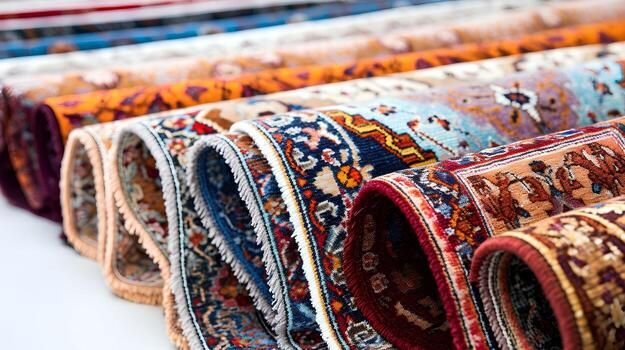
The Legend of Kisra’s Carpet
A Treasure That Puzzled Umar ibn al-Khattab
After the Battle of al-Qadisiyyah, the Muslim armies conquered Persia and acquired spoils of war the likes of which the Arabian Peninsula had never seen. Among these treasures was one that captivated hearts and minds alike: Kisra’s Carpet, the legendary masterpiece that Persian kings had long boasted about to the world.
This carpet was laid out in the Iwan (grand hall) of Kisra’s palace, directly in front of his throne. It was not merely a piece of fabric but a masterpiece of artistry. Woven from natural silk and threads of gold, it was adorned with pearls, rubies, emeralds, and other precious gems. Measuring about sixty cubits in length, it was designed as a single, seamless piece. The carpet depicted the entire Sasanian Empire—rivers, gardens, palaces, mountains, fields, and trees—so vividly that it seemed like a living map.
Kisra would spread this carpet in his court whenever he sat on his throne, earning it the name “The Carpet of Pleasure and Delight.” Seated above his throne, the king would gaze at the depicted regions of his empire and inquire about the affairs of each province and its governor, receiving updates from his advisors. Thus, the carpet was not just a symbol of luxury but also a reminder of the vastness of his kingdom and his responsibilities.
When this carpet fell into the hands of Sa’d ibn Abi Waqqas (RA) after the victory, he faced a real dilemma. The carpet was so large that it was impossible to divide among the soldiers, and its value in gold and jewels was beyond the means of any single person to purchase.
Sa’d gathered the fighters and said to them:
The army agreed, and the carpet was carried on the backs of several camels until it reached Medina.
When Umar ibn al-Khattab (RA) saw the carpet, he ordered it to be paraded through the streets of Medina so that all the people could see it. The people of Medina stood in awe, marveling at a treasure they had never laid eyes on before. Even Umar himself gazed at it for a long time, pondering what to do with it.
It was too precious to be given to a single person, too valuable to be sold easily, and keeping it as it was might lead to its damage or become a source of pride and ostentation.
Umar gathered the senior companions to seek their counsel. Opinions varied, but none satisfied him completely. Then, Ali ibn Abi Talib (RA) spoke up and said:
Umar saw the wisdom in this suggestion and ordered the carpet to be cut into pieces and distributed among the Muslims. The piece that reached Ali (RA) was later sold for twenty thousand dirhams, even though it was not the finest or most beautiful part of the carpet, indicating the immense value of the original.
The carpet was not the only treasure from Kisra’s hoard. His royal garments, crown, sword, belt, bracelets, and sandals also arrived in Medina. Umar looked at his companions and saw that Suraqah ibn Malik ibn Ju’shum (RA) was the tallest and most similar in build to Kisra. He said to Suraqah:
Suraqah put on Kisra’s clothes, and Umar ordered him to turn around so he could see him from all angles. Then, Umar exclaimed in amazement:
Umar then remembered an incident from years past, when Suraqah had chased the Prophet (ﷺ) and Abu Bakr (RA) during their migration to Medina, hoping to claim the reward offered by the Quraysh. He said to Suraqah:
But the scene did not end there. As soon as Suraqah took off the clothes, Umar’s eyes filled with tears. He raised his hands to the sky and said:
Umar then ordered the clothes to be sold, and their proceeds were distributed among the Muslims. He refused to allow the treasures of kings to become symbols of luxury in a state founded on justice and asceticism. He said as he contemplating the scene:
Thus ended the story of the greatest treasure of the Sasanian Empire—not in the palace of a new king, nor in the treasury of a caliph, but in the hands of all the Muslims, serving as a testament to the justice of the Rashidun Caliphate, the asceticism of its leaders, and their belief that public wealth is a trust, not a means of pride or luxury.
Main Points to Learn:
Key Themes
This story exemplifies the justice, humility, and wisdom of the Rashidun Caliphate in managing wealth and power.



Be First to Comment