
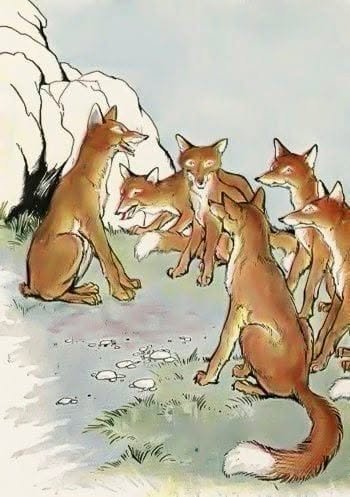
The Fox Without a Tail
What an Old Fable Reveals About Societies That Mock the Righteous
There is an old fable, simple enough to tell a child, that quietly captures one of the most unsettling patterns in human societies — the way collective wrongdoing doesn’t just tolerate itself, but eventually turns around and mocks whoever refused to take part in it.
A stone once fell and severed a fox’s tail. Another fox saw him and asked why he had cut it off. “I feel as if I’m flying through the air,” he said. “What a pleasure it is!” Tempted by this, the second fox cut off his own tail too. But when he felt only sharp pain — none of the promised pleasure — he turned to the first fox and asked, “Why did you lie to me?” The first fox replied, “If I told the other foxes about the pain, they would never cut off their tails, and they would mock us instead.” So the two of them went on telling every fox they met about this wonderful “pleasure,” until most of the foxes had no tails left at all. And then, whenever they came across a fox who still had his tail — they mocked him.
The lesson embedded in this small story is direct: once corruption becomes widespread enough, people begin to mock the righteous for their righteousness — and fools take the virtuous as objects of ridicule, simply for having kept what everyone else gave up.
A Warning Attributed to Ka’b
This exact inversion — where virtue itself becomes the target of mockery — was foreseen centuries ago. It is reported that Ka’b (may God have mercy on him) said:
ليأتين على الناس زمان يُعَيَّر المؤمن بإيمانه كما يعير اليومَ الفاجر بفجوره حتى يقال للرجل إنك مؤمن فقيه
“A time will surely come upon people when the believer will be shamed for his faith, just as the sinner is shamed today for his sin — until it is said to a man, mockingly, ‘You are a believer, a scholar.'”
Attributed to Ka’b
In other words: the very words once used as compliments — believer, scholar, righteous — become, in a corrupted society, insults hurled at anyone who still holds onto them.
The Precedent in the Story of Lot
This is not a new phenomenon, nor is it merely a folk observation. The Quran documents this same inversion happening among the people of Prophet Lot (Lut), peace be upon him. When Lot and his followers stood apart from their society’s widespread corruption, his people did not accuse them of any specific crime. Instead, they turned the very purity of Lot’s household into the accusation itself:
فَمَا كَانَ جَوَابَ قَوْمِهِ إِلَّا أَن قَالُوا أَخْرِجُوا آلَ لُوطٍ مِّن قَرْيَتِكُمْ ۖ إِنَّهُمْ أُنَاسٌ يَتَطَهَّرُونَ
“But the only answer of his people was that they said: ‘Drive the family of Lot out of your town — indeed, they are people who purify themselves.'”
Surah An-Naml, 27:56
Read closely, the charge his people brought against him is not a vice at all — it is a virtue, spoken with contempt. They mocked him for the very thing that made him different: his refusal to join their corruption. This is the fox with the tail, standing among foxes who cut theirs off, being ridiculed for the one thing that remained intact.
Those Who Laughed at the Believers
The Quran describes this same dynamic playing out more broadly — not confined to Lot’s people, but as a recurring feature of wrongdoers throughout history. In Surah Al-Mutaffifin, God describes how the guilty once treated the faithful:
إِنَّ الَّذِينَ أَجْرَمُوا كَانُوا مِنَ الَّذِينَ آمَنُوا يَضْحَكُونَ وَإِذَا مَرُّوا بِهِمْ يَتَغَامَزُونَ وَإِذَا انقَلَبُوا إِلَىٰ أَهْلِهِمُ انقَلَبُوا فَكِهِينَ وَإِذَا رَأَوْهُمْ قَالُوا إِنَّ هَٰؤُلَاءِ لَضَالُّونَ
“Indeed, those who committed crimes used to laugh at those who believed. And when they passed by them, they would exchange derisive glances. And when they returned to their own people, they would return joking. And when they saw the believers, they would say, ‘Indeed, these are the ones astray.'”
Surah Al-Mutaffifin, 83:29-32
The pattern is identical to the fable’s ending: the tailless foxes, having normalized their own loss, could no longer see a whole fox as normal — they could only see him as strange, worth laughing at, worth pointing to and mocking. Wrongdoing, once it spreads widely enough, doesn’t just stop noticing itself as wrong. It reverses the moral compass entirely, until uprightness itself looks like the deviation.
The Real Warning Here
The deeper danger in this fable isn’t the stone that struck the first fox — that was an accident, unavoidable and blameless. The real danger is the lie that followed it: the decision to hide the pain, to disguise loss as pleasure, and to recruit others into the same loss simply so the first fox wouldn’t have to face ridicule alone. Concealed failure, once socialized, becomes a norm. And a norm, once widespread, becomes the standard by which everyone else is measured — including those who did nothing wrong at all.
This is precisely why the Quran preserves the story of Lot’s people the way it does: not as an isolated historical episode, but as a mirror. Whenever a community reaches the point where it mocks purification, honesty, or faith — rather than mocking corruption itself — it has already, quietly, become a community of tailless foxes.
Ridicule is not proof of wrongdoing. Sometimes it is the clearest sign that you have kept something everyone else gave away. When a corrupted crowd mocks righteousness, the fault lies with the crowd — not with the one still standing upright.





Be First to Comment