
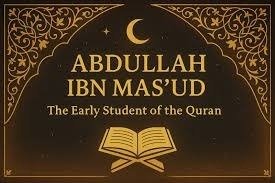
Abdullah ibn Mas’ud
The Scholar of the Ummah and Companion of the Prophet ﷺ
عبد الله بن مسعود رضي الله عنه
Abu Abd al-Rahman Abdullah ibn Mas’ud ibn Ghafil ibn Habib al-Sahli al-Hudhali (may Allah be pleased with him) was one of the greatest companions of Prophet Muhammad ﷺ. Born into the tribe of Hudhail, he would become the scholar of the Ummah, the sixth person to embrace Islam, and one of those given glad tidings of Paradise. He died in the year 32 AH (653 CE), leaving behind a legacy that continues to illuminate the path of knowledge and faith.
The Shepherd Who Found Truth
In the barren valleys of Mecca, where idols were worshipped instead of Allah, there was a young shepherd from the tribe of Hudhail tending the flock of Uqbah ibn Abi Mu’ayt. His name was Abdullah ibn Mas’ud. One day, the Messenger of Allah ﷺ and his companion Abu Bakr al-Siddiq passed by him and asked, “O young man, do you have any milk?”
The honest youth replied, “Yes, but I am entrusted with this flock.” They then asked him about a sheep that had not been mounted by a ram. He brought it to them. The Prophet ﷺ touched its udder and invoked Allah’s blessings, and it produced abundant milk. The Messenger of Allah ﷺ drank, gave Abu Bakr to drink, and then commanded the udder to return to its original state—and it did.
Abdullah ibn Mas’ud, being an alert and perceptive youth, realized he was witnessing something extraordinary. He immediately approached the Messenger of Allah ﷺ and said, “O Messenger of Allah, teach me from this speech.” The Prophet ﷺ touched his head affectionately and said, “You are a boy who has been taught well.” Abdullah embraced Islam on the spot, and his Islam was sincere and steadfast.
He became one of the earliest converts to Islam. It is narrated that he said, “I saw myself as the sixth of six; there was no Muslim on the face of the earth besides us.” Though there is some discussion about his exact position among the early converts, there is no doubt that he was among the foremost believers.
The Servant of the Prophet
From that blessed moment, Abdullah ibn Mas’ud attached himself completely to the Messenger of Allah ﷺ. He served him in his private affairs, becoming so close that he was known as the keeper of the Prophet’s sandals, his siwak (tooth-stick), and his pillow. He would enter upon the Prophet without seeking permission, such was the level of trust and intimacy.
His closeness to the Prophet was so remarkable that when Abu Musa al-Ash’ari came to Medina, he thought that Ibn Mas’ud and his mother were from the household of the Prophet ﷺ due to how frequently they would enter upon him.
“Whoever wishes to recite the Quran fresh as it was revealed, let him recite it according to the recitation of Ibn Umm Abd (Abdullah ibn Mas’ud).”
The First to Recite Publicly
Abdullah ibn Mas’ud possessed a courageous heart that feared no blame in the path of Allah. One day, the companions agreed that they wanted the polytheists to hear the Quran recited openly, but they were hesitant to do so. Abdullah stepped forward and said, “I will do it.”
They warned him of Quraysh’s brutality, reminding him that he had no large tribe to protect him. But he responded with the certainty of faith: “Leave me, for Allah will protect me.” He went to the station near the Kaaba and raised his voice, reciting: “The Most Gracious. He has taught the Quran.” (Surah Ar-Rahman)
The Quraysh gathered around him, striking and slapping him until his face bled. Yet he remained patient under the persecution, continuing his recitation as much as Allah willed. When he returned to his companions with his face marked by their violence, he said to them, “The enemies of Allah have never been more insignificant to me than they are now. If you wish, I will return to them tomorrow with the same.”
The Warrior of Badr
Abdullah ibn Mas’ud witnessed all the major battles alongside the Messenger of Allah ﷺ. At the Battle of Badr, he had a distinguished moment. He found Abu Jahl among the slain after the sons of Afra had struck him down, and he delivered the final blow. It is mentioned that the Prophet ﷺ gave him Abu Jahl’s sword as spoils of war that day.
This was not merely a moment of battle; it was a symbolic victory—the humble shepherd who had once tended sheep for the polytheists now stood over the leader of the disbelievers, demonstrating that truth triumphs over falsehood, and that honor belongs to Allah, His Messenger, and the believers.
The Scholar of the Quran
Abdullah ibn Mas’ud was truly a scholar whom Allah taught and taught well. He said about himself: “By Allah, besides Whom there is no deity, there is no surah revealed in the Book of Allah except that I know where it was revealed, and there is no verse revealed in the Book of Allah except that I know about what it was revealed.”
He learned more than seventy surahs directly from the mouth of the Messenger of Allah ﷺ. The Prophet himself testified to his knowledge and commanded the companions to learn the Quran from four people, beginning with Ibn Mas’ud.
— Surah Ar-Rahman (55:1-2)
His deep understanding of the Quran was not merely intellectual—it was transformative. He embodied the teachings of the Book of Allah in his character, his worship, and his interactions with people. His recitation was known for its beauty and its ability to move hearts, bringing tears to the eyes of those who listened.
Minister and Teacher of Kufa
After the death of the Messenger of Allah ﷺ, the rightly-guided Caliph Umar ibn al-Khattab chose Abdullah ibn Mas’ud to serve as a teacher and minister in Kufa. He wrote to the people of Kufa: “I have sent Ammar ibn Yasir as your leader, and Abdullah ibn Mas’ud as your teacher and minister. They are among the elite companions of the Messenger of Allah ﷺ from the people of Badr, so follow them… I have favored you with Abdullah over myself.”
This appointment was not merely administrative—it was a recognition of Ibn Mas’ud’s profound knowledge, trustworthiness, and ability to guide the Muslim community. In Kufa, he became a fountain of Islamic knowledge, teaching the Quran and Hadith, issuing legal rulings, and guiding the people in matters of faith and practice.
Umar’s words, “I have favored you with Abdullah over myself,” reveal the high esteem in which Ibn Mas’ud was held. The Caliph considered the presence of this companion in Kufa to be a greater benefit to them than having him serve in Medina, despite Umar’s own need for his counsel and knowledge.
The Final Journey
Abdullah ibn Mas’ud remained on the path of knowledge and piety until he passed away in Medina in the year 32 AH. The Caliph Uthman ibn Affan led the funeral prayer over him, and he was buried in al-Baqi cemetery, joining the ranks of the righteous who had preceded him.
His life was a testament to what sincere faith, humble service, courage in truth, beneficial knowledge, and complete piety can achieve. From a young shepherd in the valleys of Mecca to one of the greatest scholars of Islam, Abdullah ibn Mas’ud’s journey exemplifies the transformative power of faith and the enduring value of knowledge.
Lessons from His Life
The life of Abdullah ibn Mas’ud offers profound lessons for every generation of Muslims. His story teaches us that social status does not determine spiritual rank—a humble shepherd can become a pillar of Islamic scholarship. His unwavering commitment to truth, even in the face of persecution, reminds us that courage in faith is not the absence of fear, but the willingness to stand firm despite it.
His close companionship with the Prophet ﷺ demonstrates the importance of seeking nearness to the sources of knowledge and guidance. His mastery of the Quran shows us that true scholarship comes from both intellectual study and spiritual connection with the divine text.
Most importantly, Abdullah ibn Mas’ud’s life reminds us that the greatest legacy one can leave is not wealth or worldly achievement, but beneficial knowledge that continues to guide people long after one’s death. His teachings, his recitation, and his example continue to illuminate the path for Muslims seeking to understand and implement the message of Islam.
May Allah be pleased with Abdullah ibn Mas’ud, and may we benefit from his knowledge and follow his example of sincere faith, devoted service, and unwavering commitment to truth.






Be First to Comment