
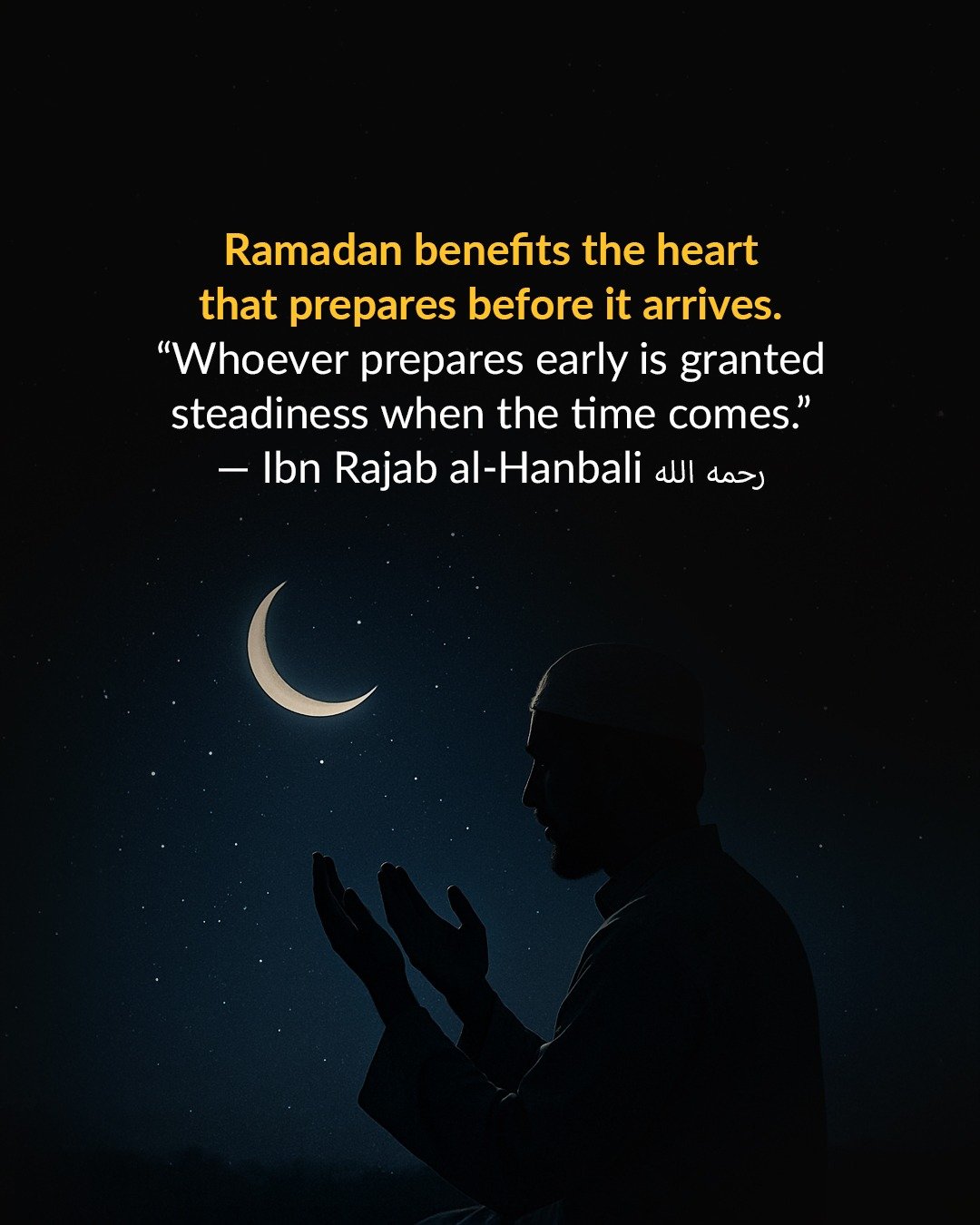
The Ultimate Guide to Preparing for Ramadan
Start Strong, Finish Stronger — How to Make This Your Best Ramadan Yet
Imagine standing at the finish line of Ramadan, looking back at thirty days of transformation. You feel lighter, closer to Allah, and more spiritually alive than you’ve felt in years. This isn’t just wishful thinking — this is what happens when you prepare.
Ramadan doesn’t begin on the first night of fasting. The companions of the Prophet Muhammad ﷺ understood this deeply. They knew that to truly maximize this blessed month, preparation must start long before the first crescent moon appears in the sky.
“O you who have believed, fasting has been prescribed for you as it was prescribed for those before you, that you may become righteous.”
— Surah Al-Baqarah (2:183)
Notice the purpose: “that you may become righteous.” Ramadan is a training ground. It’s a spiritual boot camp designed to elevate you to a higher level of taqwa (God-consciousness). But like any training program, the more prepared you are, the better your results.
Why the Prophet ﷺ Prepared Months in Advance
The Prophet Muhammad ﷺ didn’t wait until Ramadan to get ready. His preparation was deliberate, consistent, and transformative. Let’s look at what he actually did.
The two months before Ramadan — Rajab and Sha’ban — were times of intensive spiritual preparation for the Prophet ﷺ. Here’s what he did:
Aisha رضي الله عنها said: “I never saw the Messenger of Allah ﷺ fast a complete month except Ramadan, and I never saw him fast more in any month than he did in Sha’ban.”
Narrated by Al-Bukhari and Muslim
Think about this: The Prophet ﷺ fasted extensively in Sha’ban to prepare his body and soul for Ramadan. He was training. He was building momentum. He was creating spiritual muscle memory so that when Ramadan arrived, he was already in the zone.
The Prophet ﷺ used to say: “O Allah, bless us in Rajab and Sha’ban, and allow us to reach Ramadan.”
Narrated by Ahmad and Al-Tabarani
This du’a reveals something profound: reaching Ramadan is a blessing in itself. The Prophet ﷺ prayed for it months in advance, recognizing that not everyone would be granted the opportunity to experience another Ramadan.
The 8-Step Blueprint: How to Prepare Like a Champion
Based on the Prophetic example and the practices of the righteous predecessors, here’s your comprehensive preparation guide.
Don’t wait until Ramadan to seek forgiveness. Clear your slate before the blessed month begins. Why? Because you want to enter Ramadan with a clean heart, ready to build upward, not still trying to dig yourself out of past mistakes.
Make sincere tawbah (repentance) for:
- Sins you know you’ve committed
- Sins you may have forgotten
- Rights you’ve violated against others
- Times you’ve neglected Allah’s commands
“And turn to Allah in repentance, all of you, O believers, that you might succeed.”
— Surah An-Nur (24:31)
Following the Prophet’s example, fast as much as you can in Sha’ban. This serves multiple purposes:
- Physical adaptation: Your body adjusts to hunger and thirst
- Mental toughness: You build willpower and discipline
- Spiritual momentum: You enter Ramadan already in worship mode
Start with Mondays and Thursdays (the Prophet’s preferred days), then add the white days (13th, 14th, 15th of the lunar month).
Usamah ibn Zayd asked the Prophet ﷺ: “O Messenger of Allah, I do not see you fasting any month as much as Sha’ban.” He replied: “That is a month to which people do not pay much attention, between Rajab and Ramadan. It is a month in which deeds are raised up to the Lord of the worlds, and I like my deeds to be raised up when I am fasting.”
Narrated by An-Nasa’i
Ramadan is the month of the Quran. But if you haven’t opened the mushaf in months, you can’t expect to suddenly complete it in thirty days. Start building your Quran habit now.
- Set a daily minimum (even if it’s just one page)
- Read with translation to understand
- Listen to recitation during your commute
- Memorize short surahs or verses
Goal: By the time Ramadan starts, reading Quran should feel natural, not forced.
“The month of Ramadan is that in which was revealed the Quran, a guidance for the people and clear proofs of guidance and criterion.”
— Surah Al-Baqarah (2:185)
Don’t take Ramadan for granted. Make the Prophet’s du’a your daily habit:
“Allahumma barik lana fi Rajab wa Sha’ban wa ballighna Ramadan”
“O Allah, bless us in Rajab and Sha’ban, and allow us to reach Ramadan.”
This du’a keeps Ramadan in your consciousness. It builds anticipation. It reminds you that life is short and another Ramadan is not guaranteed.
Knowledge transforms worship from routine to conscious devotion. Before Ramadan begins, educate yourself:
- What breaks the fast and what doesn’t
- How to make up missed fasts properly
- The etiquette of breaking the fast
- The virtues of Laylatul Qadr
- The rulings on Taraweeh prayer
- The spiritual meanings behind fasting
Why this matters: When you understand the “why,” the “what” becomes meaningful.
The Prophet ﷺ said: “When Ramadan enters, the gates of Paradise are opened, the gates of Hell are closed, and the devils are chained up.”
Narrated by Al-Bukhari and Muslim
Think about this hadith. Paradise gates are wide open. Hell gates are locked. The devils who whisper evil to your heart are restrained. This is your moment. This is your opportunity to sprint toward Allah without the usual obstacles. But you must be ready to seize it.
“I want to have a good Ramadan” is not a goal — it’s a wish. Winners set measurable targets. Before Ramadan begins, write down:
- Quran Goal: Will you complete it once? Twice? With translation?
- Prayer Goal: Will you pray Taraweeh every night? Qiyam al-Layl in the last ten nights?
- Charity Goal: How much will you give? To whom?
- Character Goal: Which bad habit will you break? Which good one will you build?
- Knowledge Goal: Which Islamic book will you read? Which lectures will you attend?
Write these goals down. Put them somewhere visible. Review them weekly.
Enter Ramadan with a clean heart. This means:
- Apologizing to anyone you’ve wronged
- Forgiving those who’ve wronged you
- Paying back money you owe
- Returning borrowed items
- Making amends for broken promises
Why? Because your worship in Ramadan should be pure devotion to Allah, not mixed with guilt, grudges, or unpaid obligations.
The Prophet ﷺ said: “Whoever has wronged his brother with regard to his honor or anything else, let him seek his forgiveness today, before the Day when there will be neither dinars nor dirhams.”
Narrated by Al-Bukhari
Your environment shapes your behavior. Design your surroundings to support your Ramadan goals:
- Digital: Delete time-wasting apps. Unsubscribe from distracting content. Set up Quran and dhikr notifications.
- Physical: Keep a mushaf in multiple locations (bedroom, living room, car). Set up a dedicated prayer space.
- Social: Find an accountability partner. Join a Quran study circle. Inform friends and family of your goals.
- Schedule: Plan your daily routine now. When will you pray Taraweeh? When will you read Quran? When will you break fast?
Remember: Willpower is finite. If you have to fight your environment every day, you’ll exhaust yourself. Make it easy to do good.
The Companions’ Mindset: Six Months of Preparation
The righteous predecessors (Salaf) had a saying that should shake us awake:
“They used to make du’a to Allah for six months to allow them to reach Ramadan, and then they would make du’a for six months after that for Allah to accept their deeds from Ramadan.”
Six months before. Six months after. That’s an entire year centered around a single month. That’s how seriously they took Ramadan.
Why? Because they understood what many of us have forgotten: Ramadan is not a vacation from sin — it’s a revolution of the soul. It’s the opportunity to become a completely different person. But revolutions require preparation.
“Indeed, Allah will not change the condition of a people until they change what is in themselves.”
— Surah Ar-Ra’d (13:11)
Your Pre-Ramadan Action Checklist
The Truth About Transformation
Here’s what most people don’t understand: Ramadan doesn’t change you — you change yourself during Ramadan. Allah provides the blessed time, the spiritual atmosphere, the multiplied rewards. But the actual work? That’s on you.
The gates of Paradise are open, but you have to walk through them. The devils are chained, but you still have your own nafs (ego) to fight. The rewards are multiplied, but you still have to do the deeds.
The Prophet ﷺ said: “Whoever fasts Ramadan out of faith and seeking reward, his previous sins will be forgiven. Whoever stands in prayer during Ramadan out of faith and seeking reward, his previous sins will be forgiven. And whoever stands in prayer on Laylatul Qadr out of faith and seeking reward, his previous sins will be forgiven.”
Narrated by Al-Bukhari and Muslim
Did you catch that? Your entire past — wiped clean. All your mistakes, all your regrets, all your sins — forgiven. This is the offer on the table. But it comes with conditions: faith and seeking reward. Not just going through the motions. Not just culturally fasting. But conscious, intentional worship seeking only Allah’s pleasure.
And you cannot achieve this level of worship if you stumble into Ramadan unprepared, spiritually out of shape, with no plan and no momentum.
Not when the crescent moon is sighted. Not on the first night of Taraweeh. Right now. This very moment. Because preparation is part of the journey, not separate from it.
The Prophet ﷺ prepared months in advance. The companions made du’a for six months to reach Ramadan. The righteous predecessors treated Sha’ban as spiritual boot camp. They understood that excellence in Ramadan is the fruit of excellence in preparation.
So start today. Make tawbah today. Fast tomorrow. Open the Quran tonight. Set your goals this weekend. Reconcile with that person you’ve been avoiding. Delete that app that’s been wasting your time. Make that du’a to reach Ramadan.
Because here’s the reality: This could be your last Ramadan. Not to be morbid, but to be real. None of us are guaranteed another year. The companions who prepared so diligently — many of them didn’t live to see the next Ramadan. They gave it everything they had because they knew it might be their final chance.
Treat this Ramadan like it’s your last. Prepare like your soul depends on it. Because it does.
O Allah, allow us to reach Ramadan, and help us in fasting, standing in prayer, and guarding our tongues.






Be First to Comment