
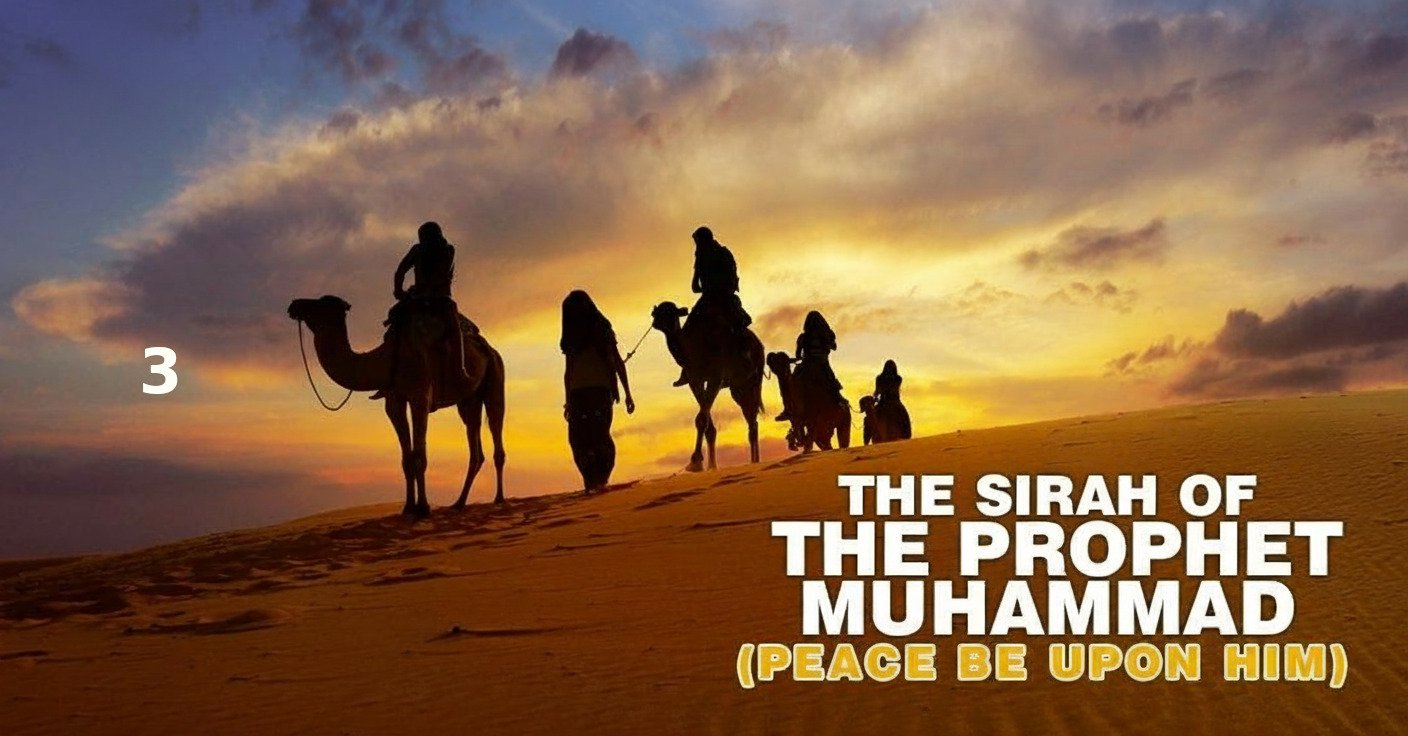
We continue the Seerah (Sirah) of the Prophet, pbuh. In this part, when Muhammad ﷺ was not yet a year old, he was sent to live with a foster mother in the countryside, as was the custom of Meccan mothers. The wealthy and middle-class families of Mecca would send their infants to Bedouin wet nurses who lived in the surrounding desert regions, where the children would remain for about five years.
The Sirah
Muhammad’s Youth
From Orphan to Shepherd: The Formative Years
Muhammad ﷺ was born in approximately the year 570 CE into the clan of Banu Hashim, a weaker and poorer branch of the Quraysh confederation. His young father ‘Abdullah died before he was born while away on a trading expedition to Syria. His mother Aminah and an African maidservant named Barakah moved themselves and the baby into the house of Abdullah’s father, ‘Abdul-Muttalib, the respected elder of Banu Hashim.
The Desert Years: A Bedouin Childhood
When Muhammad ﷺ was not yet a year old, he was sent to live with a foster mother in the countryside, as was the custom of Meccan mothers. The wealthy and middle-class families of Mecca would send their infants to Bedouin wet nurses who lived in the surrounding desert regions, where the children would remain for about five years. This practice served multiple purposes: it gave mothers time to recover and freed them from the demands of nursing, while ensuring that children learned “the ways of the desert” as the very basis of their personality and character.
The Meccan custom of sending children to Bedouin foster mothers was deeply rooted in cultural values. The town-dwellers, though wealthy from trade, were afraid of losing touch with the ancestral ways of the desert Arabs. Life in the harsh desert environment was believed to instill qualities of resilience, eloquence in Arabic, physical health, and moral strength. The clear air, wide spaces, and demanding conditions of nomadic life were thought to produce the finest specimens of Arabian character.
In the care of his Bedouin foster mother Halimah al-Sa’diyyah and her family, including her eldest daughter, the boy grew into a healthy specimen who was well-groomed, well-mannered, and extremely articulate. The desert environment shaped him profoundly—he learned to speak the purest, most eloquent Arabic, to appreciate the stark beauty of the wilderness, and to develop the physical stamina that would serve him throughout his life.
When he was finally returned to his mother Aminah around the age of five or six, he had truly taken on the air of a native son of the desert, which was precisely the goal of the town-dwellers who commissioned this arrangement. Young Muhammad spoke with the eloquence and clarity of a Bedouin, bore himself with the dignity of a free child of the wilderness, and possessed the robust health that came from years of desert living.
The Love of a Grandfather
Muhammad ﷺ had the special favor of his grandfather ‘Abdul-Muttalib, who loved him as though he were his own lost son ‘Abdullah reborn. The elderly patriarch, who was the chieftain of Banu Hashim and one of the most respected men in Mecca, showed the boy extraordinary affection and consideration.
The young Muhammad would often sit with his grandfather during city council meetings and was even allowed to perch in his lap and on his official rug—an honor no other grandchild received. This proximity to power and governance at such a young age exposed Muhammad to the workings of tribal politics, the art of diplomacy, and the weight of leadership responsibilities. ‘Abdul-Muttalib’s indulgence of the boy was noticed by all, and some even questioned why the child received such preferential treatment. The old man would simply reply that this grandson had a great future ahead of him.
A Mother’s Final Journey
When Muhammad ﷺ was about seven years old, his mother Aminah decided to undertake a significant journey. She fervently desired to visit the grave of her departed husband ‘Abdullah, for that was where he had died years earlier in the city of Yathrib (later known as Madinah), located several hundred miles north of Mecca.
She took along the faithful Barakah, who had been with her since before Muhammad’s birth, and the three of them joined a northbound caravan. Upon their arrival in Yathrib, Aminah spent several weeks mourning at her husband’s graveside, finally able to grieve properly after years of separation. During this time, young Muhammad played with his distant cousins from the Banu Najjar clan, his mother’s relatives who lived in the city. He made connections that would prove significant decades later.
On the return journey to Mecca, however, tragedy struck. Aminah caught a debilitating fever, and her life force slipped away day by day on the harsh caravan trail. The illness worsened rapidly in the unforgiving heat of the desert route. When she could travel no longer, the trio abandoned the caravan in which they were a part, and Barakah pitched a tent in which her mistress could rest.
Muhammad ﷺ could do nothing as his mother slowly passed away before his eyes. He was only a small boy of seven, helpless in the face of death’s inexorable approach. Before she died, however, Aminah extracted a solemn promise from Barakah: never to leave Muhammad and always to care for him. Barakah, though she was a teenager herself, swore to honor this sacred trust.
Barakah (later known as Umm Ayman) would keep her promise to Aminah with unwavering devotion. She would remain with Muhammad throughout his childhood, his youth, his prophethood, and beyond. She would be among the first to accept Islam, would migrate with the Muslims, and would be honored by the Prophet as “my mother after my mother” and “a woman of Paradise.” Her loyalty, born from a deathbed promise to a dying mother, would span more than six decades.
After the pair buried Aminah by the side of the trail at a place called al-Abwa, the teenage girl and small boy returned somberly to Mecca. The journey back must have been one of profound grief and uncertainty. Muhammad had now lost both parents, though he had never known his father and had only enjoyed his mother’s full presence for about two years after returning from the desert.
Under the Care of ‘Abdul-Muttalib
Muhammad’s ﷺ frail grandfather ‘Abdul-Muttalib felt deeply for the boy, who was now doubly orphaned. The old man’s affection for his grandson intensified, if anything, in the face of this tragedy. He treated Muhammad with even greater tenderness, often keeping him close and ensuring he wanted for nothing within the family’s modest means.
But ‘Abdul-Muttalib himself was quite advanced in years—he was in his eighties by this time—and he knew his time with his beloved grandson would be short. Even as Aminah had sought to protect her son through Barakah’s promise, so too did Muhammad’s grandfather make one of his sons, Abu Talib, promise to take the boy in and look after him should he pass away.
Abu Talib was ‘Abdul-Muttalib’s chosen guardian for Muhammad because he was the full brother of ‘Abdullah, Muhammad’s deceased father. Though Abu Talib was not wealthy and already had a large family of his own, he was a man of honor and deep family loyalty. He agreed to his father’s request without hesitation.
A Shepherd Boy in Abu Talib’s House
When his grandfather finally did pass away about a year later, Muhammad ﷺ soon found himself a boy of about nine years old in his uncle’s house. There were quite a number of mouths to feed in Abu Talib’s household—he had many children of his own, including his sons who would later become well-known: Talib, ‘Aqil, Ja’far, and the youngest, ‘Ali. Abu Talib was poor, struggling to support his large family through trade and whatever work he could find.
Despite his poverty, Abu Talib welcomed Muhammad warmly and treated him as he would his own sons. To help the household and to learn self-reliance, Muhammad was given the chore of minding Abu Talib’s flock of sheep in the hardscrabble hills outside the city. This was honest work, common for boys of his age and station, and it kept him occupied and useful to the family.
The Prophet Muhammad ﷺ later reflected on his years as a shepherd, saying: “There is no prophet who was not a shepherd.” When asked if he too had been a shepherd, he replied: “Yes, I used to shepherd the sheep of the people of Mecca for a few qirats (small coins).” Shepherding was seen as a training ground for prophets—it taught patience, responsibility, vigilance, compassion for the weak, and the ability to lead and guide. The qualities needed to care for vulnerable animals translated directly to caring for vulnerable people.
Thus, Muhammad ﷺ became a full-time shepherd, often alone in the wilderness for over a decade, from approximately age nine until his early twenties. Day after day, he would lead the sheep into the rocky hills surrounding Mecca, finding sparse grazing land, protecting them from predators and thieves, and bringing them safely home each evening.
These were years of solitude, contemplation, and character formation. The long hours alone with only the sheep for company gave the young Muhammad ample time to think, to observe nature, to develop inner strength, and to cultivate the patience and wisdom that would mark his later life. The hardship of this existence—the heat, the thirst, the isolation, the physical demands—forged in him a resilience that would be tested again and again in the years to come.
The wilderness experience shaped Muhammad’s character in profound ways. He learned self-reliance, as he had to depend on his own judgment and abilities. He developed a deep appreciation for the natural world and its signs pointing to the Creator. He learned to be content with little, as a shepherd’s life was one of simplicity and scarcity. Most importantly, he learned leadership—a shepherd must lead, guide, protect, and serve his flock, placing their needs above his own comfort. These were exactly the qualities he would need as a prophet and leader of a nation.
The Journey to Syria
The only real adventure that came into Muhammad’s ﷺ life during these years occurred when he was about twelve years old. Abu Talib was preparing for a trading expedition to the city of Bosra in Syria, a journey of several weeks through desert and settled lands. Young Muhammad begged his uncle to allow him to come along. Perhaps he was tired of the monotonous shepherd’s life, or perhaps he simply yearned to see something beyond the hills of Mecca.
Abu Talib initially refused, concerned about the dangers and difficulties of such a long journey for a young boy. But Muhammad persisted in his request with such earnestness that his uncle finally relented. However, the boy would not be a passenger—he would have to earn his place in the caravan. Muhammad was assigned the difficult task of minding the camels and other animals, which made for an arduous, though no less rewarding, experience.
The journey itself was transformative. As the caravan slowly made its way northward, Muhammad ﷺ saw vast stretches of desert, encountered different tribes and peoples, observed the practices of traders and the dynamics of commerce, and experienced the rhythms of caravan life. When they finally reached Syria, he witnessed a world entirely different from Mecca.
Syria was part of the Byzantine Empire, a Christian land with great cities, churches, monasteries, and a civilization far more developed than the tribal society of Arabia. It was a cosmopolitan region where Greek, Aramaic, and Arabic were spoken, where Christianity in its various forms was practiced openly, and where the remnants of ancient civilizations could still be seen. For a boy from the isolated, pagan society of Mecca, this was an entirely new world—a glimpse of different religions, different forms of government, different ways of life.
In the exotic lands of Syria, Muhammad ﷺ would get to see the wider world for the first time, and it made an impression on him that would last a lifetime. He saw Christians at prayer, monks in their monasteries, and the evidence of revealed religion practiced on a social scale. He witnessed the grandeur of Byzantine architecture and the sophistication of urban life. He learned that the world was far larger and more complex than the tribal enclave of Mecca.
Most significantly, during this journey, the caravan stopped near the monastery of a Christian monk named Bahira. According to traditional accounts, this learned monk recognized signs in the young Muhammad that indicated he was destined for prophethood. Bahira warned Abu Talib to protect the boy carefully and to return him safely to Mecca, as great things awaited him. Whether Abu Talib fully believed this prophecy or not, he did indeed bring his nephew home safely, and the memory of Bahira’s words may have lingered in the back of his mind.
Return to the Shepherd’s Life
After the excitement of the Syrian journey, Muhammad ﷺ returned to his familiar role as a shepherd in the hills outside Mecca. But he was no longer quite the same boy who had left. He had seen the wider world, had glimpsed different civilizations and religions, and had been told by a learned man that his destiny was special.
Yet there was no immediate change in his circumstances. He continued to live in Abu Talib’s household, continued to tend the sheep, and continued to grow into young manhood in relative obscurity. His reputation in Mecca was that of an honest, trustworthy, and well-mannered young man—qualities that would earn him the nickname الأمين (al-Amin), “the Trustworthy.” But few could have guessed that this humble shepherd would one day transform not just Arabia, but the entire world.
The years of his youth—from age nine to his early twenties—were years of preparation, though he did not know it. Every hardship he endured, every hour spent alone in contemplation, every lesson learned from responsibility and poverty, every glimpse of the wider world beyond Mecca was shaping him for the monumental task that awaited him.
Muhammad’s youth was marked by loss, hardship, and humble circumstances—orphaned twice, raised by relatives, working as a shepherd for over a decade. Yet these very difficulties forged in him the qualities that would make him an extraordinary prophet and leader: empathy for the orphan and the weak, humility despite later power and success, self-reliance and independence of thought, patience in the face of adversity, gratitude for the smallest blessings, and an unwavering moral character built on honesty and trustworthiness. The trials of his youth were, in retrospect, the crucible in which a prophet was formed.
The years would pass, Muhammad would grow into manhood, and eventually his life would take dramatic turns—marriage to a wealthy widow, success in trade, and finally, at age forty, the beginning of revelation. But the foundation of everything that would come was laid in these quiet years of his youth: the orphan boy, the shepherd in the wilderness, the young traveler who glimpsed a wider world and knew, somehow, that he was meant for something greater.






Be First to Comment