
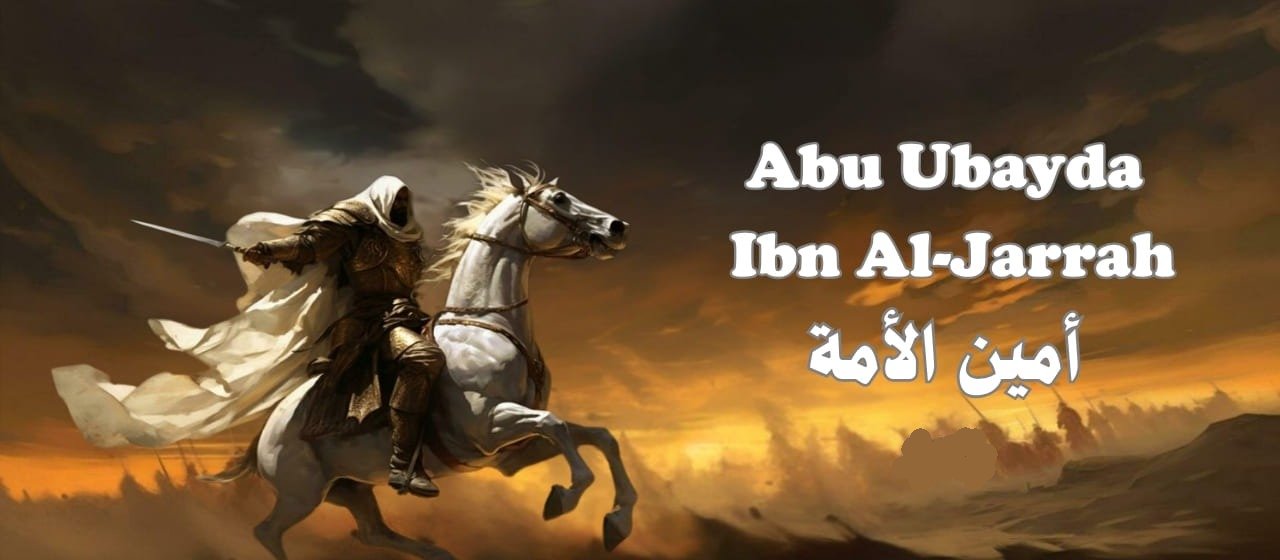
Abu Ubaydah ibn al-Jarrah
The Trustee of This Ummah
أمين هذه الأمة
The Character Praised by Abu Bakr
These were the words of Abu Bakr al-Siddiq رضي الله عنه describing Abu Ubaydah ibn al-Jarrah. This was no ordinary companion—this was a man whose character embodied the highest Islamic virtues, whose faith was so strong that it led him to one of the most difficult tests any human being could face.
The Most Beloved to the Prophet ﷺ
When Aisha was asked: “Which of the companions of the Messenger of Allah was most beloved to him?” She replied: “Abu Bakr, then Umar, then Abu Ubaydah ibn al-Jarrah.”
To be ranked third in the Prophet’s love, after only Abu Bakr and Umar, speaks volumes about Abu Ubaydah’s status. He was among the earliest Muslims, one of the Ten Promised Paradise, and a man whose trustworthiness was so renowned that the Prophet ﷺ himself gave him the title “The Trustee of This Ummah” (Amin Hadhihi al-Ummah).
The Trial at Badr: A Father and a Son
On the day of the Battle of Badr, the first major battle between the Muslims and the Quraysh, Abu Ubaydah faced a trial that no imagination could have conceived and no mind could have fully grasped. In the heat of battle, in the grinding mill of war, Abu Ubaydah saw a man from among the polytheists in the Quraysh army who wanted to duel him.
Abu Ubaydah tried desperately to avoid fighting this particular man. He moved away, he evaded, he attempted to find another opponent. But the polytheist followed him everywhere, tracking him down, intent on killing him. He would not let Abu Ubaydah escape.
In one of the rarest moments in human history, the two faces finally met. There was no more running, no more avoiding. Abu Ubaydah and the polytheist faced each other. They fought. And Abu Ubaydah killed him.
This polytheist was Abdullah ibn al-Jarrah—Abu Ubaydah’s own father.
Imagine the weight of that moment. A son, defending the truth, forced to strike down his own father who had come to kill him and destroy Islam. The pain, the conflict, the absolute surrender to Allah’s command—all crystallized in a single, devastating choice.
Immortalized in the Quran
This moment, this supreme sacrifice, this ultimate demonstration of faith over blood ties, was so significant that Allah immortalized it in the Quran. This verse would be recited until the Day of Judgment:
“You will not find a people who believe in Allah and the Last Day having affection for those who oppose Allah and His Messenger, even if they were their fathers or their sons or their brothers or their kindred. For such He has decreed within their hearts faith and supported them with a spirit from Him. And He will admit them to gardens beneath which rivers flow, wherein they abide eternally. Allah is pleased with them, and they are pleased with Him—those are the party of Allah. Unquestionably, the party of Allah—they are the successful.”
— Surah al-Mujadilah (58:22)
The scholars of tafsir note that this verse was revealed about Abu Ubaydah and those like him who put their faith in Allah above all worldly relationships. Even if they were their fathers—this phrase speaks directly to Abu Ubaydah’s trial at Badr.
Abu Ubaydah’s action at Badr teaches us that true faith sometimes requires the hardest sacrifices. It’s not that Islam encourages severing family ties—rather, it establishes that when someone stands in active opposition to Allah and His Messenger, even attempting to destroy Islam and kill the believers, then faith must take precedence. Abu Ubaydah did not seek this confrontation; his father forced it upon him. And when forced to choose between his father who came to kill him and his faith in Allah, Abu Ubaydah chose Allah.
The Battle of Uhud: Devotion Beyond Measure
Abu Bakr al-Siddiq رضي الله عنه described another scene that reveals the depth of Abu Ubaydah’s love for the Prophet ﷺ:
Abu Bakr narrates: “On the day of Uhud, when the Messenger of Allah ﷺ was struck and two rings from his helmet became embedded in his cheek, I rushed toward him. But I saw a man coming from the east, flying like a bird. I prayed: ‘O Allah, make him come in obedience!’ When we both reached the Messenger of Allah, I found it was Abu Ubaydah ibn al-Jarrah—he had beaten me there.”
Abu Ubaydah said to Abu Bakr: “I ask you by Allah, O Abu Bakr, leave this to me. Let me remove the rings from the face of the Messenger of Allah.”
Abu Bakr continues: “So I left him. Abu Ubaydah took hold of one of the rings with his front tooth, and pulled it out. The ring came out, and his tooth fell to the ground along with it. Then he took hold of the other ring with another tooth, and pulled. That tooth also fell out.”
From that day forward, Abu Ubaydah walked among the people missing his two front teeth—athram (gap-toothed). But what made him gap-toothed? Not an accident. Not a disease. He lost his teeth while removing the rings of the helmet from the blessed face of the Prophet Muhammad ﷺ.
His missing teeth became a badge of honor, a sign of his love and sacrifice for the Messenger of Allah ﷺ.
A Life of Trustworthiness
Just as Abu Ubaydah lived with the Prophet ﷺ as a trustworthy companion, he continued to live after the Prophet’s death as a trustworthy leader, carrying his responsibilities with a level of integrity that would have sufficed all the people of the earth if they had taken from it.
“Indeed, for every ummah there is a trustworthy guardian, and the trustworthy guardian of this ummah is Abu Ubaydah ibn al-Jarrah.”
This wasn’t just a title—it was a reality that defined his life. Whether in battle, in leadership, or in daily dealings, Abu Ubaydah exemplified trustworthiness. The Muslims knew that when they put something in his hands, it would be guarded with absolute integrity.
The Battle of Yarmuk: Commander of Victory
At the Battle of Yarmuk, one of the most decisive battles in Islamic history, Abu Ubaydah served as the Supreme Commander of the Muslim forces. Under his leadership, the Muslims achieved a stunning victory against the Byzantine Roman army—an army that numbered close to 240,000 soldiers.
This victory paved the way for the liberation of Jerusalem and the entire region of Syria. Abu Ubaydah would later personally receive the keys to Jerusalem, fulfilling the prophecy and bringing the blessed city under Islamic rule.
The Plague of Amwas: Umar’s Desperate Plan
Before the spread of the devastating Plague of Amwas throughout the land of Syria—spreading like wildfire through dry grass—Umar ibn al-Khattab رضي الله عنه wanted to save Abu Ubaydah from certain death by any means possible. He tried to summon him using a clever excuse.
Umar wrote to Abu Ubaydah: “If my letter reaches you in the evening, I have determined that you must not let the morning come before you set out toward me. And if it reaches you in the morning, do not let evening come before you set out toward me. For I have a need, and I cannot do without you in it. So hasten to me.”
When Abu Ubaydah read the letter, he smiled. He understood Umar’s intention—the Caliph wanted to rescue him from the plague. But Abu Ubaydah’s response demonstrated his character:
Abu Ubaydah wrote back: “I have received your letter, O Commander of the Faithful, and I understand your purpose. But I am among an army of Muslims, and what befalls them befalls me. So release me from your determination, O Commander of the Faithful.”
When the letter reached Umar, he wept.
Those around him asked: “Has Abu Ubaydah died?”
Umar replied: “As if he has.”
Umar meant: If he hasn’t died yet, he is surely walking toward death, and there is no avoiding it now.
The Plague Takes Its Toll
Abu Ubaydah was with an army of thirty-six thousand soldiers. The plague ravaged them mercilessly. When the plague finally subsided, only six thousand remained. Thirty thousand Muslims had perished, including some of the greatest companions.
The Plague of Amwas (named after the town of Amwas in Palestine) was one of the deadliest pandemics to strike the early Muslim community. It claimed the lives of approximately 25,000 Muslims, including many senior companions. Abu Ubaydah ibn al-Jarrah, Mu’adh ibn Jabal, and countless other heroes of Islam were martyred in this plague. Despite the devastating losses, the survivors saw it as a test from Allah and a martyrdom for those who died with patience.
Among those who died was Abu Ubaydah ibn al-Jarrah رضي الله عنه, in the year 18 AH (639 CE). The Trustworthy of the Ummah returned to his Lord, having carried the banner of “La ilaha illa Allah, Muhammad Rasul Allah” (There is no god but Allah, Muhammad is the Messenger of Allah) to the cities and villages of Syria.
The Eternal Reward
This is the reward of those who open lands for Islam. Every good deed, every prayer, every act of worship performed in the lands they liberated—they receive a reward equal to it. Abu Ubaydah opened Syria and Jerusalem. Every Muslim who prays in Masjid Al-Aqsa, every scholar who teaches in Damascus, every believer who says “La ilaha illa Allah” in the lands he freed—Abu Ubaydah shares in their reward.
And this reward continues to flow to him until the Day of Judgment. While his body returned to the earth, his rewards continue to multiply, growing every moment of every day, for every act of worship and goodness performed in those blessed lands.
The Legacy of Abu Ubaydah
- Faith Above All: When forced to choose between family ties and faith, Abu Ubaydah chose Allah without hesitation. This doesn’t mean severing relationships unjustly, but it means that when someone actively opposes Allah and His Messenger, faith must take precedence.
- Trustworthiness as a Way of Life: The Prophet ﷺ didn’t give Abu Ubaydah the title “Trustworthy of the Ummah” casually. It was earned through a lifetime of integrity, honesty, and reliability. In every situation, Abu Ubaydah proved himself worthy of trust.
- Love for the Prophet ﷺ: Abu Ubaydah’s willingness to lose his teeth while removing the helmet rings from the Prophet’s face shows a love that transcends the physical. He didn’t just serve the Prophet—he sacrificed for him with joy.
- Equality in Calamity: When Umar tried to save him from the plague, Abu Ubaydah refused to be treated differently from his soldiers. “What befalls them befalls me,” he said. True leaders don’t abandon their people in times of hardship.
- The Eternal Nature of Good Deeds: Abu Ubaydah’s conquest of Syria means that over 1,400 years later, he is still receiving rewards for every prayer, every Quran recitation, and every good deed performed in those lands. This is the power of opening doors to goodness—the rewards never stop.
Abu Ubaydah ibn al-Jarrah was a man who chose faith over blood, who sacrificed his teeth for his beloved Prophet, who led armies to victory, who refused special treatment in times of plague, and who opened lands that would become centers of Islamic civilization for over a millennium.
He was gentle, forgiving, connected to family, merciful to believers, stern against disbelievers, and above all—trustworthy. The Trustworthy of This Ummah. And Allah was pleased with him, and he was pleased with Allah.
“Allah is pleased with them, and they are pleased with Him.”
— Surah al-Mujadilah (58:22)







Be First to Comment