
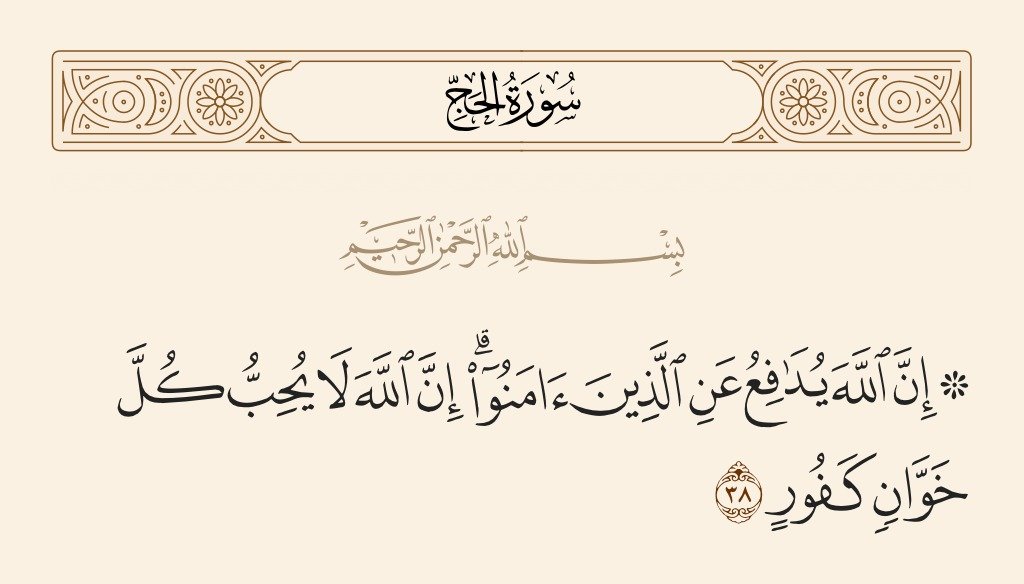
Surah Al-Hajj, Verse 38
The Promise of Divine Defense
إِنَّ اللَّهَ يُدَافِعُ عَنِ الَّذِينَ آمَنُوا ۗ إِنَّ اللَّهَ لَا يُحِبُّ كُلَّ خَوَّانٍ كَفُورٍ
This verse from Surah Al-Hajj (The Pilgrimage) contains one of the most profound promises in the Quran: that Allah Himself actively defends those who believe. It is a declaration of Divine protection that transcends the physical realm, encompassing spiritual, moral, and social dimensions. This explanation explores the depth of this promise and its implications for believers.
The Verse in Translation
“Truly, Allah defends those who believe. Verily! Allah likes not any treacherous ingrate.” (Surah Al-Hajj, 22:38)
Context: The Spirit of Sacrifice
This powerful declaration of Divine protection immediately follows verses that discuss the rites of sacrifice during the Hajj (Pilgrimage). The preceding verse (22:37) emphasizes that God does not require the physical flesh or blood of the sacrificial animals, but rather the piety (Taqwa) and sincerity of the worshipper.
The connection is profound and intentional. After establishing that the true essence of sacrifice is the believer’s intention and devotion, God immediately promises His defense to those who possess this sincerity. It signifies that those who sacrifice for the sake of God—be it time, wealth, effort, or even their own comfort—will not only be rewarded but will also earn the active, personal defense of the Almighty.
In Islamic tradition, sacrifice (Qurbān) is not limited to the ritual offering of animals during Hajj. It encompasses any form of dedication to the path of Allah, including personal sacrifice, financial contribution, intellectual effort, and moral commitment. The verse promises that all such sacrifices, when made with sincere intention, attract Divine protection.
The Nature of Divine Defense (Yudāfi’u)
The Arabic verb يُدَافِعُ (Yudāfi’u) is in the present simple tense, emphasizing that this defense is not a one-time event but a continuous, active, and ongoing process. God Himself is the defender of the believers, and this defense operates on multiple levels.
| Aspect of Defense | Description | Example of Manifestation |
|---|---|---|
| Physical/External | Protection from visible enemies, harm, and oppression. | A believer being saved from a physical attack, a community being protected from invasion, or the frustration of an oppressor’s plans. |
| Moral/Internal | Protection from spiritual diseases, doubt, and betrayal of one’s own principles. | Strengthening the believer’s resolve against temptation, clarifying truth during confusion, and maintaining integrity in the face of corruption. |
| Socio-Economic | Protection of one’s livelihood, reputation, and family from malicious intent. | Ensuring a believer’s honest endeavors succeed despite envy, or preserving their good name against slander. |
The Contrast: Treachery and Ingratitude
The second part of the verse provides a stark contrast, explaining why God defends the believers: “Verily! Allah likes not any treacherous ingrate (Khawwānin Kafūr).”
Understanding the Terms
Khawwān (Treacherous/Betrayer): This refers to one who is habitually deceitful, who betrays trusts, and whose nature is one of treachery. This includes betraying God’s covenant, the trust of one’s community, or even the trust of one’s own conscience. The treacherous person is fundamentally unreliable and destructive.
Kafūr (Ingrate/Denier): This signifies one who denies or covers up the blessings of God. This ingratitude is not merely a lack of thanks, but an active denial of the source of all good. The ingrate often attributes blessings to their own efforts or to others, thereby severing the connection between the blessing and its Divine source.
The verse stresses that those who possess these traits—betrayal and ingratitude—are fundamentally opposed to the sincere, sacrificing nature of the believer. They are focused on their own selfish desires, often envying the blessings of others, which leads to a loss of focus and failure in their own endeavors.
The Consequences of Treachery and Ingratitude
When a person allows treachery and ingratitude to dominate their character, they create their own misfortune. Those who envy the blessings of others often find that their envy consumes them, filling their hearts with hatred and grudges. This internal corruption manifests externally as repeated failures and losses. They lose focus on their own affairs, becoming preoccupied with the success of others, and consequently, they fail in their own endeavors.
This is not punishment in the traditional sense, but rather the natural consequence of a corrupted character. Just as a plant cannot grow in poisoned soil, a person filled with treachery and ingratitude cannot flourish in any aspect of their life. Their own nature becomes their prison.
The Promise of Divine Defense
In contrast, God’s defense of the believer is a manifestation of His justice and mercy. The believer who maintains sincere faith, who sacrifices for the sake of Allah, and who remains grateful for Divine blessings, gains an ally whose power is absolute. This defense operates on multiple levels and in ways that the believer may not always perceive.
Some forms of Divine defense are visible and immediate. Others are subtle and work behind the scenes. Some we understand, and some remain beyond our comprehension. But the promise is clear and absolute: God Himself takes on the role of the ultimate Defender.
Conclusion
Surah Al-Hajj, Verse 38, is a profound source of comfort and motivation for the believer. It assures us that our sincerity and sacrifice are not overlooked by the Divine. When a person aligns their actions with their faith, dedicating their life and resources to righteousness, they gain an ally whose power is absolute and whose protection is comprehensive.
The verse also serves as a warning to those who choose the path of treachery and ingratitude. Such a path leads not to success, but to self-destruction. The choice is clear: align yourself with truth, sincerity, and gratitude, and gain the protection of the Almighty. Or choose the path of treachery and ingratitude, and face the consequences of your own corruption.
This is the promise and the warning of Surah Al-Hajj, Verse 38—a verse that encapsulates the Divine justice and mercy that permeates the entire Quran.













Be First to Comment