
The Third Type
When Allah Exposed the Hypocrites in Verse 2:8 — And Why This Warning Is More Relevant Today Than Ever
In Makkah, the lines were clear. There were two types of people: those who believed in the Prophet Muhammad ﷺ and his message, and those who rejected him outright—openly, fiercely, violently. The disbelievers didn’t hide their hatred. They tortured the believers. They expelled them. They mocked them in public. At least you knew where everyone stood. But when the Prophet ﷺ migrated to Madinah, Allah revealed something that would forever change how Muslims understood belief: there was a third type.
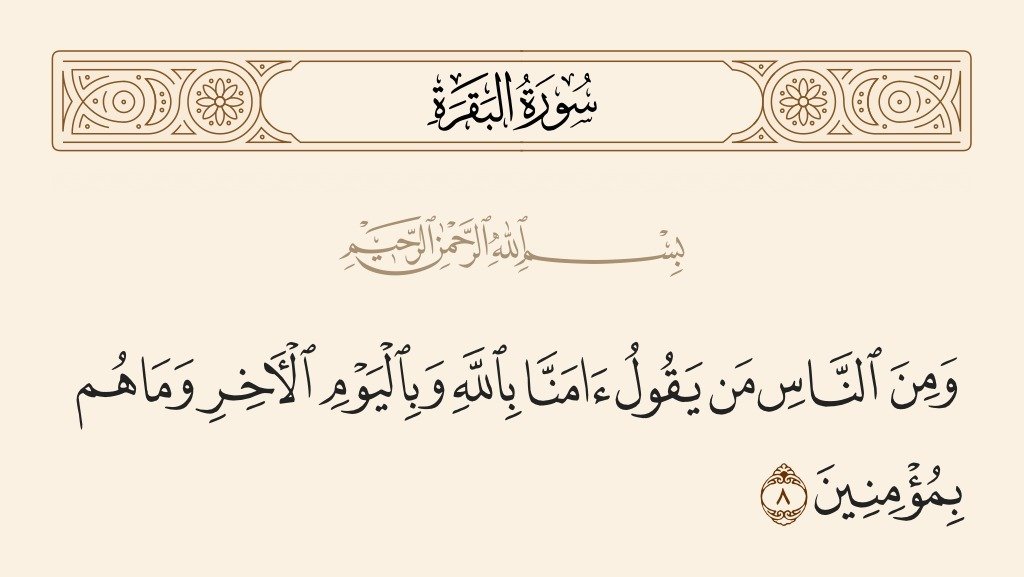
“And of the people are some who say, ‘We believe in Allah and the Last Day,’ but they are not believers.”
— Surah Al-Baqarah (2:8)
This verse didn’t come down in Makkah. It came down in Madinah—after the Hijrah, after the Muslims had established their community, after Islam had begun to gain strength. And it introduced a reality the Prophet ﷺ had not encountered before: people who claimed to be Muslim but whose hearts concealed disbelief.
These were not the open enemies. These were the Munafiqoon—the hypocrites. They sat in the mosque. They prayed beside the believers. They said “We believe,” but Allah declared: “No, they are not believers.”
Why Hypocrisy Didn’t Exist in Makkah
The scholars of tafsir explain: There were no hypocrites in Makkah. Why? Because there was no benefit to pretending to be Muslim. In fact, the opposite was true—people were forced to hide their faith, not their disbelief. If you declared Islam in Makkah, you faced torture, boycott, expulsion, and death. Who would fake that?
But in Madinah, everything changed. Islam became strong. The Muslims were no longer a persecuted minority—they were a rising power. The tribes of Aws and Khazraj, who had been at war with each other for generations, united under Islam. The Battle of Badr stunned Arabia: a small group of Muslims defeated the mighty Quraysh. Suddenly, being Muslim came with social status, political influence, and military strength.
And that’s when hypocrisy was born.
Abdullah ibn Ubayy: The Chief of the Hypocrites
His name was Abdullah ibn Ubayy ibn Salul. He was the chief of the Khazraj tribe, one of the two dominant tribes of Madinah. Before Islam, the people of Madinah had been preparing to crown him their king. They had agreed on his leadership. They were about to give him the crown he had waited his entire life for.
Then the Prophet Muhammad ﷺ arrived. And everything Abdullah ibn Ubayy had worked for evaporated overnight.
The people didn’t just accept Islam—they loved the Prophet ﷺ. They gave him their allegiance. They made him their leader. And Abdullah ibn Ubayy? He was left standing on the sidelines, watching his kingdom slip away.
But he was too clever to fight openly. After the Battle of Badr, when it became clear that Islam was not going away, he made a calculated decision: “Allah’s religion has become apparent,” he said. And so, he pretended to become Muslim.
He said the Shahada. He came to the mosque. He even stood up during Friday prayers and said, “O people, the Messenger of Allah is present among you. Allah has honored you through him. Support him, listen to him, and obey him.”
But when he was alone with his followers, he said: “When we return to Madinah, surely the most honorable will expel the meanest.” He meant: I will drive Muhammad out.
Allah doesn’t say they claim to be Muslims. He says they claim to be believers (mu’minun). This is critical. Anyone can call themselves Muslim—it’s an outward label. But belief is a matter of the heart, known only to Allah. The hypocrites didn’t just claim Islam as an identity. They claimed iman—true faith. And Allah immediately refutes them: “No, they are not believers.”
The Modern Application: Look Around You
Now here’s where this becomes uncomfortable. This verse is not just about Abdullah ibn Ubayy. It’s not just a history lesson about seventh-century Madinah. It is a timeless warning about a type of person who exists in every generation.
Look around you. How many people do you see who claim to be believers, but their actions tell a different story? How many people invoke Islam when it benefits them, but abandon it when it costs them something?
We see people who hide behind the most beautiful principles of Islam—justice, equality, unity—but use these principles as weapons to cause chaos, division, and fitna. They say: “We’re all equal! Who are you to correct me?” But equality in Islam doesn’t mean everyone is right. It means everyone stands equal before the truth.
We see people who declare loudly, “I am a believer!”—but when you look at their life, what do you find? Backbiting. Slander. Arrogance. Deception. They call others names. They spread rumors. They destroy reputations. And when confronted, they hide behind the label: “How dare you judge me? I’m a Muslim!”
But Allah already judged. In verse 2:8, He declares: “They are not believers.”
- They claim faith, but their actions contradict it. They say “I believe,” but lie, cheat, and betray without hesitation.
- They use Islam when it benefits them. They invoke “equality” to escape accountability. They invoke “unity” to silence criticism. But they abandon these principles the moment they become inconvenient.
- They hide behind labels. “I’m a Muslim, how dare you!” But Islam is not a shield for bad character. Being Muslim carries responsibilities, not just rights.
- They cause fitna while claiming to seek good. They spread discord, division, and suspicion—then say, “I’m only trying to help.”
- They change with the crowd. With Muslims, they say one thing. With non-Muslims, they say another. With the powerful, they’re loyal. With the weak, they’re cruel.
The Terrifying Reality: Only Allah Knows
Here’s what makes this so chilling: Only Allah truly knows who is a believer. The companions didn’t know Abdullah ibn Ubayy was a hypocrite until Allah revealed it. The Prophet ﷺ himself treated him with patience and mercy, even though he knew the truth.
So we cannot point fingers and declare, “That person is a hypocrite!” Only Allah sees what’s in the hearts. But we can—and must—recognize the traits, warn against them, and examine our own hearts.
Let this verse be a mirror. Ask yourself:
Do I claim to believe, but my character says otherwise? Do I use Islam as a costume I wear when it benefits me? Do I hide behind “equality” to escape accountability? Do I spread rumors, slander, and division—then claim I’m “just being honest”?
If your answer to any of these is yes, then this verse is speaking to you.
When the Prophet ﷺ arrived in Madinah, Allah revealed to him: You will meet a third type. Not open believers. Not open disbelievers. But people who say “We believe,” yet their hearts conceal the opposite.
This warning was not just for the seventh century. It is for every generation. It is for right now. Because hypocrisy doesn’t die—it adapts. It wears new masks. It speaks new languages. But at its core, it remains the same: a claim of faith that the heart does not hold.
So ask yourself: When I say “I believe in Allah and the Last Day,” is it just words? Or is it the truth of my heart, reflected in my actions, my character, and my choices?
Because Allah already knows the answer.
The question is: Do you?









Be First to Comment