
The Fragmentation of Christianity
A Historical Journey Through 35,000 Denominations
Martin Luther didn’t like the Catholic Church and founded the Lutheran Church. Calvin didn’t like the Lutheran Church and founded the Reformed or Calvinist Church. Henry VIII didn’t like being denied Catholic marriage and founded the Anglican Church. John Smyth disliked the Anglican Church and founded the Baptist Church.
William Miller didn’t like the Baptist Church and founded the Adventist Movement. Ellen G. White really liked what William Miller said and founded the Seventh Day Adventist Church. Charles T. Russell didn’t like the Adventist Church and founded Jehovah’s Witnesses. Joseph Smith disliked the Methodist Church and founded the Church of Jesus Christ of Latter Day Saints, also known as the Mormons. John Wesley disliked the Anglican Church and founded the Methodist Church.
Some pastors didn’t like the Methodist Church and founded the Pentecostal Church. Many did not like the Pentecostal Church and founded thousands of churches like Stop Suffering, Assemblies of God, Light of the World, and countless others. The evangelical movement came from the Baptist Church while the Born Again movement came from the Evangelical Churches. The Born Again faith emerged in the late 1930s in the US and gained popularity in the 1970s and 1980s—its golden age.
Each claiming their interpretation of the Bible is the right one
Understanding the Divisions: A Closer Look
To understand how Christianity splintered into tens of thousands of denominations, we must examine the key figures, events, and theological disputes that led to each major division. What follows is a detailed historical account of the major branches and their founders.
The Lutheran Church
Founded: Early 16th Century (1517)
Martin Luther founded the Lutheran Church in the early 16th century as a result of the Protestant Reformation. A former Augustinian friar, Luther’s critique of Roman Catholic teachings—particularly on indulgences and papal authority—sparked a massive theological and ecclesiastical upheaval. His famous Ninety-five Theses (1517) challenged Catholic practices and initiated a movement that transformed Christianity forever.
- Posted the Ninety-five Theses in 1517, challenging the sale of indulgences
- Translated the Bible into German, making it accessible to common people
- Established doctrines of justification by faith alone and scripture as the sole authority
- The Augsburg Confession (1530) and The Book of Concord (1580) formalized Lutheran doctrine
The Reformed Church (Calvinism)
Founded: Mid-16th Century (1536)
While the Reformed Church emerged from the broader Protestant Reformation with contributions from Huldrych Zwingli, Martin Bucer, and others, John Calvin became its central architect. His seminal work, Institutes of the Christian Religion (first published 1536), and his leadership in Geneva established him as the movement’s defining figure. The term “Calvinism” derives from his name, though “Reformed” is preferred to reflect the movement’s broader origins.
- Predestination: God has predetermined who will be saved
- Total depravity and unconditional election
- Regulative Principle of Worship
- Influenced Presbyterianism, Congregationalism, and Dutch Reformed churches
The Anglican Church (Church of England)
Founded: 1534
The Anglican Church was formally established in 1534 when King Henry VIII broke from the Roman Catholic Church. The separation was driven primarily by the Pope’s refusal to grant Henry an annulment of his marriage to Catherine of Aragon. With Parliament’s support, Henry enacted the Act of Supremacy, declaring himself Supreme Head of the Church of England. While Henry initiated the break, the theological foundations were shaped by Thomas Cranmer (author of the Book of Common Prayer, 1549) and later monarchs Edward VI and Elizabeth I, who established Anglicanism’s distinctive “middle way” between Catholicism and Protestantism.
- Founded for political and personal reasons rather than theological reform
- Established the via media (middle way) between Catholic and Protestant traditions
- Thomas Cranmer’s Book of Common Prayer (1549) standardized worship
- Became the foundation for the worldwide Anglican Communion
The Baptist Church
Founded: 1609
The Baptist tradition traces its origins to John Smyth, who in 1609 led a group of Separatists in Amsterdam to reject infant baptism, believing only professing believers should be baptized. Smyth baptized himself and his followers in what became the first Baptist church. Thomas Helwys led a group back to England in 1612, establishing the first Baptist church on English soil. In North America, Roger Williams founded the first Baptist church in Providence, Rhode Island (c. 1638), and John Clarke established another in Newport (1644). These pioneers emphasized religious liberty and congregational autonomy—principles that became foundational to Baptist identity.
- Believer’s baptism (rejection of infant baptism)
- Congregational autonomy and church independence
- Religious liberty and separation of church and state
- Authority of scripture in matters of faith
The Methodist Church
Founded: 18th Century (1738–1784)
John Wesley founded the Methodist movement in the 18th century as a revival initiative within the Church of England. Though Wesley remained an Anglican clergyman throughout his life, his organized societies, circuit system, and preaching efforts laid the foundation for what became the independent Methodist Church. Wesley established Methodist societies in England starting in 1738 and chartered the first Methodist Church in the United States in 1784. His emphasis on personal holiness, social justice, and disciplined Christian living created a distinct movement that influenced the Holiness and Pentecostal movements.
- Emphasis on personal holiness and sanctification
- Circuit riding preachers and organized class meetings
- Social activism and care for the poor
- Wesley’s sermons and hymns shaped Methodist worship
The Adventist Movement
Founded: 1830s–1840s
The Adventist movement originated with William Miller, who began preaching in the 1830s about the imminent Second Coming of Jesus Christ. His teachings, based on Daniel 8:14, led to the widespread Millerite Movement, which peaked in the early 1840s. When Christ did not return as expected on October 22, 1844—an event known as the “Great Disappointment”—most followers left. However, a small group continued studying the Bible and developed new understandings, leading to the formal establishment of the Seventh-day Adventist Church in 1863 under leaders like Joseph Bates, James White, and Ellen G. White.
The Seventh-day Adventist Church
Formally Founded: 1863
The Seventh-day Adventist Church was formally founded in 1863 in Battle Creek, Michigan, by a core group including Joseph Bates (who championed Saturday Sabbath observance), James White (minister and publisher), and Ellen G. White (whose prophetic visions and writings became foundational to the church). Along with J.N. Andrews, Hiram Edson, and Uriah Smith, these leaders shaped distinctive Adventist doctrines including the investigative judgment, soul sleep, and the heavenly sanctuary. Ellen G. White’s writings remain highly influential in the church today.
- Saturday (seventh day) as the biblical Sabbath
- Investigative judgment beginning in 1844
- Soul sleep (conditional immortality)
- Ellen G. White’s prophetic gift and writings
- Emphasis on health reform and vegetarianism
Jehovah’s Witnesses
Founded: 1870s (Name adopted 1931)
Charles Taze Russell founded the Bible Student movement in the 1870s, which later evolved into Jehovah’s Witnesses. Russell co-founded the Zion’s Watch Tower Tract Society in 1881 and promoted end-time prophecies based on biblical numerology. While the group considers Jesus Christ the true founder of Christianity, Russell is recognized as the key organizer of the modern movement. The name “Jehovah’s Witnesses” was officially adopted in 1931 under the leadership of Joseph Franklin Rutherford, following Russell’s death. The organization reported approximately 9.2 million members worldwide as of 2025.
- God’s kingdom began in 1914
- Rejection of the Trinity doctrine
- Door-to-door evangelism and distribution of The Watchtower
- Belief in imminent Armageddon
- Refusal of blood transfusions and military service
The Church of Jesus Christ of Latter-day Saints (Mormons)
Founded: April 6, 1830
Joseph Smith founded The Church of Jesus Christ of Latter-day Saints, originally organized as the Church of Christ on April 6, 1830, in Fayette, New York. Smith claimed to have received divine revelation and translated the Book of Mormon from golden plates delivered by an angel. He served as the church’s first president until his assassination on June 27, 1844, in Carthage, Illinois. Following his death, Brigham Young led the majority of followers to the Salt Lake Valley in present-day Utah, establishing the church’s headquarters. The church has grown to over 17.5 million members worldwide as of 2024.
- Book of Mormon as additional scripture alongside the Bible
- Belief in continuing revelation through prophets
- Temple rituals and eternal families
- Missionary service expected of young members
- Word of Wisdom (health code prohibiting alcohol, tobacco, coffee, tea)
The Pentecostal Movement
Founded: 1901–1906
The Pentecostal movement was primarily founded by Charles Fox Parham, who in 1901 taught that speaking in tongues (glossolalia) was the “Bible evidence” of being baptized in the Holy Spirit. However, William James Seymour, a Black evangelist and former student of Parham, played the pivotal role in spreading the movement globally. In 1906, Seymour led the famous Azusa Street Revival in Los Angeles, which became the birthplace of modern Pentecostalism. Though Parham and Seymour had a falling out, Seymour’s multiracial revival catalyzed the worldwide expansion of Pentecostalism, giving rise to denominations like the Assemblies of God and the Church of God in Christ.
- Speaking in tongues as evidence of Holy Spirit baptism
- Emphasis on spiritual gifts (prophecy, healing, miracles)
- Expressive worship with music, dancing, and emotional expression
- Belief in divine healing and deliverance from demons
- Spawned thousands of denominations including Assemblies of God
Why So Many Divisions?
The fragmentation of Christianity into 35,000 denominations stems from several fundamental issues:
1. No Central Authority: After the Protestant Reformation broke papal authority, there was no universally accepted leadership to settle disputes. Each reformer could interpret scripture independently, leading to new churches.
2. Personal Disagreements: Many denominations emerged not from profound theological differences, but from personal conflicts, ego, or dissatisfaction with leadership styles.
3. Individualized Interpretation: The Protestant principle of “sola scriptura” (scripture alone) meant that anyone could claim their interpretation was correct, leading to endless fragmentation.
4. Cultural and Political Factors: Some churches, like the Anglican Church, were founded for political rather than theological reasons, setting a precedent for non-doctrinal splits.
5. The Cycle Continues: As each new generation encounters the existing denominations, some find reasons to disagree and start their own churches, perpetuating the cycle of division.
Islam: A Different Story
In stark contrast to the fragmentation of Christianity, Islam does not have such fundamental divisions. While various groups and schools of thought exist within the Muslim world, and many throughout history have tried to create sects and factions, Islam has maintained remarkable unity in its core beliefs and practices.
All Muslims—regardless of whether they are Sunni, Shia, or follow different schools of jurisprudence—believe in the same fundamental articles of faith:
✓ One God (Allah) with no partners or equals
✓ Muhammad ﷺ as the final Prophet and Messenger
✓ The Quran as the unchanged, preserved word of God
✓ The Five Pillars: Shahada (testimony of faith), Salah (prayer), Zakat (charity), Sawm (fasting), and Hajj (pilgrimage)
✓ The Day of Judgment and accountability before Allah
✓ Angels, Divine Decree, and the Books revealed to previous prophets
Allah warns against division in the Quran:
“And hold firmly to the rope of Allah all together and do not become divided. And remember the favor of Allah upon you—when you were enemies and He brought your hearts together and you became, by His favor, brothers.”
— Surah Ali ‘Imran (3:103)
The Quran also states:
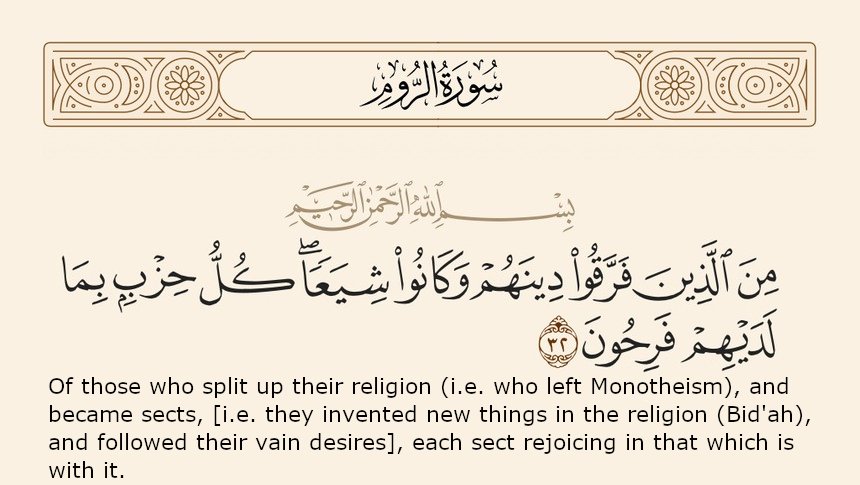
“Indeed, those who have divided their religion and become sects—you, [O Muhammad], are not [associated] with them in anything. Their affair is only [left] to Allah; then He will inform them about what they used to do.”
— Surah Al-An’am (6:159)
While differences of opinion exist on secondary matters of jurisprudence (fiqh), these do not constitute new religions or denominations in the way Christianity has fractured. The Quran remains unchanged and universally accepted by all Muslims. There is no equivalent to the Protestant Reformation, no multiple versions of the holy book, and no 35,000 different “Islams.”
The Prophet Muhammad ﷺ warned his followers:
“My ummah (community) will split into seventy-three sects, all of which will be in the Fire except one.” When asked which one, he said, “The one that follows what I and my companions are upon.”
— Narrated by Abu Dawud and At-Tirmidhi
This hadith emphasizes unity around the Quran and the authentic Sunnah (teachings) of the Prophet ﷺ. Although various groups emerged throughout Islamic history, the core religion remains unified, and the efforts to create permanent divisions have largely failed.
Muslims around the world—from Indonesia to Morocco, from Russia to South Africa—pray in the same direction (toward Mecca), perform the same rituals during Hajj, fast during the same month of Ramadan, and recite the same Quran in the same Arabic language. This unity, despite cultural and linguistic diversity, stands in remarkable contrast to the fragmentation seen in Christianity.








Be First to Comment