

The Mathematician Who Found God in Logic
“I was reading the Quran, I found it reading me” — Dr. Jeffrey Lang’s extraordinary journey from atheism to Islam
Imagine being so convinced there is no God that you build your entire worldview on His absence. Then imagine encountering a book that doesn’t just challenge your arguments — it anticipates them, answers them before you’ve even fully formed them, and somehow seems to be reading you while you’re reading it.
This is the story of Dr. Jeffrey Lang, Associate Professor of Mathematics at the University of Kansas, one of America’s most prestigious universities. A man whose mind was trained to accept only what could be proven through facts and figures. A mathematician who demanded concrete answers. An atheist who was conquered by a book.
The Rebellion of a Searching Mind
Born on January 30, 1954, in Bridgeport, Connecticut, Jeffrey Lang grew up in a devout Roman Catholic family. His first 18 years were spent entirely in Catholic schools — surrounded by rituals, doctrines, and teachings that were supposed to provide answers.
Instead, they left him with questions. Lots of them.
“Like most kids back in the late 60s and early 70s, I started questioning all the values that we had at those times — political, social, and religious. I rebelled against all the institutions that society held sacred, including the Catholic Church.”
The questions were the kind that millions ask but few get satisfactory answers to:
“If there is a God, and He is all merciful and all loving, then why is there suffering on this earth? Why does He not just take us to heaven? Why create all these people to suffer?”
When the Catholic Church couldn’t provide answers that satisfied his logical mind, Lang didn’t just drift away from religion. He actively rejected it. By age 18, he had become a full-fledged atheist.
Not the casual, indifferent kind. The convinced, argumentative, intellectual kind. The kind who has thought through his position and is prepared to defend it.
The Unexpected Encounter
Years later, as a young mathematics lecturer at San Francisco State University, Lang was living the life of a successful academic. His mind was occupied with equations, proofs, theorems — the clean, logical world of mathematics where everything had its place and every problem had a solution.
Then he met some Muslim students.
One in particular stood out: Mahmoud Qandeel, a regal-looking Saudi student who commanded attention the moment he walked into a room. When Lang posed a question about medical research, Qandeel answered in perfect English with remarkable self-assurance. He was the kind of person everyone knew — the mayor, the police chief, regular people on the street.
The professor and the student became friends. They went to the glittering places of San Francisco together — places where, as Lang would later describe, “there was no joy or happiness, only laughter.”
This wasn’t what Lang expected. He was used to religious people offering platitudes, emotional appeals, or the ultimate conversation-ender: “You just have to have faith.”
But these Muslim students were different. They engaged his questions. They took his doubts seriously. They responded with logic, reasoning, and intellectual depth.
Then, at the end of one of their conversations, Qandeel did something surprising: he gave Lang a copy of the Quran and some books on Islam.
The Book That Reads You
What happened next is one of the most remarkable conversion stories in modern times.
Lang, the skeptical mathematician, the committed atheist, the man who demanded facts and concrete answers, began reading the Quran. Alone. With no pressure, no proselytizing, no one watching over his shoulder.
And he discovered something that shook him to his core.
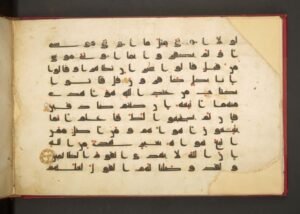
“Painters can make the eyes of a portrait appear to be following you from one place to another, but which author can write a scripture that anticipates your daily vicissitudes?… Each night I would formulate questions and objections and somehow discover the answer the next day. It seemed that the author was reading my ideas and writing in the appropriate lines in time for my next reading. I have met myself in its pages…”
Read that again. Let it sink in.
A book written 1,400 years ago was anticipating his objections. Answering questions he formulated in his mind the night before. Speaking directly to his doubts, his struggles, his intellectual challenges.
This wasn’t some vague spiritual feeling. This was a precise, repeatable experience. Night after night, he would think of objections. Day after day, he would find the answers in the next passages he read.
For a mathematician — a man trained to recognize patterns, to demand replicable results, to distinguish correlation from causation — this was undeniable.
He was being read by the book he was reading.
The Surrender of Logic
Lang found his way to the student-run prayer hall at the university. He began attending. Learning. Observing.
And then, without much struggle, without the dramatic crisis some conversions involve, he surrendered.
Not the surrender of defeat. The surrender of recognition. The surrender that comes when a mathematician finally sees the proof that’s been in front of him all along.
He was conquered by the Quran.
Lang’s journey demolishes the false dichotomy between faith and reason. He didn’t abandon his logical mind to embrace Islam — his logical mind led him to Islam. As he put it: “Having a mind that accepts ideas on their factual merit makes believing in a religion difficult because most religions require acceptance by faith. Islam appeals to man’s reasoning.”
Lang rebelled against Catholicism not because he was rebellious by nature, but because his sincere questions were met with inadequate answers. The Muslim students he encountered didn’t offer quick fixes or platitudes — they engaged his questions seriously, thoughtfully, intellectually. Sometimes the greatest service we can do for seekers is to take their doubts seriously.
A book revealed in 7th-century Arabia spoke directly to a 20th-century American mathematician’s specific objections and questions. This isn’t coincidence — it’s design. The Quran’s claim to be divine revelation finds evidence in its ability to address the unique challenges of every era and every individual who approaches it sincerely.
Mahmoud Qandeel didn’t argue Lang into Islam. He befriended him. They built a relationship. And within that relationship of trust and respect, Qandeel simply offered Lang the Quran — no pressure, no conditions. Sometimes the most effective da’wah (invitation to Islam) is simply being a good friend and trusting God to do the rest.
Lang now performs the five daily prayers regularly and finds profound spiritual satisfaction in them. He describes the Fajr (pre-dawn) prayer as “one of the most beautiful and moving rituals in Islam.” When asked how he finds Quranic recitation captivating despite not knowing Arabic, he responds: “Why is a baby comforted by his mother’s voice?” Practice creates experience. Ritual opens spiritual doors.
The Life After Surrender
Dr. Lang went on to earn his master’s and doctoral degrees from Purdue University. He became an Associate Professor at the University of Kansas. He serves as faculty advisor for the Muslim Student Association, helping Muslim students navigate American university culture while maintaining their Islamic identity.
But more importantly, he became a voice for intellectual Islam in America.
His books — particularly “Even Angels Ask: A Journey to Islam in America” — have become bestsellers in the Muslim community, not because they’re easy reads, but because they’re honest. They share the questions, the doubts, the struggles, and the insights of someone who came to Islam not from tradition or culture, but from genuine seeking.
And yet this man — this mathematician who needed concrete answers — found them in a faith that billions follow. Not despite his logical mind, but because of it.
The Deepest Question
When asked about the Quran being recited in Arabic — a language he doesn’t speak fluently — Dr. Lang’s response is both simple and profound:
“Why is a baby comforted by his mother’s voice?”
Think about that. A baby doesn’t understand the words. Doesn’t grasp the meaning of sentences. Doesn’t comprehend the grammar or syntax.
But the baby knows the voice. Recognizes it. Is comforted by it.
Because some connections transcend language. Some recognitions operate at a level deeper than vocabulary.
When the Quran says it comes from the Creator of humanity, perhaps what Lang discovered is that our souls recognize their Creator’s voice — even when our minds don’t yet understand all the words.
Dr. Jeffrey Lang’s story isn’t just about one man’s journey from atheism to Islam. It’s about the fundamental human search for meaning, the compatibility of faith and reason, and the power of approaching sacred texts with both sincerity and intellectual honesty.
He teaches us that the most profound questions deserve more than superficial answers. That doubt, honestly pursued, can lead to certainty. That intellectual rigor and spiritual depth are not opposites but partners.
Most importantly, he teaches us that the Quran’s claim to be divine revelation can withstand the most skeptical scrutiny — not by demanding blind faith, but by engaging the mind, addressing the questions, and revealing truths that transcend time and culture.
The mathematician who demanded concrete answers found them. The atheist who rejected easy platitudes discovered profound truth. The skeptic who insisted on logic encountered the Divine.
What if the book has been waiting to read you too?
Dr. Jeffrey Lang continues to teach, write, and inspire seekers of truth worldwide
His books remain essential reading for anyone exploring Islam through the lens of reason
















Be First to Comment