
The Most Losers in Deeds
A Divine Warning Against Self-Deception and the Peril of Good Intentions Built on False Foundations
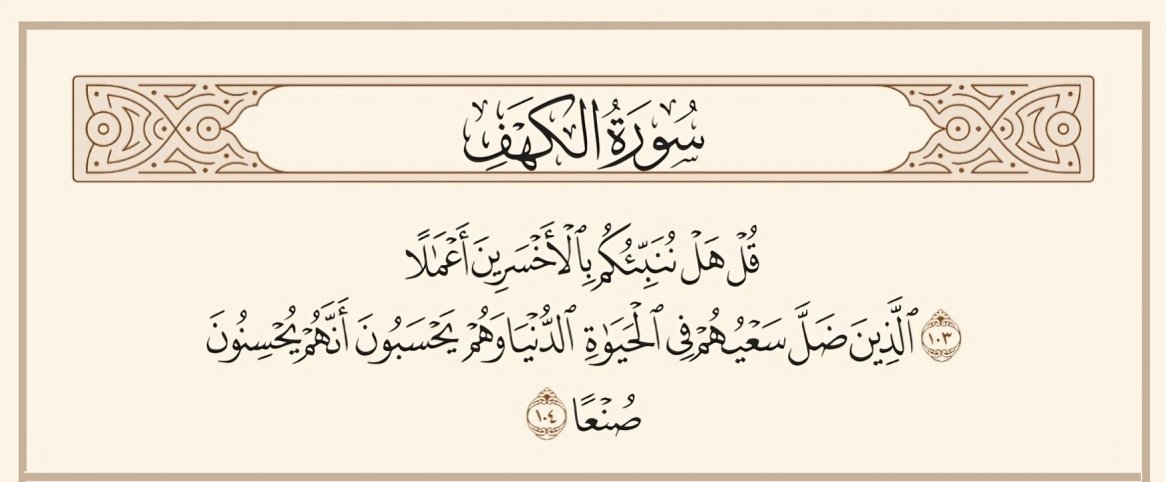
“Say, [O Muhammad], ‘Shall we inform you of the greatest losers as to [their] deeds? [They are] those whose effort is lost in worldly life, while they think that they are doing well in work. Those are the ones who disbelieve in the verses of their Lord and in [their] meeting Him, so their deeds have become worthless; and We will not assign to them on the Day of Resurrection any weight [or value].'”
— Surah Al-Kahf (18:103-105)
Among the most chilling verses in the entire Quran are these words from Surah Al-Kahf. Allah ﷻ does not simply warn us about wrongdoers who know they are doing wrong. Rather, He warns us about something far more dangerous: people who are convinced they are doing right, while in reality, their deeds are worthless.
This is perhaps the most terrifying position a human being can find themselves in—working hard, striving constantly, exhausting themselves in effort, all while thinking they are pleasing Allah, only to discover on the Day of Judgment that everything they did was in vain.
Understanding the Verse: A Deeper Look
Allah ﷻ begins with a question: “Shall we inform you of the greatest losers?” This is not a rhetorical flourish—it’s an invitation to pay close attention. What follows is crucial knowledge that every believer must internalize.
2. “While they think that they are doing well in work” — This is the key. They are not intentionally doing wrong. They genuinely believe they are doing good. They are self-deceived.
3. “Those are the ones who disbelieve… so their deeds have become worthless” — The root cause is revealed: disbelief in Allah’s signs and meeting Him. Without this foundation, no deed has value.
The verse concludes with the most devastating consequence: “We will not assign to them on the Day of Resurrection any weight.” No value. No recognition. No reward. Despite all their efforts, they arrive on Judgment Day with nothing.
The Danger of Self-Deception
One of the greatest trials of this life is that the human soul is capable of convincing itself of almost anything. We can rationalize our worst impulses. We can dress up our base desires in the clothing of righteousness. We can pursue our grudges while convincing ourselves we’re pursuing justice.
Consider the person who spends years criticizing others, calling it “enjoining good and forbidding evil.” But if you look closely, you’ll notice they only criticize people they dislike. They never offer advice to friends. They never correct themselves first. Their “righteousness” is just a socially acceptable way to express their resentment.
Or the person who claims to be “protecting Islam” by attacking other Muslims online, spreading rumors, destroying reputations. They convince themselves they’re defending the faith, when in reality, they’re just satisfying their ego and their need to feel superior.
Or the person who refuses to forgive family members, claiming “I have my principles.” But principles about what? About maintaining grudges? About nursing hurt feelings? About making sure everyone knows you were wronged?
Real-World Examples of Self-Deception
These are the people this verse warns about. They’re busy. They’re active. They might even be praying, fasting, giving charity. But the foundation is rotten—and a building on a rotten foundation will collapse, no matter how beautiful it looks from the outside.
The Divine Criterion: Intentions Matter
Here is the mercy of Allah ﷻ: He has not left us without a criterion. He hasn’t abandoned us to wander in confusion, never knowing if our deeds are accepted or rejected. He has given us a clear standard by which to judge ourselves.
“Actions are but by intentions, and every person shall have only what they intended. So whoever’s migration was for Allah and His Messenger, then his migration was for Allah and His Messenger. And whoever’s migration was for worldly gain or to marry a woman, then his migration was for that which he migrated.”
— Sahih al-Bukhari & Sahih Muslim
This hadith is so fundamental that Imam Ahmad ibn Hanbal said, “Islam revolves around three hadiths,” and this was one of them. Why? Because it reveals the secret that determines the value of every deed: intention.
Two people can do the exact same action—pray the same prayer, give the same amount in charity, fast the same days—and one person’s deed is accepted while the other’s is rejected. The difference? The purity of intention.
This is both liberating and terrifying. Liberating because it means people’s praise or criticism ultimately doesn’t matter—Allah sees the truth. Terrifying because it means you cannot fool Allah the way you fool yourself.
Watch Yourself: Self-Accountability
The verse and hadith together teach us something critical: we must become vigilant observers of our own hearts. We cannot simply assume our intentions are pure. We cannot take for granted that we’re doing good.
• Before you take a “principled stand,” ask: Is this really about principles, or about proving I’m right?
• Before you do a good deed publicly, ask: Would I still do this if no one would ever know?
• Before you refuse to forgive, ask: Is this really about justice, or about making them pay?
• Before you speak “the truth,” ask: Is this truth being spoken for Allah’s sake, or to wound?
This is hard work. It’s much easier to simply assume our intentions are good and move on. But that’s exactly the trap this verse warns against: thinking we’re doing well when we’re not.
The Companions understood this. Umar ibn al-Khattab رضي الله عنه used to say, “Take account of yourselves before you are taken to account.” And when Hudhayfah ibn al-Yaman رضي الله عنه was asked, “Who is a hypocrite?” he responded: “The one who describes Islam but doesn’t practice it, and the one who practices Islam but with corrupt intentions.”
The Blessing of Understanding: Not Everyone Receives It
Here is a profound reality that many overlook: reading is not the same as understanding. Recitation is not the same as reflection. Knowledge is not the same as wisdom.
Many people read this verse. They recite it in Surah Al-Kahf every Friday. The Arabic passes over their tongues beautifully. But they never pause to understand it. They never allow it to penetrate their hearts. They never apply it to themselves.
They read about “those who think they are doing good while their deeds are lost”—and immediately think of others. They think of non-Muslims, of misguided sects, of people they disagree with. It never occurs to them that this verse might be about them.
1. The blessing of learning Arabic — They can understand the Quran in its original language, catching nuances that translations miss.
2. The blessing of understanding — Not just reading, but comprehending. Not just hearing, but absorbing. Not just memorizing, but internalizing.
3. The blessing of watchfulness (muraqabah) — The ability to observe their own hearts, to catch themselves in moments of self-deception, to remain vigilant against the tricks of the nafs.
4. The blessing of fear (khashyah) — A healthy, productive fear of Allah’s judgment that motivates them to constantly purify their intentions and improve their character.
These blessings don’t always come together. You can know Arabic but lack understanding. You can understand intellectually but lack the watchfulness to apply it to yourself. You can be watchful but lack the fear that drives you to change.
When Allah grants all these blessings together, that person has been given a tremendous gift. They read the Quran and see themselves in its warnings. They hear a verse about self-deception and immediately check their own hearts. They understand that every verse is a mirror, not a window—it’s meant to show them their own flaws, not others’.
“We were given the Quran and we recite it and we know. There will come people after you who recite the Quran but it does not pass beyond their throats.”
— Sahih al-Bukhari
What did he mean? He meant that recitation without reflection is hollow. The Quran enters through the mouth and exits through the mouth, never touching the heart, never changing the character, never transforming the soul.
But when Allah blesses someone with understanding and watchfulness and fear, the Quran becomes something else entirely. It becomes a living guide, a constant companion, a mirror that shows the truth even when we’d rather not see it.
The Path Forward: Purifying Intentions
So what do we do with this knowledge? How do we ensure we’re not among “the greatest losers in deeds”? How do we make sure our efforts are not wasted?
The answer lies in constant, honest self-examination and sincere du’a to Allah.
This verse from Surah Al-Kahf is not meant to paralyze us with fear or make us doubt every good deed. Rather, it’s meant to make us careful, thoughtful, and humble.
It teaches us that good actions are not enough—we must also have good foundations. Pure intentions are not luxuries; they’re necessities. Without them, all our striving is like building a magnificent palace on quicksand.
Allah has given us the tools to avoid this fate: His clear criterion in the hadith about intentions, the blessing of understanding His words, the gift of self-awareness, and the mercy of being able to constantly renew our intentions and seek His forgiveness.
The question is: Will we use these tools? Or will we be among those who read but don’t understand, who recite but don’t reflect, who worship but with impure intentions?
May Allah ﷻ protect us from self-deception. May He purify our intentions and accept our deeds. May He bless us with understanding, watchfulness, and a healthy fear that drives us toward Him. And may we never be among those whose efforts are wasted while they think they are doing well.
Ameen.









Be First to Comment