
The Hadith of the Heart
Navigating Between the Lawful and Unlawful
Among the most comprehensive and profound teachings of the Prophet Muhammad ﷺ is a hadith that serves as a complete moral and spiritual compass for every believer. It is a hadith that addresses the very foundation of Islamic law, the psychology of temptation, and the centrality of the heart in all matters of faith and action.
An-Nu’man ibn Bashir reported that the Messenger of Allah ﷺ said: “What is lawful is clear and what is unlawful is clear, but between them are certain doubtful things which many people do not recognize. He who guards against doubtful things keeps his religion and his honor blameless, but he who falls into doubtful things falls into what is unlawful, just as a shepherd who pastures his animals round a preserve will soon pasture them in it. Every king has a preserve, and God’s preserve is the things He has declared unlawful. In the body, there is a piece of flesh; if it is sound, the whole body is sound, and if it is corrupt, the whole body is corrupt. It is the heart.”
— Narrated by Al-Bukhari and Muslim
The Three Zones of Islamic Law
The Prophet ﷺ begins by establishing a fundamental framework for understanding Islamic legislation. He divides all matters into three distinct categories, each with its own characteristics and rulings.
The Clearly Lawful
The Doubtful Matters
The Clearly Unlawful
The beauty of this categorization is that it acknowledges the reality of Islamic law: most things are clear. The vast majority of what is halal is obvious, and the vast majority of what is haram is obvious. This prevents both extremes—those who make everything forbidden and those who make everything permissible.
“O mankind, eat from whatever is on earth that is lawful and good and do not follow the footsteps of Satan. Indeed, he is to you a clear enemy.”
— Surah Al-Baqarah (2:168)
Understanding the Doubtful Matters (المشتبهات)
The middle category—the doubtful matters—is where the hadith’s wisdom becomes most apparent. These are not matters that are inherently unclear in Islamic law, but rather matters that many people do not recognize due to lack of knowledge or understanding.
A matter becomes doubtful when there is conflicting evidence, when the texts are not explicit, when scholars differ in interpretation, or when the circumstances surrounding it are unclear. For example, a business transaction might involve elements that are unclear—is this interest or legitimate profit? A social gathering might have both permissible and impermissible elements—should one attend or avoid?
The Prophet’s statement that “many people do not recognize them” is crucial. It means that these matters are not doubtful to everyone—scholars and those with deep knowledge may know their exact ruling. But for the average person, they present genuine uncertainty.
The Path of Caution: Guarding Against Doubtful Things
The Prophet ﷺ then provides clear guidance on how to deal with these doubtful matters:
This statement introduces the Islamic principle of الورع (al-wara’)—cautious piety or scrupulousness. It means avoiding what is doubtful out of fear of falling into what is forbidden.
The hadith mentions that avoiding doubtful matters protects two precious things:
1. Your Religion (دينه): By staying away from doubtful matters, you ensure that your worship and obedience to Allah remain pure and uncontaminated by potential sin. Your relationship with Allah stays clean.
2. Your Honor (عرضه): Your reputation among people remains unblemished. When you avoid doubtful matters, people cannot accuse you of wrongdoing, and you maintain your dignity and standing in the community.
“And whoever fears Allah—He will make for him a way out and will provide for him from where he does not expect.”
— Surah At-Talaq (65:2-3)
The Danger of Approaching the Forbidden
The hadith continues with a stark warning about the opposite behavior:
“He who falls into doubtful things falls into what is unlawful, just as a shepherd who pastures his animals round a preserve will soon pasture them in it.”
This metaphor is profound and psychologically astute. The Prophet ﷺ compares someone who engages in doubtful matters to a shepherd grazing his flock near a protected royal preserve. The closer the shepherd allows his animals to graze to the boundary, the more likely they are to cross into the forbidden territory.
This is a universal truth about human behavior: when you consistently operate near a boundary, you will eventually cross it. The person who watches questionable content will eventually watch forbidden content. The person who engages in flirtatious conversations will eventually cross into inappropriate relationships. The person who takes money from doubtful sources will eventually take from clearly forbidden ones.
The metaphor teaches us that proximity breeds familiarity, and familiarity breeds transgression. The more comfortable you become with approaching the line, the easier it becomes to cross it.
Islamic scholars explain this hadith by noting that sins rarely happen in isolation. A person doesn’t suddenly commit a major sin without having normalized smaller transgressions first. The path to the clearly forbidden is paved with indulgence in the doubtful. This is why the Prophet ﷺ emphasizes creating distance between yourself and potential sin, not just avoiding the sin itself.
The Divine Preserve: Understanding Allah’s Boundaries
The hadith continues with another powerful metaphor:
“Every king has a preserve, and God’s preserve is the things He has declared unlawful.”
In ancient Arabia (and throughout history), kings would designate certain lands as حمى (hima)—a protected reserve where no one was allowed to graze animals or take resources. These were inviolable zones, protected by the king’s authority.
The Prophet ﷺ uses this familiar concept to explain that Allah, as the ultimate King and Sovereign, has His own sacred preserve: the things He has forbidden. Just as no one would dare violate a king’s preserve without facing consequences, we should never violate Allah’s prohibitions.
“These are the limits [set by] Allah, so do not transgress them. And whoever transgresses the limits of Allah—it is those who are the wrongdoers.”
— Surah Al-Baqarah (2:229)
The comparison is meant to inspire both reverence and caution. If people respected the boundaries of earthly kings out of fear of worldly punishment, how much more should we respect the boundaries of the King of Kings, whose knowledge encompasses all things and whose justice is perfect?
The Heart: The Master of the Body
The hadith reaches its profound conclusion with one of the most important statements in Islamic spirituality:
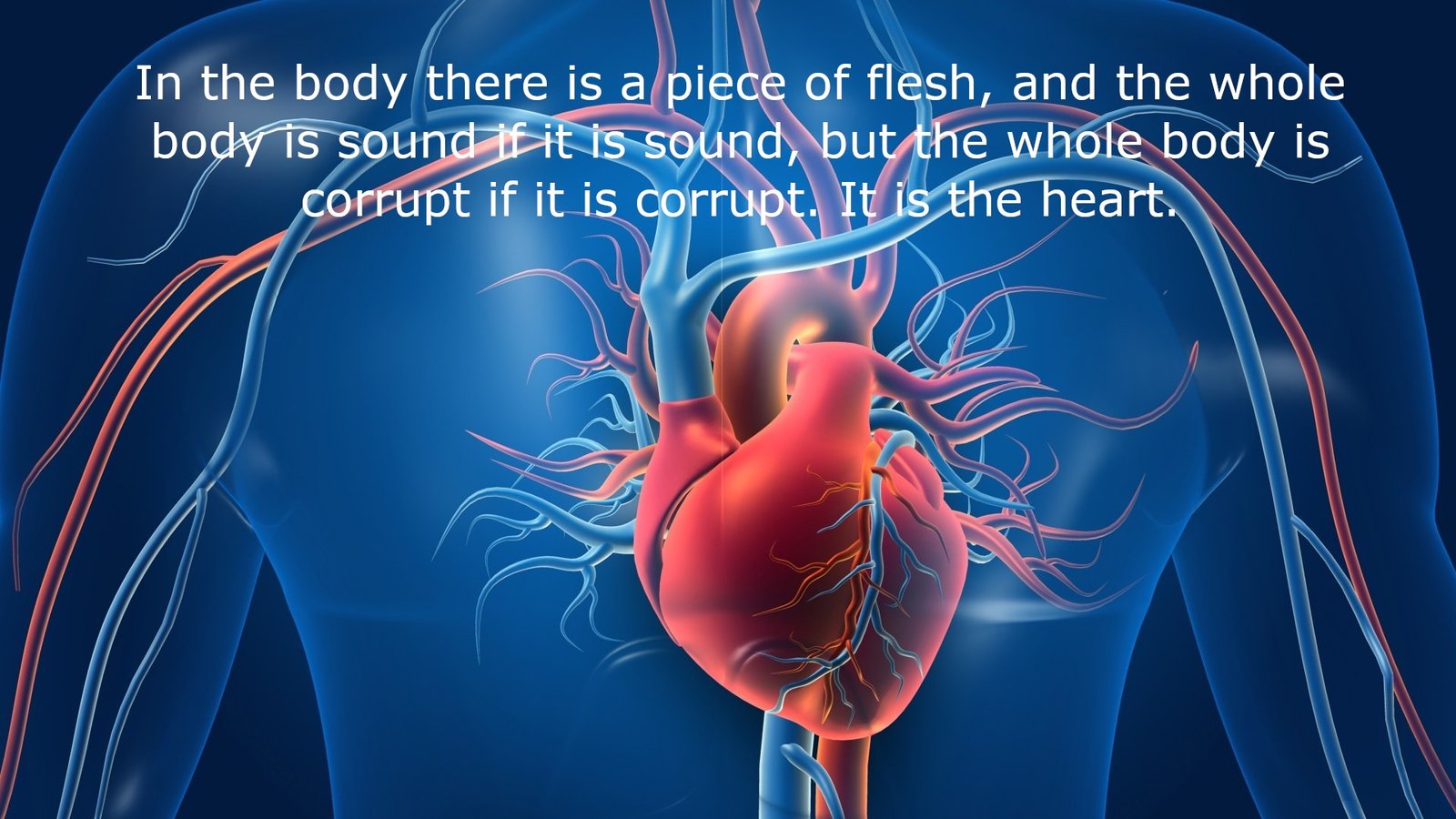
“In the body there is a piece of flesh; if it is sound, the whole body is sound, and if it is corrupt, the whole body is corrupt. It is the heart.”
This concluding statement reveals the central importance of the heart in Islamic thought. The Arabic word used is مضغة (mudghah), which literally means “a morsel of flesh” or “a piece of meat the size of what can be chewed.” This small description emphasizes how relatively tiny the physical heart is compared to the rest of the body, yet how absolutely central it is to everything.
The Prophet ﷺ is teaching us that the heart is the command center of human behavior. It is not merely an organ that pumps blood, but the spiritual core that determines the state of everything else. When the heart is sound—filled with faith, sincerity, love of Allah, and consciousness of Him—the entire person becomes sound. Their actions, words, intentions, and character all reflect this inner purity.
Conversely, when the heart is corrupt—filled with doubt, hypocrisy, love of sin, or heedlessness of Allah—the entire person becomes corrupt. No matter how outwardly righteous they may appear, if the heart is diseased, the corruption will eventually manifest in their actions.
This final part of the hadith ties everything together. Why should we avoid doubtful matters? Why should we stay far from the boundaries of the forbidden? Because these external actions directly affect the internal state of the heart. Every time we indulge in something doubtful, we weaken the heart’s resistance to sin. Every time we approach forbidden boundaries, we harden the heart’s sensitivity to Allah’s limits.
“The Day when there will not benefit [anyone] wealth or children, but only one who comes to Allah with a sound heart.”
— Surah Ash-Shu’ara (26:88-89)
On the Day of Judgment, the only thing that will matter is the state of your heart. Not your wealth, not your achievements, not your appearance—only whether you come before Allah with a قلب سليم (qalb saleem)—a sound, pure, sincere heart.
Practical Applications of This Hadith
When considering a business deal or source of income, ask yourself: Is this clearly halal? If there’s any doubt—unclear contract terms, questionable business practices, potential riba (interest), or dubious sources—then apply the principle of this hadith and avoid it. The temporarily lost profit is nothing compared to the protection of your religion and honor. Many Muslims have found that when they refused doubtful income, Allah opened doors to clearly halal and more blessed sustenance.
In interactions with the opposite gender, the principle of avoiding doubtful matters is crucial. While Islam permits necessary and respectful professional or educational interactions, any situation that creates privacy, involves inappropriate conversation, or blurs Islamic boundaries falls into the doubtful category. The person who maintains strict boundaries protects their religion and honor, while the one who says “we’re just friends” or “it’s innocent” is grazing near the preserve and will likely fall into the forbidden.
The content we consume has a direct effect on our hearts. If you’re watching something and feel uncertain about whether it’s appropriate—maybe it has some good content but also includes music, immodesty, or questionable themes—this hadith guides you to avoid it. The temporary entertainment is not worth the potential corruption of the heart. Choose clearly halal content, and when in doubt, abstain.
When you’re unsure about the source of meat (is it truly halal?), or about food that may contain doubtful ingredients, or about whether a restaurant maintains proper halal standards—apply this principle. It’s better to eat something simple and clearly permissible than to consume what is doubtful and risk consuming the forbidden.
Even in worship, this principle applies. If you’re uncertain about the validity of a particular practice, or about whether something is from the Sunnah or an innovation, pause and seek knowledge. Don’t rush into worship practices without clarity, as sincerity in worship requires both good intention and correct form.
The Balance: Not Becoming Extreme
It is important to note that this hadith does not call for obsessive doubt about everything or for making life unnecessarily difficult. The Prophet ﷺ clearly stated that what is halal is clear and what is haram is clear—these form the vast majority of life’s matters.
The First Extreme: Making everything halal and ignoring Islamic boundaries entirely, following desires without regard for Allah’s limits. This is the path of the heedless.
The Second Extreme: Making everything haram, seeing doubt in every matter, and becoming paralyzed by excessive scrupulosity. This is not what Islam requires and leads to unnecessary hardship.
The balanced path is to have knowledge of what is clearly permitted and forbidden, to avoid what is doubtful when you encounter it, and to seek authentic knowledge when needed. Trust in the clarity of Islamic law while exercising appropriate caution.
“Allah intends for you ease and does not intend for you hardship.”
— Surah Al-Baqarah (2:185)
Purifying the Heart: The Ultimate Goal
The hadith’s emphasis on the heart reminds us that Islamic practice is not merely about external compliance with rules, but about internal transformation and purification.
1. Constant Remembrance of Allah (Dhikr): The heart becomes sound through continuous connection with Allah. Regular remembrance, prayer, and Quran recitation polish the heart and remove its impurities.
2. Avoiding Sin and Doubtful Matters: As this hadith teaches, protecting the heart requires avoiding not just the forbidden but also the doubtful.
3. Keeping Good Company: Your heart is influenced by those around you. Righteous companionship strengthens the heart while bad company corrupts it.
4. Regular Self-Accounting (Muhasabah): Taking time to reflect on your intentions, actions, and the state of your heart helps you identify and address spiritual diseases before they take root.
5. Sincere Repentance (Tawbah): When you do fall into error, immediately return to Allah with sincere repentance. This keeps the heart soft and responsive to guidance.
“Those who have believed and whose hearts are assured by the remembrance of Allah. Unquestionably, by the remembrance of Allah hearts are assured.”
— Surah Ar-Ra’d (13:28)
Conclusion: Living by This Comprehensive Guidance
This single hadith contains complete guidance for living an Islamic life. It teaches us:
The Structure of Islamic Law: Three clear categories that cover all of life’s matters.
The Principle of Caution: Avoiding doubtful matters protects both your faith and your reputation.
The Psychology of Sin: Proximity to forbidden things leads inevitably to transgression.
The Reality of Divine Authority: Allah’s boundaries are sacred and inviolable.
The Centrality of the Heart: Everything depends on the state of this small piece of flesh.
When you encounter any situation in life, run it through the framework of this hadith:
Is this clearly halal? Then proceed with gratitude to Allah for His bounty.
Is this clearly haram? Then avoid it completely, no matter the temptation.
Is this doubtful? Then err on the side of caution and avoid it, protecting your religion and honor.
How will this affect my heart? Will it bring me closer to Allah or distance me from Him?
“So whoever does an atom’s weight of good will see it, and whoever does an atom’s weight of evil will see it.”
— Surah Az-Zalzalah (99:7-8)
Every choice matters. Every decision to avoid the doubtful is a brick in the fortress protecting your heart. Every moment of caution is an investment in the soundness of your religion and the purity of your standing before Allah.
May Allah grant us sound hearts, protect us from the doubtful and the forbidden, and allow us to live within the clear boundaries of what He has made lawful. May He make us among those who guard their religion and honor by avoiding what is uncertain, and may He purify our hearts so that we may meet Him with قلب سليم—a sound and sincere heart.







Be First to Comment