
When Family Becomes a Test
Understanding the Divine Warning in Surah At-Taghabun
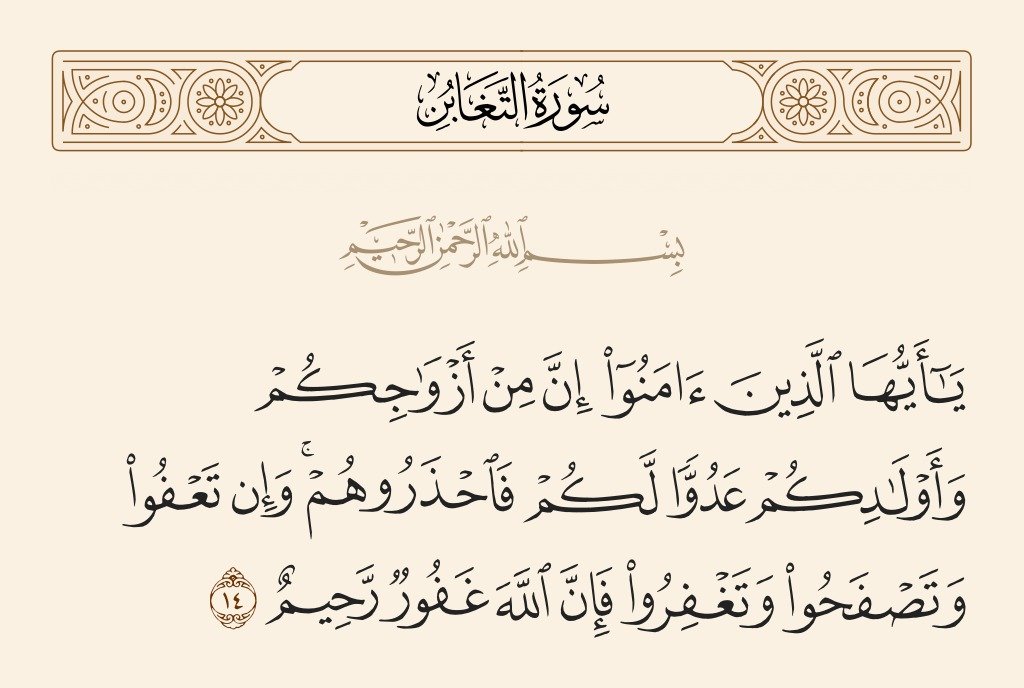
“O you who believe! Indeed, among your spouses and your children are enemies to you, so beware of them. But if you pardon, overlook, and forgive, then indeed Allah is Forgiving and Merciful.”
— Surah At-Taghabun (64:14)
🎵 Listen to the Quranic Recitation
Upload your MP3 recitation file to replace the placeholder
In this profound verse from Surah At-Taghabun, Allah Almighty calls upon the believers with a warning that may initially seem startling. How could our beloved spouses and children, those closest to our hearts, be described as potential adversaries? This divine guidance carries depths of wisdom that deserve our careful contemplation and understanding.
The Nature of This Test
The Arabic word used in this verse, “عَدُوًّا” (enemy or adversary), should not be understood in its literal or physical sense. Rather, it refers to a profound spiritual reality: our families can become obstacles on our path to Allah when they inadvertently or deliberately turn us away from righteousness and the fulfillment of our duties toward our Creator.
This adversarial relationship can manifest in several ways, each representing a unique trial for the believer’s faith and commitment to divine guidance.
First Form: The Test of Trust in Allah’s Provision
Wives and children represent responsibilities that Allah has entrusted to the believer. These responsibilities, while sacred and beloved, can sometimes become barriers to acts of worship and charity. A believer may decide to give charity or volunteer for a noble cause, but then hesitates, fearing that his wealth might not suffice for his family’s needs, or feeling that his family requires the money more urgently.
In both scenarios, we witness the believer’s faith being tested and, unfortunately, tarnished by incomplete trust in Allah, the Sustainer Himself, the Provider Who originally granted the wealth. The believer has forgotten a fundamental principle: Allah is Ar-Razzaq, the Provider, and He will never let those who trust in Him down.
When family considerations prevent us from fulfilling our obligations to Allah, we have allowed our loved ones to become adversaries to our spiritual growth, albeit unintentionally. This is precisely what the verse warns against.
Second Form: Active Resistance to Good Deeds
Another manifestation of this test occurs when family members actively resist or discourage the believer from performing righteous deeds. This can take many forms. They may express opposition to charitable giving, volunteering for community service, or dedicating time to acts of worship. Their resistance often comes wrapped in seemingly rational arguments and genuine concern.
Family members might argue that the charity will go to waste, that the person or community receiving help is actually wealthy and doesn’t truly need assistance, or that the believer’s time and resources would be better spent on the family itself. While these concerns may appear valid on the surface, they can become tools that distance the believer from earning Allah’s pleasure and performing obligations.
I have witnessed this firsthand in my own life and in the lives of many fellow believers. The true believer often faces resistance from their own household whenever they wish to do something purely for the sake of Allah. This resistance, whether born of genuine concern or worldly attachment, can become a significant obstacle on the path of righteousness.
Third Form: Encouragement Toward Wrongdoing
Perhaps the most dangerous manifestation occurs when family members, instead of advising against evil deeds and bad actions, actively support and encourage the believer in their wrongdoing. Rather than serving as a moral compass pointing toward righteousness, they become accomplices in sin, continuously encouraging more transgressions.
This phenomenon is not new to Islamic history. During the Battle of Uhud, when the disbelievers marched against the Muslims, they brought their wives with them for a specific purpose. These women were not merely passive observers; they actively encouraged the men to fight against the believers and harm the Messenger of Allah, may peace and blessings be upon him.
According to Islamic historical records, the Qurayshi women, led by Hind bint ‘Utbah (the wife of Abu Sufyan), participated actively in the Battle of Uhud. They wandered among the rows of the disbelievers, striking their drums and reciting poetry to inflame the warriors’ emotions and encourage them to fight fiercely against the Muslims. Their role was specifically designed to bolster the morale of the fighters and push them toward greater aggression against the believers.
This historical example illustrates how family members can become instruments that lead one further into wrongdoing rather than toward repentance and righteousness. When those closest to us fail to advise us against our mistakes and instead cheer us on in our transgressions, they have indeed become adversaries to our spiritual well-being and eternal success.
The Divine Balance: Warning and Mercy
What makes this verse particularly beautiful is how it balances the warning with guidance on how to respond. After cautioning believers about this potential test, Allah immediately provides the solution: “But if you pardon, overlook, and forgive, then indeed Allah is Forgiving and Merciful.”
The verse teaches us to be aware of these challenges without becoming harsh or severe toward our families. We are instructed to maintain our faith and fulfill our obligations to Allah while treating our loved ones with kindness, patience, and forgiveness. This balance reflects the comprehensive nature of Islamic guidance, which never demands that we choose between our duties to Allah and our responsibilities toward our families, but rather shows us how to fulfill both with wisdom and grace.
Classical Islamic scholars have emphasized that believers, particularly in the early days of Islam, faced unique challenges when their family members remained in disbelief or actively opposed their faith. The guidance in this verse, along with similar teachings in other parts of the Quran, instructs believers to maintain their faith firmly while treating their families with gentleness and compassion.
This approach serves multiple purposes. First, it keeps the door to the family members’ reformation and guidance perpetually open. Harshness and severity would close these doors forever. Second, it prevents negative perceptions of Islam in the broader community, demonstrating that embracing faith doesn’t make one harsh or unreasonable toward their own family. Third, it reflects the mercy and balance that characterize true Islamic teachings.
Scholarly Insights on This Verse
According to classical tafsir (Quranic exegesis), this verse carries two primary meanings. The first, as we have discussed, relates to the difficulties many believing men face from their wives and children, and women from their husbands and children, in following the path of Allah. It is indeed rare in this world to find complete harmony where spouses are full companions and helpers in matters of faith and righteousness, and where children bring comfort to their parents’ eyes in terms of faith, deeds, morals, and conduct.
The second meaning relates specifically to the historical context of early Muslims who faced pressure from their family members to abandon their faith. This pressure could come from parents who remained disbelievers, or from spouses and children who persisted in unbelief and actively worked to force the believer to abandon the truth.
This warning is reinforced by the verse that immediately follows: “Your wealth and your children are only a fitnah (trial), whereas Allah, with Him is a great reward” (64:15). This reminder places the test in proper perspective: our families and wealth are temporary trials in this worldly life, but with Allah lies the eternal reward that far surpasses any worldly attachment.
Practical Guidance for Modern Believers
How should contemporary Muslims apply this divine guidance in their daily lives? The answer lies in developing a balanced approach that honors both our duties to Allah and our responsibilities toward our families.
Believers must remain constantly aware of these potential tests. When family concerns begin to prevent acts of worship or charity, when loved ones actively discourage righteous deeds, or when they encourage wrongdoing, we must recognize these as the trials mentioned in this verse. This recognition is the first step toward overcoming the challenge.
We must continuously work to strengthen our tawakkul (trust in Allah). When we truly internalize that Allah is Ar-Razzaq, that He is the one who provides for us and our families, it becomes easier to give in charity and serve the community without fear that our resources will be depleted. The Provider who gave us what we have will continue to provide.
When family members discourage us from good or encourage us toward evil, we must respond with gentle firmness. We should explain our positions with wisdom and kindness, but never compromise our commitment to what is right. This approach, modeled after the Prophet’s own dealings with his family and community, maintains relationships while preserving our faith and principles.
The best way to guide our families is through our own example. When they see the peace, contentment, and blessings that come from living according to Allah’s guidance, when they witness the positive outcomes of trust in Allah and commitment to good deeds, they are more likely to support rather than oppose our spiritual journey.
The Call to Higher Consciousness
Ultimately, this verse from Surah At-Taghabun serves as a call to higher consciousness and awareness. It reminds us that the greatest test in life is not from external enemies but often from those we hold dearest. Our families, through no malicious intent, can become obstacles on our path to Allah when we allow worldly concerns and emotional attachments to override our spiritual obligations.
However, the verse also provides the cure: awareness coupled with pardon, overlooking faults, and forgiveness. We are not called to abandon our families or treat them harshly. Rather, we are instructed to navigate this delicate balance with wisdom, maintaining our commitment to Allah while treating our loved ones with the compassion and mercy that Allah Himself shows to His servants.
This divine guidance reflects the perfect wisdom of our Creator, who knows the trials we face and provides us with both the warning and the solution. May Allah grant us the strength to remain steadfast in our faith, the wisdom to navigate these family trials with grace, and the ability to be a source of guidance rather than an obstacle for those we love. May He make our families a source of comfort in this life and companions in the eternal gardens of Paradise.
The following verse (64:16) provides the practical conclusion to this guidance: maintaining consciousness of Allah to the best of our ability, listening to and obeying divine guidance, and spending in charity despite our attachment to wealth and family. Those who overcome their own selfishness and the pull of worldly attachments are the ones who achieve true success, both in this life and the hereafter.









Be First to Comment