

Prophet Zakariyah (Zachary)
Peace Be Upon Him – A Story of Unwavering Faith and Miraculous Answered Prayer
Prophet Zakariyah (Zachary), peace be upon him, holds a special place in Islamic tradition as one of the honored prophets sent to the Children of Israel. His story, beautifully narrated in the Qur’an, is one of unwavering faith, patient endurance, profound devotion, and the miraculous power of Allah. In Islam, Zakariyah is revered not only as a prophet but also as a righteous guardian, a devoted worshipper, and a man whose desperate prayers to Allah were answered in the most extraordinary way.
The Status of Prophets in Islam
Before delving into Zakariyah’s story, it is essential to understand how Islam views prophets. In Islamic belief, prophets and messengers are the best of creation, chosen by Allah from among the best of their people and from the noblest lineages. They are protected (ma’ṣūmūn) from major sins and moral transgressions, making them perfect models for humanity to follow.
“Allah knows best where to place His message.”
— Qur’an 6:124
Prophets are tested and tried, but they remain steadfast. They may face hardship, persecution, and rejection, but they never waver in their devotion to Allah or compromise their moral integrity. They do not commit adultery, idolatry, oppression, or any act that would undermine their reliability as guides for humanity.
Prophet Zakariyah exemplifies all these qualities. He was from a distinguished priestly lineage among the Children of Israel, known for his piety, scholarship, and devotion to the worship of Allah. The Qur’an describes him as one who:
“…used to hasten to good deeds and call upon Us in hope and fear, and he was humbly submissive to Us.”
— Qur’an 21:90
Who Was Prophet Zakariyah?
Zakariyah was a prophet sent to the Children of Israel during a time when faith had weakened among them. He served as a priest in the Temple in Jerusalem (Bayt al-Maqdis), dedicating his life to worship, teaching, and guiding his people back to the path of Allah. Islamic tradition identifies him as a carpenter by trade, earning his livelihood through honest labor while simultaneously carrying out his prophetic mission.
The Qur’an mentions him by name in several chapters, always with honor and respect. His lineage is noble—according to Islamic sources, he was a descendant of the prophets of Israel, carrying forward the message of monotheism (tawḥīd) that had been preached by all prophets before him.
Zakariyah’s life was marked by devotion and service. He spent his days and nights in the Temple, leading prayers, reciting scripture, and calling people to worship Allah alone. Despite his advanced age and the trials he faced, he remained patient, hopeful, and deeply connected to his Lord.
Zakariyah and Maryam (Mary): The Story of Guardianship
One of the most beautiful aspects of Zakariyah’s story is his relationship with Maryam (Mary), the mother of Prophet ‘Īsā (Jesus), peace be upon them both. The Qur’an dedicates an entire chapter to Maryam (Surah 19) and mentions her story in Surah Āl ‘Imrān (Chapter 3), where Zakariyah’s role as her guardian is detailed.
The story begins with Maryam’s mother, Hannah (the wife of ‘Imrān), who had been barren for many years. She prayed earnestly to Allah for a child and vowed that if Allah granted her request, she would dedicate the child to the service of Allah in the Temple. Allah accepted her prayer, and she became pregnant. However, she had expected a son, as only males typically served in the Temple.
When she gave birth to a daughter, she said:
“My Lord, I have delivered a female… And the male is not like the female. And I have named her Maryam, and I seek refuge for her in You and her descendants from Satan, the expelled [from the mercy of Allah].”
— Qur’an 3:36
Allah responded to her supplication with mercy and acceptance:
“So her Lord accepted her with good acceptance and caused her to grow in a good manner and put her in the care of Zakariyah.”
— Qur’an 3:37
According to Islamic tradition, there was a dispute among the priests and scholars of the Temple about who would have the honor of caring for Maryam, as she came from a noble and righteous family. The matter was settled by drawing lots (a form of casting lots to determine divine will), and Zakariyah was chosen. Some narrations suggest that Zakariyah, being married to Maryam’s maternal aunt, had a family connection that made him a natural guardian.
Zakariyah took his responsibility seriously, providing Maryam with a private chamber (miḥrāb) in the Temple where she could worship Allah in seclusion and purity. What happened next astonished him and became a turning point in his own life.
“Every time Zakariyah entered upon her in the prayer chamber, he found with her provision. He said, ‘O Maryam, from where is this [coming] to you?’ She said, ‘It is from Allah. Indeed, Allah provides for whom He wills without account.'”
— Qur’an 3:37
The provision (rizq) mentioned here refers to food—specifically, fruits and sustenance that were out of season or not available in that region. Zakariyah would enter her chamber and find summer fruits in winter and winter fruits in summer, clear signs of Allah’s miraculous provision for His devoted servant.
This realization sparked a desperate, heartfelt prayer that would change his life forever.
The Prayer for a Child: Zakariyah’s Desperate Supplication
The context of Zakariyah’s prayer is crucial. He was an old man—the Qur’an describes him as having “weakened bones” and “hair turned white.” His wife was barren and had never borne children. By all human standards, the possibility of having a child was impossible. Yet Zakariyah had witnessed Allah’s power in providing miraculously for Maryam, and his faith in Allah’s ability to do the impossible was strengthened.
The most detailed account of Zakariyah’s prayer appears in Surah Maryam. This prayer is a masterpiece of sincere supplication, demonstrating the proper etiquette of making du’ā (supplication) to Allah.
“Kaf, Ha, Ya, ‘Ayn, Sad. [This is] a mention of the mercy of your Lord to His servant Zakariyah. When he called to his Lord a private supplication. He said, ‘My Lord, indeed my bones have weakened, and my head has filled with white, and never have I been in my supplication to You, my Lord, unhappy. And indeed, I fear the successors after me, and my wife has been barren, so give me from Yourself an heir who will inherit me and inherit from the family of Ya’qūb. And make him, my Lord, pleasing [to You].'”
— Qur’an 19:1-6
Analysis of Zakariyah’s Prayer
Zakariyah prayed in secret, in the depths of the night, with humility and sincerity. He did not make a public display of his need but turned to Allah in private, demonstrating the Islamic principle that the most sincere prayers are those made in secret, away from the eyes of people.
Zakariyah honestly acknowledged his physical condition. He was old and frail. This was not a complaint but a humble admission of his human weakness, recognizing that only Allah’s power could overcome such limitations.
Despite his old age and his wife’s barrenness, Zakariyah had never lost hope in Allah. Throughout his life, Allah had always answered his prayers, and he trusted that Allah would answer this one too. This is a profound statement of faith and gratitude.
Zakariyah was concerned about who would continue his prophetic mission after his death. He feared that those who would come after him might not uphold the religion properly or might corrupt the message. He wanted a righteous heir who would carry on the work of calling people to Allah.
Another honest acknowledgment of the impossibility of the situation from a human perspective. His wife had never been able to conceive, and now they were both elderly.
Notice the phrasing—”from Yourself.” Zakariyah was not asking for an ordinary child through ordinary means. He was asking for a miraculous gift directly from Allah, a child that would be a sign of Allah’s power.
Zakariyah wanted a child who would inherit his knowledge, his prophethood, and his mission—not worldly wealth, but spiritual legacy. He also wanted this child to be from the blessed lineage of Ya’qūb (Jacob), continuing the prophetic tradition.
Above all, Zakariyah wanted a righteous son who would be pleasing to Allah, not just a biological heir.
The prayer is also mentioned more briefly in other chapters of the Qur’an:
“At that, Zakariyah called upon his Lord, saying, ‘My Lord, grant me from Yourself a good offspring. Indeed, You are the Hearer of supplication.'”
— Qur’an 3:38
“And [mention] Zakariyah, when he called to his Lord, ‘My Lord, do not leave me alone [with no heir], while You are the best of inheritors.'”
— Qur’an 21:89
This last version highlights Zakariyah’s acknowledgment that ultimately, Allah is the best of inheritors—meaning that even if he had no biological heir, Allah would take care of everything. Yet he still hoped for a child who could continue his mission.
Allah’s Response: The Miraculous Announcement
Allah’s response to Zakariyah’s prayer was swift, merciful, and miraculous. The Qur’an describes the moment of glad tidings:
“‘O Zakariyah, indeed We give you good tidings of a boy whose name will be Yaḥyā. We have not assigned to any before him [this] name.’ He said, ‘My Lord, how will I have a boy when my wife has been barren and I have reached extreme old age?’ [An angel] said, ‘Thus [it will be]; your Lord says, “It is easy for Me, for I created you before, while you were nothing.”‘”
— Qur’an 19:7-9
Surah Āl ‘Imrān provides additional details about how the announcement came:
“So the angels called him while he was standing in prayer in the chamber, ‘Indeed, Allah gives you good tidings of Yaḥyā, confirming a word from Allah and [who will be] honorable, abstaining [from women], and a prophet from among the righteous.'”
— Qur’an 3:39
The angels themselves delivered the news while Zakariyah was in the midst of prayer, emphasizing the sacred nature of this moment. The child was described with remarkable qualities even before his birth:
Yaḥyā (John): A name that had never been given to anyone before
Confirming a word from Allah: He would confirm and support ‘Īsā (Jesus), who is described as “a word from Allah”
Honorable (sayyid): Noble in character and status
Abstaining (ḥaṣūr): Chaste, restraining himself from worldly desires, dedicated to worship
A prophet from among the righteous: He would be granted prophethood and righteousness
Despite his faith and his prayer, Zakariyah was astonished by the news. He asked:
“He said, ‘My Lord, how will I have a boy when I have reached old age and my wife is barren?’ The angel said, ‘Such is Allah; He does what He wills.'”
— Qur’an 3:40
This was not doubt in Allah’s power but natural human amazement at such a miracle. The angel’s response is profound: the same Allah who created him from nothing in the first place could certainly grant him a child in his old age. Nothing is difficult for Allah.
Zakariyah then asked for a sign—not out of doubt, but to know when this miracle would occur and to have confirmation. Allah granted him a miraculous sign: he would be unable to speak to people for three days and nights, even though he was physically sound and healthy.
“He said, ‘My Lord, make for me a sign.’ He said, ‘Your sign is that you will not speak to the people for three days except by gesture. And remember your Lord much and exalt [Him with praise] in the evening and the morning.'”
— Qur’an 3:41
“[Zakariyah] said, ‘My Lord, make for me a sign.’ He said, ‘Your sign is that you will not speak to the people for three nights, [being] sound.’ So he came out to his people from the prayer chamber and signaled to them to exalt [Allah] in the morning and afternoon.”
— Qur’an 19:10-11
This temporary muteness served as a sign of the miracle that was to come and as a time for Zakariyah to focus entirely on worship and gratitude. Even unable to speak, Zakariyah communicated to his people through gestures, encouraging them to remember and glorify Allah. His silence did not stop his mission; instead, it became a testimony to Allah’s power.
The Birth and Prophethood of Yaḥyā (John)
True to Allah’s promise, Zakariyah’s wife conceived despite her barrenness and old age, and she gave birth to a son. Allah Himself named the child Yaḥyā, a name that had never been given before. The name “Yaḥyā” in Arabic means “he lives” or “he who gives life,” which some scholars interpret as a reference to his role in reviving faith among his people.
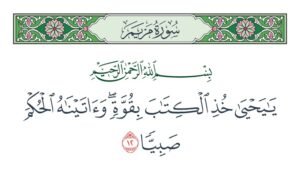
“[Allah said], ‘O Yaḥyā, take the Scripture with determination.’ And We gave him wisdom [even] while a boy, and affection from Us and purity, and he was fearing of Allah. And dutiful to his parents, and he was not a disobedient tyrant. And peace be upon him the day he was born and the day he dies and the day he is raised alive.”
— Qur’an 19:12-15
The Seven Qualities of Yaḥyā
Yaḥyā was commanded to study and hold firmly to the Torah and the teachings of the prophets. He was serious and committed to the scripture from a young age.
Yaḥyā was granted wisdom, understanding, and prophethood at a very young age, even as a child. This was a miraculous sign of Allah’s favor.
Allah gave him a tender heart, compassion for people, and moral purity. He was chaste, restraining himself from worldly desires and dedicating himself to worship.
Yaḥyā lived in constant awareness of Allah, in reverence and piety.
He honored and respected Zakariyah and his mother, treating them with kindness and obedience.
He was neither rebellious toward Allah nor arrogant and oppressive toward people. He was humble and gentle.
This is a special blessing, similar to what was said about ‘Īsā (Jesus) in Qur’an 19:33. It signifies that Yaḥyā would be under Allah’s protection and peace at the three most critical moments: birth, death, and resurrection on the Day of Judgment.
Islamic tradition holds that Yaḥyā was a prophet of truth and courage, unafraid to speak against injustice even among the powerful. He lived a life of asceticism, wearing simple clothing, eating simple food, and dedicating himself entirely to calling people to Allah. His piety, purity, and fearlessness made him beloved to Allah and a model for all who seek righteousness.
Interestingly, the Qur’an does not provide details about how Yaḥyā died. The verse “peace be upon him the day he was born and the day he dies” acknowledges that he will die, but the circumstances are not mentioned. This is consistent with the Qur’anic approach of focusing on the spiritual and moral lessons rather than all historical details.
The Qur’anic Narrative vs. the Biblical Narrative
Both the Qur’an and the Bible tell the story of Zakariyah (Zacharias/Zechariah in the Bible) and his son Yaḥyā (John the Baptist), but there are notable similarities and differences in how the two scriptures present these figures.
The Qur’anic narrative is characterized by a focus on faith rather than doubt, emphasis on moral and spiritual excellence, integration with the broader Islamic narrative, and protection of prophetic integrity. Islam does not attribute doubt or punishment to Zakariyah; instead, it presents him as a faithful servant whose prayer was answered. Both scriptures honor these figures, but the Qur’anic account purifies the narrative from elements that might suggest moral weakness or doubt in the prophets, consistent with the Islamic belief that prophets are protected from such failings.
Lessons from the Story of Zakariyah
The story of Prophet Zakariyah offers profound lessons for believers:
Zakariyah’s prayer was made in secret, in the depths of the night, with complete sincerity. Allah answers the prayers of those who turn to Him with humble hearts.
Despite his old age and his wife’s barrenness, Zakariyah never lost hope. He recognized that Allah had always answered his prayers in the past, and he trusted that Allah would answer this one too.
Seeing Allah’s miraculous provision for Maryam strengthened Zakariyah’s faith and inspired him to ask for his own miracle. Observing Allah’s power in the world around us can inspire us to greater faith and trust.
Zakariyah did not just ask for a child; he asked for a righteous child who would be pleasing to Allah and carry on his mission. Parents should pray for their children’s righteousness, not just their worldly success.
Even when facing difficulties, Zakariyah remained grateful to Allah and continued his worship and service.
Zakariyah’s care for Maryam shows the importance of protecting, nurturing, and educating those entrusted to our care, especially in matters of faith.
Zakariyah served Allah faithfully for many years, even without the child he longed for. His patience was eventually rewarded.
The central message of Zakariyah’s story is that Allah can do anything. When all human means fail, Allah’s power remains. He created Zakariyah from nothing in the first place, so granting him a child in old age was easy for Him.
Complete List of Qur’anic Verses
Verses About Zakariyah:
• Verse 37: Zakariyah becomes Maryam’s guardian; miraculous provision for Maryam
• Verse 38: Zakariyah’s prayer for a child
• Verse 39: The angels announce Yaḥyā’s birth
• Verse 40: Zakariyah’s question and Allah’s response
• Verse 41: The sign of three days of muteness
• Verses 1-6: Zakariyah’s private supplication for a child
• Verses 7-9: Allah’s announcement of Yaḥyā
• Verse 10: The sign of muteness for three nights
• Verse 11: Zakariyah signals to his people to glorify Allah
• Verse 89: Zakariyah’s prayer not to be left alone without an heir
• Verse 90: Allah’s response and description of Zakariyah’s character
Verses About Yaḥyā (John):
The announcement of Yaḥyā’s birth and his qualities
Allah announces Yaḥyā’s name
• Verse 12: Yaḥyā commanded to take the Scripture with determination; given wisdom as a boy
• Verse 13: Given affection and purity; fearing of Allah
• Verse 14: Dutiful to his parents; not disobedient
• Verse 15: Peace upon him at birth, death, and resurrection
Brief mention: “And Zakariyah and John and Jesus and Elias—all were among the righteous”
Reference to Zakariyah’s family: “So We responded to him, and We gave to him John, and amended for him his wife. Indeed, they used to hasten to good deeds and supplicate Us in hope and fear, and they were to Us humbly submissive.”










Be First to Comment