

Tamim al-Dari
The First to Light the Mosque, The One Who Narrated the Hadith of the Dajjal
Died 40 AH (660 CE) • Buried in Bayt Jibrin, Palestine
Among the companions of Prophet Muhammad ﷺ, there are those whose names shine with particular brilliance—not because of their military exploits or political prominence, but because of their profound devotion, their scholarship, and their unique contributions to Islam.
Tamim al-Dari رضي الله عنه was such a companion. A former Christian who embraced Islam, he became known for innovations that would benefit Muslims for all time, and for narrating one of the most extraordinary hadiths in Islamic history—the only hadith that the Prophet ﷺ himself narrated from one of his companions.
His Noble Lineage
Tamim ibn Aws ibn Kharijah ibn Sawd ibn Judhaymah ibn Dhira’ ibn ‘Adi ibn al-Dar ibn Hani’ ibn Habib ibn Numarah ibn Lakhm. He carried the kunya (nickname) Abu Ruqayyah and belonged to the Banu al-Dar clan of the Lakhm tribe, which traces its lineage to Qahtani Arabs from Palestine.
Al-Dar was a sub-tribe of Lakhm, and Lakhm itself was a branch of Ya’rub ibn Qahtan—tracing back to the ancient Arab lineages of Yemen and the southern Arabian peninsula.
His Journey to Islam
Tamim al-Dari was originally a Christian living in Palestine. In the year 9 AH, when the Prophet ﷺ returned from the expedition to Tabuk, a delegation from the Banu al-Dar tribe came to Madinah.
The delegation consisted of ten men, including Tamim. They came bearing gifts for the Prophet ﷺ, who welcomed them warmly and accepted their Islam. The Prophet ﷺ granted them provisions—a hundred wasq (a measure of dates or grain) from the date harvest.
According to Ibn Jurayj, who reported from ‘Ikrimah: When Tamim accepted Islam, he said to the Messenger of Allah ﷺ: “O Messenger of Allah, Allah will make you victorious over all the earth. So grant me my village of Bayt Lahm (Bethlehem).”
The Prophet ﷺ replied: “It is yours,” and wrote a document granting it to him.
Tamim later brought this document to ‘Umar رضي الله عنه, who confirmed: “I bear witness to this,” and ratified it.
Al-Layth reported that the Prophet ﷺ stipulated: “You do not have the right to sell it.” And so it remained in the hands of Tamim’s descendants until the narrator’s time.
After embracing Islam, Tamim resided in Madinah, where he became one of the devoted companions. However, after the martyrdom of Caliph ‘Uthman ibn ‘Affan رضي الله عنه, Tamim moved to the Levant (Sham), where he would spend the remainder of his life.
His Unique Distinctions
Tamim al-Dari held several remarkable distinctions that set him apart among the companions:
Tamim was the first person to place lamps (oil lamps) in the mosque to illuminate it for worshippers. This innovation allowed people to pray comfortably at night and facilitated the recitation of Quran in the darkness. It was a simple yet profound contribution that benefited the entire Muslim community.
According to al-Zuhri, narrated from al-Sa’ib ibn Yazid: Tamim al-Dari was the first to deliver public religious sermons (qasas). He sought permission from ‘Umar ibn al-Khattab رضي الله عنه for several years, but ‘Umar initially refused.
When Tamim persisted, ‘Umar finally asked him: “What will you say?” Tamim replied: “I will recite to them the Quran, command them to good, and forbid them from evil.” ‘Umar said: “That is profit!” Then he permitted him, saying: “Admonish them before I go out for Friday prayer.”
Tamim would deliver his sermon standing. Later, during the caliphate of ‘Uthman رضي الله عنه, he requested to add another day, and ‘Uthman granted him permission for a second weekly sermon.
Tamim is credited with constructing the pulpit (minbar) that the Prophet ﷺ used for delivering sermons. This was a practical contribution that served the Islamic community for generations.
Perhaps most remarkably, Tamim al-Dari is the only companion from whom the Prophet ﷺ himself narrated a hadith. The Prophet ﷺ gathered the Muslims in the mosque and recounted to them the extraordinary story that Tamim had told him—the hadith of al-Jassasah and the Dajjal.
His Devotion and Scholarship
Tamim al-Dari was renowned for his extraordinary worship, dedication to the Quran, and ascetic lifestyle. The scholars of his time marveled at his devotion.
According to Abu Qilabah, from Abu al-Muhallab: Tamim used to complete the entire Quran in recitation every seven days.
Even more remarkably, ‘Asim al-Ahwal narrated from Ibn Sirin: Tamim al-Dari would recite the entire Quran in a single unit of prayer (rak’ah).
Abu al-Duha narrated from Masruq: “A man from the people of Makkah said to me: ‘This is the place where your brother Tamim al-Dari stood. He prayed throughout the night until morning, or nearly so, repeating and weeping over a single verse: ‘Or do those who commit evil deeds think We will make them like those who believe and do righteous deeds?’ [Quran 45:21]”
Abu Nubatah Yunus ibn Yahya narrated from al-Munkadir ibn Muhammad, from his father: Tamim al-Dari slept one night without performing his night vigil (tahajjud). As a penalty for what he had done, he stood in prayer for an entire year without sleeping.
Qatadah narrated from Ibn Sirin, and Qatadah also from Anas: Tamim al-Dari purchased a cloak for one thousand dirhams, which he would wear when going to prayer.
Hammad narrated from Thabit: Tamim acquired a garment for one thousand dirhams, which he would wear on the night when Laylat al-Qadr (the Night of Decree) was expected.
These accounts paint a picture of a man who combined outward beauty in worship (wearing fine clothes for prayer) with profound inner devotion (standing all night in prayer, weeping over Quranic verses).
The Memorizers of Quran
This places Tamim among the elite group of companions who had committed the entire Quran to memory during the Prophet’s lifetime—a tremendous achievement given that the revelation was still being completed.
The Hadith of al-Jassasah
The most famous narration from Tamim al-Dari is the extraordinary account of his encounter with the Dajjal (the Antichrist) through an intermediary creature called al-Jassasah (the Spy). This hadith is recorded in Sahih Muslim.
Fatimah bint Qays رضي الله عنها narrated: “I heard the caller of the Messenger of Allah ﷺ calling: ‘Assemble for prayer!’ So I went to the mosque and prayed with the Messenger of Allah ﷺ. I was in the row of women closest to the backs of the men. When the Messenger of Allah ﷺ finished his prayer, he sat on the pulpit while laughing, and said: ‘Let each person remain in their prayer place.’
Then he said: ‘Do you know why I have gathered you?’ They said: ‘Allah and His Messenger know best.’ He said: ‘By Allah, I have not gathered you for good tidings or for warning. Rather, I have gathered you because Tamim al-Dari was a Christian man who came, pledged allegiance, accepted Islam, and told me a story that corresponded with what I had been telling you about the Dajjal (Antichrist)…’”
Tamim al-Dari narrated: “I boarded a sea vessel with thirty men from Lakhm and Judham. The waves tossed us about for a month at sea, then we anchored at an island in the sea at sunset.
We sat in the ship’s small boat and entered the island. There we encountered a creature extremely hairy, with so much hair that we could not tell its front from its back.
We said: ‘Woe to you! What are you?’ It said: ‘I am al-Jassasah (the Spy).’ We said: ‘What is al-Jassasah?’ It said: ‘O people, go to this man in the monastery, for he is eager for your news.'”
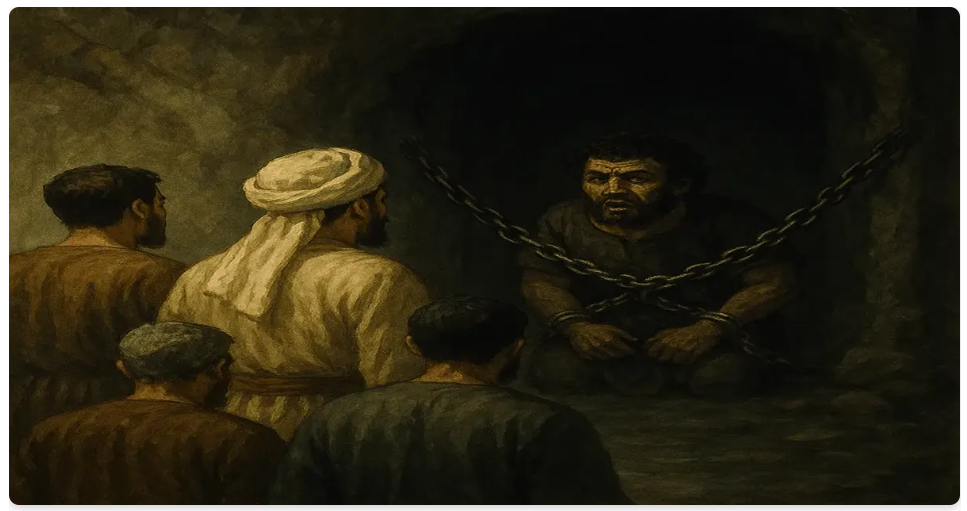
“When it mentioned a man to us, we became frightened, thinking it might be a devil. We rushed quickly until we entered the monastery. There we found the largest human being we had ever seen, most severely bound—his hands tied to his neck, and from his knees to his ankles bound in iron chains.
We said: ‘Woe to you! What are you?’ He said: ‘You will soon know my news. But tell me about yourselves.’ They said: ‘We are people from the Arabs. We boarded a sea vessel, but the sea became turbulent and the waves played with us for a month. Then we came to your island…'”
“The chained man then asked us: ‘Tell me about the date palms of Baysan (in Palestine).’ We said: ‘What do you wish to know about them?’ He said: ‘I ask you: do they still bear fruit?’ We said: ‘Yes.’ He said: ‘Soon they will not bear fruit.’
He said: ‘Tell me about the Lake of Tiberias.’ We said: ‘What do you wish to know about it?’ He said: ‘Is there still water in it?’ We said: ‘It has abundant water.’ He said: ‘Soon its water will disappear.’
He said: ‘Tell me about the Spring of Zughar (near the Dead Sea).’ We said: ‘What do you wish to know about it?’ He said: ‘Is there water in the spring, and do its people farm with its water?’ We said: ‘Yes, it has abundant water and its people farm from it.’
He said: ‘Tell me about the Prophet of the unlettered (Muhammad). What has he done?’ We said: ‘He has emerged from Makkah and settled in Yathrib (Madinah).’ He said: ‘Have the Arabs fought him?’ We said: ‘Yes.’ He said: ‘How did he deal with them?’ We informed him that he had prevailed over the Arabs in his vicinity and they had obeyed him. He said: ‘Has that truly happened?’ We said: ‘Yes.’ He said: ‘It is better for them that they obey him.'”
“Then the chained man said: ‘I will inform you about myself. I am the Dajjal (Antichrist). Soon I will be given permission to emerge. I will come out and travel through the earth, and there will not remain a town except that I will descend upon it in forty nights—except Makkah and Taybah (Madinah), for they are both forbidden to me. Every time I try to enter one of them, an angel with a drawn sword will meet me and prevent me. Upon every mountain pass to them are angels guarding them.’”
The Prophet ﷺ struck the pulpit with his staff and said: “This is Taybah! This is Taybah! This is Taybah!”—meaning Madinah. “Did I not tell you this before?” The people said: “Yes!” The Prophet ﷺ said: “Indeed, I was pleased by Tamim’s story because it confirms what I have been telling you about him (the Dajjal) and about Madinah and Makkah. Beware! He is in the Syrian Sea or the Yemeni Sea. No, rather from the direction of the East. From the direction of the East. From the direction of the East.” And he pointed with his hand toward the East.
This is the only instance in authentic Islamic texts where the Prophet ﷺ narrated from a companion rather than from divine revelation. He did so because Tamim’s account confirmed what had already been revealed to him about the Dajjal.
His Narrations and Students
Tamim al-Dari narrated 18 hadiths from the Prophet ﷺ, including the famous hadith of al-Jassasah recorded in Sahih Muslim. His narrations covered various aspects of Islamic knowledge and practice.
• Ibn ‘Abbas رضي الله عنهما
• ‘Abdullah ibn Muhayyib
• Anas ibn Malik رضي الله عنه
• Kathir ibn Murrah
• ‘Ata’ ibn Yazid al-Laythi
• Zurarah ibn Awfa
• Shahr ibn Hawshab
• And others
Incidents from His Life
Hammad ibn Salamah narrated from al-Juriri, from Abu al-‘Ala’, from Mu’awiyah ibn Harmal: “One night while we were at Tamim’s house, a fire broke out on the volcanic plain (al-Harrah). ‘Umar came to Tamim and said: ‘Get up and go to this fire.’
Tamim said: ‘O Commander of the Faithful, who am I? What am I?’ (expressing humility). But ‘Umar kept insisting until Tamim went with him, and I followed them.
They went to the fire, and Tamim began herding it with his hand until it entered the mountain pass, and Tamim followed it in. ‘Umar kept saying: ‘One who sees is not like one who has not seen!’ He repeated this three times.”
Khalid ibn ‘Abdullah narrated from Bayan, from Wabarah: “‘Umar saw Tamim al-Dari praying after ‘Asr (afternoon prayer). He struck him on the head with his whip (durrah).
Tamim said: ‘O ‘Umar, you strike me for a prayer that I used to pray with the Messenger of Allah ﷺ!’ ‘Umar said: ‘O Tamim, not all people know what you know.’”
This incident shows both Tamim’s devotion to voluntary prayer and ‘Umar’s concern about maintaining proper times for prayer in the public eye, as voluntary prayers immediately after ‘Asr are generally discouraged to distinguish them from the obligatory prayer.
Sa’id al-Juriri narrated from Abu al-‘Ala’, from a man who said: “I came to Tamim al-Dari and he spoke to us. I said: ‘How much is your portion (of Quran in prayer)?’ He said: ‘Perhaps you are one of those who recites the entire Quran, then says in the morning: I have read the Quran tonight!’ By the One in whose hand is my soul, for me to pray three voluntary units of prayer is more beloved to me than reciting the entire Quran in one night, then waking up and telling others about it.’
When he saw that I became angry, he softened and said: ‘Let me tell you something, my nephew. Suppose you are a strong believer and I am a weak believer—if I burden you with my strength upon your weakness, you cannot bear it and you will collapse. Or suppose you are a strong believer and I am a weak believer—if I burden myself with your strength upon my weakness, I cannot bear it and will collapse.
Rather, take from yourself for your religion, and from your religion for yourself, until the matter becomes balanced for you in an act of worship you can sustain.’”
This beautiful advice shows Tamim’s wisdom: while he himself was capable of extraordinary acts of worship, he recognized that each person must find a sustainable path that balances their spiritual aspirations with their capacity.
His Death
Ibn Sa’d reported: Tamim al-Dari remained in Madinah until after the assassination of ‘Uthman رضي الله عنه, then he moved to the Levant (Sham).
Tamim al-Dari رضي الله عنه passed away in the year 40 AH (660 CE) in the Levant. He was buried in Bayt Jibrin in Palestine, where his grave remains to this day—a testament to his Palestinian heritage and his final resting place in the blessed land of Sham.
Tamim al-Dari رضي الله عنه represents a beautiful example of a convert to Islam who not only embraced his new faith wholeheartedly but contributed lasting innovations that benefited the entire Muslim community.
Every time a lamp is lit in a mosque, we remember Tamim. Every time a scholar delivers a public sermon, we remember his pioneering role. Every time we reflect on the signs of the End Times, we remember his extraordinary encounter that the Prophet ﷺ himself shared with the Muslims.
Most importantly, his life teaches us that true devotion is not just about quantity of worship, but about quality, sustainability, and sincerity. His night vigils, his weeping over single verses, his year of prayer as penance for one missed night—these were the acts of a man whose heart was utterly devoted to Allah.
May Allah be pleased with Tamim al-Dari and grant us a fraction of his devotion,
his knowledge, and his service to Islam.









Be First to Comment