
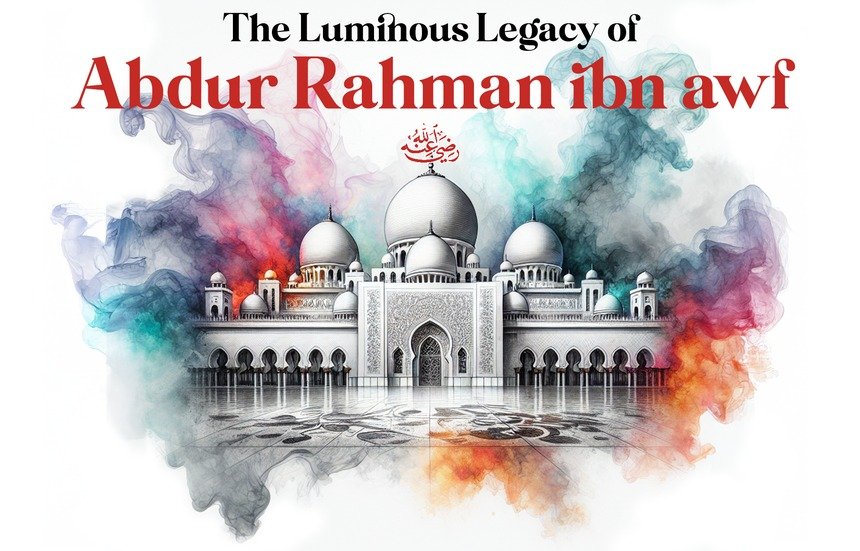
Abdul Rahman ibn Awf
The Golden Merchant of Paradise
Abdul Rahman ibn Awf (RA) stands as one of the most remarkable figures in Islamic history. Known as the “Golden Merchant,” he was a man who transformed every business venture into a victory for the faith. He was one of the “First Eight” to accept Islam, one of the “Ten Promised Paradise” (*Ashara Mubashara*), and a member of the elite Shura council that determined the future of the Caliphate. His life is a masterclass in balancing immense worldly success with profound spiritual devotion.
Early Life and the Dawn of Faith
Born approximately ten years after the Prophet Muhammad ﷺ, Abdul Rahman was originally named Abu Amr. He was a man of noble character and a successful trader even before his conversion. When the light of Islam began to shine in Mecca, he was among the very first to respond. He accepted Islam just two days after Abu Bakr as-Siddiq (RA), making him one of the foundational pillars of the early Muslim community. Upon his conversion, the Prophet ﷺ gave him the name Abdul Rahman (the Servant of the Beneficent), a name he carried with pride as he faced the early persecutions in Mecca.
Like all the early Muslims, Abdul Rahman endured the torment and ridicule of the Quraysh. Yet his faith remained unshakeable. He was not only a believer but a living embodiment of the Quranic verse that speaks of those who spend their wealth in the way of Allah.
The Hijrah and the Lesson of Self-Reliance
When the Muslims were commanded to migrate to Medina, Abdul Rahman left behind his wealth and property in Mecca, arriving in the new city with nothing but his faith. In a historic move to foster unity, the Prophet ﷺ paired the immigrants (*Muhajirin*) with the residents of Medina (*Ansar*). Abdul Rahman was paired with Sa’d ibn al-Rabi (RA), one of the wealthiest men in Medina.
The encounter between these two men remains one of the most touching stories of brotherhood in history. Sa’d said to him:
“My brother! Among the people of Medina, I have the most wealth. I have two orchards and I have two wives. See which of the two orchards you like and I shall vacate it for you, and which of my two wives is pleasing to you and I will divorce her for you to marry.”
Abdul Rahman’s response was a testament to his dignity and self-reliance. He did not take a single coin. Instead, he replied:
“May Allah bless you in your family and your wealth. But just show me where the market (*suq*) is.”
Abdul Rahman’s refusal of Sa’d’s generous offer teaches a profound lesson: true honor lies in self-reliance and earning one’s sustenance through honest work. This principle became the foundation of his legendary success in business.
He went to the market and began trading with small amounts of dried buttermilk and ghee. His business acumen was so sharp that he famously remarked, “If I were to lift a stone, I would expect to find gold or silver beneath it.” Within a short time, he was wealthy enough to marry and provide a generous dowry, earning the Prophet’s ﷺ prayers for further blessings in his wealth.
The Prophet ﷺ said to him when he came perfumed and married: “Mahyarn, O Abdur Rahman!” (meaning “What a pleasant surprise!”). When Abdul Rahman explained that he had married and given his wife a dowry of a *nuwat* (a piece of gold), the Prophet ﷺ responded with encouragement, saying, “You must have a walimah (wedding feast) even if it is with a single sheep. And may Allah bless you in your wealth.”
Valor on the Battlefield: Badr and Uhud
Abdul Rahman was not only a giant of the marketplace but also a lion on the battlefield. At the Battle of Badr, he fought with distinction. It was during this battle that a complex incident occurred involving his old Meccan friend, Umayyah ibn Khalaf. Umayyah had been a fierce enemy of Islam and the torturer of Bilal ibn Rabah (RA).
During the battle, Abdul Rahman captured Umayyah and his son, intending to protect them as prisoners of war. However, when Bilal saw his former torturer, he cried out to the Ansar, “The head of disbelief, Umayyah ibn Khalaf! May I not be saved if he is saved!” Despite Abdul Rahman’s attempts to shield them with his own body—even lying on top of Umayyah to protect him—the Ansar, fueled by the memory of Umayyah’s cruelty, killed the captives.
Abdul Rahman’s attempt to protect his captive reveals the depth of his character: even in the midst of battle, he honored the bonds of old friendship and the Islamic principles of mercy. Yet he also understood the justice of those who had suffered at Umayyah’s hands.
Abdul Rahman was wounded in the leg during the struggle, a scar he carried as a reminder of that day. At the Battle of Uhud, when many fled, Abdul Rahman remained firm by the side of the Prophet ﷺ. He received over twenty wounds, some so deep that they left him with a permanent limp and the loss of several teeth, marking his body with the “medals” of his devotion.
The Caravan of 700 Camels: A Legacy of Generosity
Abdul Rahman’s wealth was never for his own luxury; it was a trust for the community. On one occasion, a massive caravan of 700 camels belonging to him entered Medina, laden with food and goods. The sound was so great that the city shook. When Aisha (RA) heard the commotion, she remarked that she had heard the Prophet ﷺ say that Abdul Rahman would enter Paradise “crawling” (due to the weight of his accounting for his wealth).
When this reached Abdul Rahman, he rushed to her and vowed, “If I could, I would enter it standing!” He immediately donated the entire caravan—the camels, their saddles, and all their cargo—for the sake of Allah. His charity was legendary; he once sold a piece of land for 40,000 dinars and distributed the entire sum among the poor of Banu Zuhrah and the widows of the Prophet ﷺ.
The Prophet ﷺ himself praised Abdul Rahman’s generosity, saying that his wealth would be a means of his salvation, not a burden. This was a remarkable statement, for wealth is often a trial for those who possess it. Yet Abdul Rahman had transformed it into a vehicle for righteousness.
The Final Years and the Shura Council
In his later years, Abdul Rahman played a pivotal role in the stability of the Islamic state. After the assassination of Umar ibn al-Khattab (RA), he was one of the six men appointed to choose the next Caliph. In an act of profound humility, he withdrew his own name from consideration and spent three days and nights consulting the people of Medina before announcing Uthman ibn Affan (RA) as the leader.
This decision was not without controversy, but it demonstrated Abdul Rahman’s commitment to the community’s welfare over his own ambitions. He had been offered the Caliphate, yet he chose to serve in a different capacity.
The Legacy of Abdul Rahman ibn Awf
Abdul Rahman ibn Awf passed away at the age of 72 or 75, leaving behind a legacy that proves wealth, when held in the hand and not in the heart, can be a bridge to the highest levels of Paradise. He was buried in Al-Baqi, leaving the world as he entered it—a servant of the Beneficent.
His life teaches us that success in business and devotion to faith are not contradictory. Rather, when guided by Islamic principles, they complement each other. His refusal of easy wealth from Sa’d, his hard work in the market, his bravery in battle, and his legendary generosity all paint a portrait of a man who understood that true wealth is not measured in dinars and dirhams, but in the hearts of those who remember his kindness and the legacy of righteousness he left behind.
| Key Aspect | Description |
|---|---|
| Title | The Golden Merchant / One of the Ten Promised Paradise |
| Conversion | One of the first eight people to accept Islam |
| Business Philosophy | Extreme self-reliance and integrity (“Show me the market”) |
| Military Service | Fought at Badr, Uhud (20+ wounds), and all major battles |
| Generosity | Donated entire caravans of 700 camels; supported the widows of the Prophet ﷺ |
| Political Role | Arbitrator of the Shura council for the third Caliph |
| Death | Buried in Al-Baqi, Medina |











Be First to Comment