
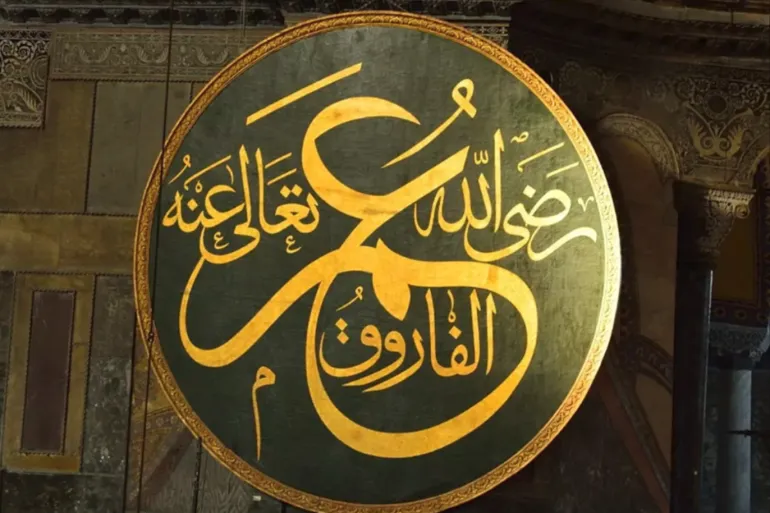
Umar Has Died
How the compassion of Umar ibn al-Khattab, may Allah be pleased with him, shaped the laws of a just society
Historians relate that Umar ibn al-Khattab, may Allah be pleased with him, known for his severity and formidable strength, was one day preparing tables of food for the people of Medina when he noticed a man eating with his left hand.
The first lawThe Man With the Wounded Hand
Umar came up behind him and said:
Umar repeated himself twice, and the man gave the same answer each time.
Umar sat down beside him and wept. He asked: Who helps you perform your ablution? Who washes your clothes? Who washes your hair? And who… and who… and who? With every question his tears poured down. Then he ordered a servant, a mount and provisions for the man, begging his forgiveness for having hurt him by criticizing something he could not possibly help.
This is how the law protecting those injured in war came into being.
The second lawThe Elderly Man and the Stones
On another occasion Umar saw an elderly man carrying stones and asked him, “Why do you do this hard labor?”
He assigned the man a monthly stipend that was enough for his needs. Then the Commander of the Faithful went home and wrote the decision, so that the state’s executive apparatus would adopt it and organize society by it.
This is how the social security system took shape.
The third lawThe Crying Child
Umar continued his evening rounds, as a caretaker and never a spy. One night he heard a child crying mournfully, drew near the house and asked what was wrong. The child’s mother replied:
A perfectly ordinary event: a mother weans her child, and he cries. But the Commander of the Faithful did not simply walk on. He discovered that she had weaned her baby early because she needed the hundred dirhams that the public treasury paid for each child after weaning.
Umar went home, but not to sleep, for the sound of that child’s crying had not left his mind or his heart. He issued an order that the hundred dirhams be paid for every child from the day of birth, not from the day of weaning. The order became a law that safeguards children’s rights and protects them from the dangers of premature weaning.
This is how the law of the child took shape.
The fourth lawThe Murderer of His Brother
Umar dearly loved his brother Zayd, who had been killed in the wars of apostasy. One day in the market of Medina, Umar came face to face with Zayd’s killer, who had since embraced Islam and become one of his subjects. Umar said to him in anger:
The bedouin asked warily:
The man walked away, utterly unconcerned, saying: “Only women grieve over lost love.” In other words: what is your love to me? Between you and me there is nothing but rights and duties.
The Commander of the Faithful did not rage, and he did not throw the man in prison. He swallowed his anger at the bedouin’s boldness and mockery and went on with his rounds. He did so out of faith in the man’s right to speak, and out of restraint of anger while holding the highest power.
This is how freedom of expression took root in society.
The fifth lawThe Woman Who Corrected the Caliph
One Friday, in the mosque, a woman stripped him of the title “Commander of the Faithful” when she said, “You are mistaken, Umar!” An ordinary woman was rejecting the law on dowries that Umar al-Faruq had drafted.
The Commander of the Faithful did not dig in. He did not imprison her or order her flogged. He admitted his error in plain words: “Umar was wrong, and a woman was right.” Then he withdrew his law and left it to society to set dowries according to what people could afford.
This is how the law protecting women was established.
The final lessonAbu Bakr and the Blind Woman
Umar ibn al-Khattab was watching Abu Bakr after the dawn prayer, and noticed that Abu Bakr went out to the edge of Medina and entered a certain house, staying for hours. Days passed, and the Caliph kept visiting that tiny house. Umar decided to enter it after Abu Bakr left, to learn the secret. Inside he found an elderly woman, blind and unable to move.
Umar fell to his knees, his eyes overflowing with tears, and spoke his famous words:
This is how laws are made. People have not changed, and neither has life. What is missing among the people is… Umar, may Allah be pleased with him and make him pleased.






Be First to Comment