
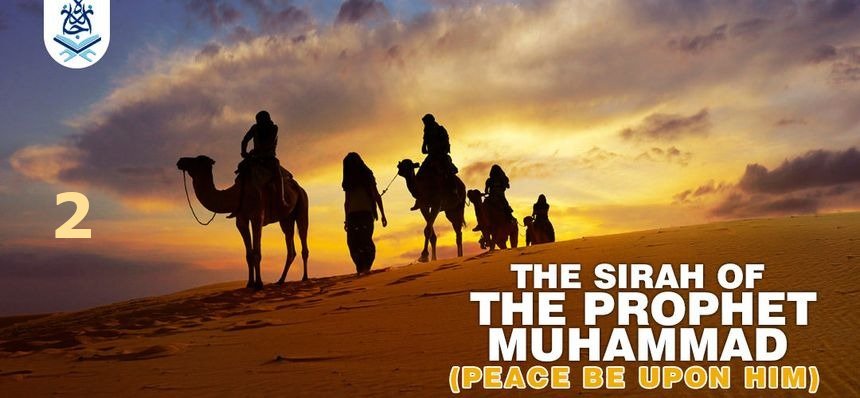
The Sirah
The Age of Ignorance
Pre-Islamic Arabia and the Rise of Idolatry
Through evolving customs and the accretion of tribal myths and legends that built up over countless generations, the One God was removed further and further away from the active consciousness of the people of Arabia and was ultimately replaced with an entire pantheon of idols and demigods.
The Arabs came to believe that the One Supreme God, whom they knew as Allah (Hebrew: Elohim), was remote and disinterested in human affairs and that the idols were the day-to-day maintainers of luck, health, wealth and social stability.
They also adopted the view that there was no afterlife and certainly no consequences to pay for one’s own bad behavior or immorality. The very notion of God keeping track of their faith and deeds was preposterous to them, for they held that this life was all there was.
Women exerted only a marginal influence on the rough and tumble life of the desert nomads, and they fared only a little better in the dusty settlements that dotted the trade routes.
The Code of Honor
Honor, both personal and tribal, was the badge a man wore to showcase his reputation, courage and self-worth. Honor dictated that guests should be treated well—even to excess—but it also held that any small insult or slight could lead to a fight between men and even between entire tribes, a fight that would, more often than not, spiral downward into a generation-wide conflict of revenge and counter-revenge, of murder, looting and kidnapping.
Add to this the constant inter-tribal raiding that was a fact of life in that visually stunning but desperate land, and one comes away with a picture of a lawless place where chaos could ensue at any moment—a land ruled by long-standing customs and pagan superstitions.
The Great Empires and Arabia
The civilized empires of the day, the Byzantine Romans and the Persians, held little sway in the Arabian Peninsula, though each tried to play the tribes against each other in the north and south of Arabia in their own quest for power and influence.
As for religious diversity, only a handful of Christians lived in scattered settlements, some Zoroastrians dwelt in the northeast, while a small number of Jewish tribes were settled in the oasis towns to the north. Other than that, the overwhelming majority of Arabs were basically pagans, albeit with a limited sense of an all-powerful God.
Mecca: Center of Idolatry
Mecca was the place where some semblance of a central culture could reign, for the Shrine of Abraham still resided within the Arab imagination. However, it was no longer a center of monotheism. Rather, it was transformed over the centuries into a neutral place where every tribe could store its patron idol in safety.
For religious and trade purposes, the Arabs mutually agreed that four months out of the year were to be truce months, wherein all fighting in Arabia had to cease so people could conduct their business and visit Mecca to venerate their idols. Any violation of these truce months was inconceivable because of the amount of shame it would heap upon the offender’s family and tribe (though sometimes various tribes would try to ‘bend’ the rules on this issue).
The Meccan tribe of Quraysh, which was a collection of loosely related clans that governed the city through a council of elders, ensured that Mecca was more or less an open city for all, though they did so mostly for financial interests. In other words, they exploited the beliefs of their countrymen for their own gain.
Yearly trade fairs, like those held in other cities, were especially extravagant and diverse in Mecca due to her special status as the home of the gods. Thus, Mecca was the focal point of nearly the entire Arabian Peninsula.
To be continued in Part 3: The Year of the Elephant…










Be First to Comment