
The Call to Collective Goodness
A Comprehensive Study of Surah Al-Imran, Verse 104
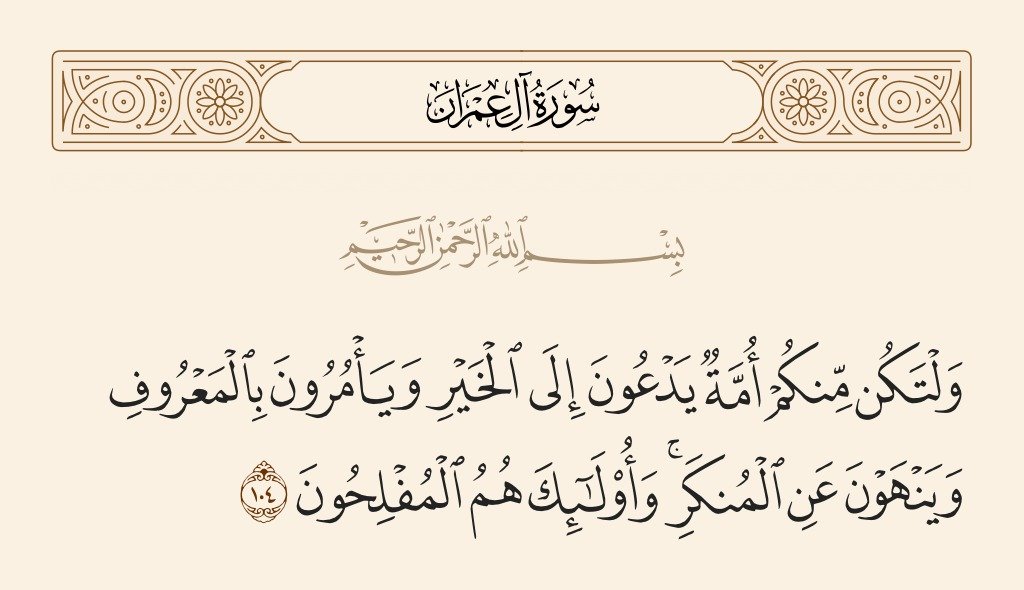
“And let there be [arising] from you a nation inviting to [all that is] good, enjoining what is right and forbidding what is wrong, and those will be the successful.”
— Surah Al-Imran (Chapter 3, Verse 104)
Surah Al-Imran, verse 104, Sheikh Mahmoud Ali Al-Banna
Introduction: A Divine Mandate for Social Reform
In the heart of Surah Al-Imran, Allah ﷻ presents one of the most profound verses addressing the collective responsibility of the Muslim community. Verse 104 is not merely a suggestion or recommendation—it is a divine command that establishes the framework for a just, moral, and spiritually vibrant society.
This verse comes in a chapter named after the family of ‘Imran, the family of Maryam (Mary) and ‘Isa (Jesus), peace be upon them. The surah addresses themes of faith, community, struggle, and the characteristics of a believing nation. Within this context, verse 104 emerges as the cornerstone principle for how Muslims should organize themselves as a force for good in the world.
Surah Al-Imran was revealed in Madinah during a critical period when the Muslim community was establishing itself as a cohesive social and political entity. The Muslims had just experienced the Battle of Badr and were preparing for the challenges of Uhud. In this environment, Allah ﷻ was not only giving them military and political guidance, but more importantly, defining the moral and spiritual character that would distinguish the Muslim ummah for all time.
Linguistic and Grammatical Analysis
The verse contains several key terms and grammatical structures that reveal layers of meaning often lost in translation. Let us examine each component:
“And let there be from among you…”
The phrase “minkum” (from you) has been interpreted in two ways by classical scholars:
1. Partitive interpretation: Some scholars understand this to mean “a group from among you”—indicating that not every single Muslim must perform this function, but rather a dedicated group should arise from within the community who specialize in this work.
2. Explanatory interpretation: Others, like Ibn Kathir, interpret “min” here as explanatory rather than partitive, meaning “let you as a community be a nation that…” This reading suggests the entire Muslim community shares this responsibility collectively.
“A nation/community”
The word “ummah” is rich with meaning. It doesn’t simply mean a random collection of individuals, but rather an organized, united community with shared values, vision, and purpose. An ummah is characterized by:
• Shared beliefs and objectives
• Collective consciousness
• Mutual support and cooperation
• A common direction (the root word “amma” means “to intend” or “to head toward”)
This implies that the work described in this verse requires organization, structure, and collective effort—not merely individual, sporadic acts of goodness.
“Inviting to [all that is] good”
The verb “yad’ūna” (they invite/call) is in the present tense, indicating continuous, ongoing action. This is not a one-time event but a perpetual state of calling people toward goodness.
“Al-khayr” (the good) is a comprehensive term that encompasses:
• Islam and its teachings
• Moral virtues and ethical conduct
• Knowledge and wisdom
• Social justice and welfare
• Everything that benefits humanity in this life and the Hereafter
“Enjoining what is right”
“Al-ma’rūf” literally means “that which is recognized” or “that which is known.” It refers to that which is universally recognized as good by sound human nature (fitrah) and confirmed by divine revelation. This includes:
• Acts of worship ordained by Allah
• Justice, honesty, and integrity
• Kindness, compassion, and mercy
• Family ties and social bonds
• Everything the Shariah commands or encourages
“Forbidding what is wrong”
“Al-munkar” is the opposite of ma’rūf—it is that which is rejected by sound human nature and condemned by divine revelation. The root word “nakara” means to deny, reject, or find repugnant. Al-munkar includes:
• Acts of disobedience to Allah
• Injustice, oppression, and corruption
• Immorality and vice
• Falsehood and deception
• Everything the Shariah prohibits or discourages
“And those will be the successful”
The word “falah” (success/prosperity) is one of the most beautiful concepts in the Quran. It signifies:
• Ultimate success in both worlds
• Achievement of one’s goals and aspirations
• Salvation and deliverance from harm
• Lasting happiness and contentment
Notice that Allah ﷻ uses the definite article “al” before “muflihūn,” making it “THE successful ones”—as if to say that true success belongs exclusively to those who fulfill this divine mandate.
The Three Pillars of Social Reform
This verse establishes three interconnected pillars that form the foundation of a healthy, moral society. Each pillar builds upon the previous one, creating a comprehensive system of social reform:
Inviting to all that is good is the broadest and most foundational of the three responsibilities. This involves:
1. Teaching and Education: Spreading knowledge of Islam, helping people understand the Quran and Sunnah, and educating them about their faith and its wisdom.
2. Spiritual Guidance: Reminding people of Allah, the Hereafter, and the purpose of life. Encouraging them to develop their relationship with their Creator.
3. Moral Development: Cultivating noble character traits, promoting ethical behavior, and inspiring people to pursue excellence in all aspects of life.
4. Social Welfare: Encouraging charitable work, community service, and efforts to improve the material and spiritual well-being of society.
This pillar is positive and proactive—it focuses on building, creating, and establishing goodness rather than merely reacting to evil.
Commanding what is recognized as right is more specific than general da’wah. It involves:
1. Active Encouragement: Not merely inviting people to good in general, but specifically urging them toward particular acts of righteousness and obedience to Allah.
2. Establishing Norms: Working to make virtue, piety, and ethical behavior the social norm rather than the exception.
3. Supporting the Righteous: Standing with those who do good, encouraging them, and creating an environment where righteousness is celebrated and rewarded.
4. Institutional Reform: Working within families, organizations, and institutions to ensure they promote and uphold what is right.
This pillar involves both personal example and active advocacy—we must embody the good we enjoin and actively work to spread it.
Forbidding what is wrong is the protective mechanism that prevents the corruption and decay of society. It involves:
1. Speaking Against Injustice: Raising one’s voice against oppression, corruption, and wrongdoing, regardless of who commits it.
2. Preventing Harm: Taking appropriate steps to stop or minimize evil and its spread in society, according to one’s ability and position.
3. Promoting Accountability: Ensuring that wrongdoers face consequences and that systems of justice function properly.
4. Resisting Normalization of Evil: Refusing to accept, accommodate, or remain silent about evil, even when it becomes widespread or socially accepted.
This pillar requires courage, wisdom, and strategic action—knowing when and how to confront wrong in a manner that is effective and in accordance with Islamic principles.
Prophetic Guidance on Implementation
The Prophet Muhammad ﷺ provided extensive guidance on how to implement the principles outlined in this verse. His teachings show us the methodology, the conditions, and the wisdom required for this sacred duty.
“Whoever among you sees an evil, let him change it with his hand; if he cannot, then with his tongue; if he cannot, then with his heart—and that is the weakest of faith.”
— Narrated by Muslim
This hadith establishes three levels of response to wrongdoing, based on one’s ability and position. The “hand” represents those with authority and power to physically change the situation. The “tongue” represents speaking out, advising, and warning. The “heart” represents internal rejection and supplication to Allah for change—the minimum level required of every believer.
“By the One in Whose Hand is my soul, you must enjoin what is right and forbid what is wrong, or else Allah will certainly send upon you a punishment from Him, then you will call upon Him, but He will not respond to you.”
— Narrated by Ahmad and Tirmidhi
This hadith emphasizes the collective consequences of abandoning this duty. When a society allows evil to spread unchecked, it invites divine punishment that affects everyone, not just the wrongdoers.
“The example of the one who stands for the limits of Allah and the one who transgresses them is like people who boarded a ship in shares. Some of them were on the upper deck and others were on the lower deck. When those on the lower deck wanted water, they had to pass by those on the upper deck. So they said: ‘If we make a hole in our share, we will not harm those above us.’ If they let them do what they wanted, all would be destroyed. But if they stopped them, all would be saved.”
— Narrated by Bukhari
This powerful parable illustrates that we are all in this together—society is like a ship, and evil unchecked will sink everyone. We cannot adopt an attitude of “live and let live” when it comes to matters that threaten the well-being of the entire community.
Conditions and Etiquettes of Commanding Good
Islamic scholars have established important conditions and etiquettes that must be observed when fulfilling this obligation. These ensure that our efforts are effective, ethical, and pleasing to Allah:
One must have knowledge of what is right and wrong according to Islamic teachings before attempting to enjoin or forbid. Acting without knowledge can lead to:
• Calling people to what is actually wrong
• Forbidding what is actually permissible
• Using incorrect methods that harm more than help
• Damaging the reputation of Islam through ignorance
Allah says in the Quran: “Say, ‘This is my way; I invite to Allah with insight, I and those who follow me.'” (12:108)
The intention must be purely for the sake of Allah and for the benefit of the person being advised, not:
• To show off one’s knowledge or piety
• To humiliate or embarrass others
• To assert superiority or control
• To gain praise or recognition
The goal is reform and guidance, not condemnation and judgment.
The method of delivery is crucial. The Prophet ﷺ said: “Gentleness does not enter into anything except that it beautifies it, and it is not removed from anything except that it makes it ugly.” (Muslim)
This means:
• Using kind words and a gentle tone
• Choosing the right time and place
• Being patient and understanding
• Focusing on the issue, not attacking the person
• Offering alternatives and solutions, not just criticism
One must practice what one preaches. Allah ﷻ says: “Do you order righteousness of the people and forget yourselves while you recite the Scripture? Then will you not reason?” (2:44)
While it is not required to be perfect before advising others, one should:
• Strive to embody the good being enjoined
• Acknowledge one’s own shortcomings humbly
• Not be hypocritical in one’s advice
• Use one’s own journey as a teaching tool
Islamic jurisprudence operates on the principle of weighing benefits against harms. Sometimes forbidding a minor wrong might lead to a greater wrong. For example:
• If speaking out will lead to violent retaliation against innocents
• If confrontation will cause someone to leave Islam entirely
• If the method will create more animosity toward the religion
In such cases, wisdom dictates choosing the approach that minimizes harm while still upholding truth.
Focus should be given to more serious matters, especially:
• Issues of belief and creed
• Major sins and injustices
• Matters affecting the community at large
• Rights of Allah and rights of people
Obsessing over minor issues while ignoring major problems is a sign of misplaced priorities.
Who Are “The Successful Ones”?
The verse concludes with a powerful promise: “وَأُولَٰئِكَ هُمُ الْمُفْلِحُونَ” (wa ulā’ika humul-muflihūn) — “and those will be the successful.”
This is not merely worldly success, but comprehensive success (falah) that encompasses both this world and the Hereafter. It includes:
1. Spiritual Success: Nearness to Allah, purification of the soul, and contentment of the heart
2. Social Success: Building a just, moral, and compassionate society where people thrive
3. Material Success: Allah’s barakah (blessing) in one’s provisions, health, and worldly affairs
4. Ultimate Success: Entry into Paradise and salvation from the Fire in the Hereafter
5. Legacy Success: Leaving behind a positive impact that continues to benefit others even after one’s death
Notice that Allah ﷻ restricts true success to those who fulfill this duty. The definite article “al” in “al-muflihūn” (THE successful) indicates exclusivity—as if to say that others may appear successful by worldly standards, but real, lasting success belongs only to those who call to good, enjoin right, and forbid wrong.
Consequences of Neglecting This Duty
The Quran and Sunnah are clear about the severe consequences—both in this life and the next—for communities that abandon the duty of enjoining good and forbidding evil.
Allah ﷻ says: “Cursed were those who disbelieved among the Children of Israel by the tongue of David and of Jesus, the son of Mary. That was because they disobeyed and [habitually] transgressed. They used not to prevent one another from wrongdoing that they did. How wretched was that which they were doing.” (5:78-79)
Entire communities were cursed and punished not just for committing evil, but for failing to prevent it. When evil is allowed to spread unchecked, divine punishment descends upon the entire society, not just the wrongdoers.
History demonstrates that societies which abandon moral accountability inevitably experience:
• Widespread corruption in government and institutions
• Breakdown of family structures and social bonds
• Normalization of vice and immorality
• Oppression of the weak by the powerful
• Loss of ethical standards and principles
• Economic exploitation and injustice
When good people remain silent, evil flourishes.
As mentioned in the hadith earlier, the Prophet ﷺ warned that when people abandon enjoining good and forbidding evil, Allah may send punishment upon them, and when they cry out to Him for help, He will not respond.
This is among the most frightening consequences—to be cut off from divine assistance when we need it most, because we failed to fulfill our collective responsibility when we had the chance.
Practical Applications in Modern Life
This divine command is not abstract or theoretical—it has direct, practical applications in every sphere of our lives. Here are concrete ways to implement this verse in the modern world:
- In the Home: Create a family culture where good values are taught, modeled, and reinforced. Lovingly correct children’s mistakes. Encourage spouse and family members toward righteousness with gentleness and patience.
- In the Workplace: Stand against corruption, dishonesty, and unethical practices. Be a voice for integrity and fairness. Support colleagues who do right. Report violations through proper channels.
- In the Community: Organize educational programs, support charitable initiatives, mentor youth, visit the sick, reconcile between people, and work on projects that benefit society.
- In Public Discourse: Use social media and other platforms to spread beneficial knowledge, counter misinformation, promote good values, and speak against injustice—always with wisdom and proper etiquette.
- In Politics and Governance: Support leaders who uphold justice and ethics. Hold officials accountable through legitimate means. Participate in civic processes. Vote according to Islamic principles.
- In Education: Ensure children receive both Islamic and secular education. Teach them critical thinking and moral courage. Be involved in school boards and educational institutions.
- In Personal Relationships: Be the friend who advises with sincerity. Correct misconceptions about Islam through your character and knowledge. Invite others to good through your example.
- In Crisis Response: When you witness injustice or harm, respond according to your ability—whether by direct intervention, public advocacy, supporting victims, or at minimum, supplicating to Allah and refusing to normalize the wrong.
Conclusion: Our Collective Calling
Surah Al-Imran, verse 104, is not just a verse to be recited in prayer or memorized for blessings. It is a divine mandate, a mission statement for the Muslim ummah, and a roadmap for building a civilization based on justice, mercy, and truth.
This verse reminds us that Islam is not merely a private relationship between an individual and their Creator—it is a comprehensive way of life that demands active engagement with society. We are called to be a force for good, agents of positive change, and guardians of moral values.
The promise of success (falah) is not given to the passive, the silent, or the indifferent. It is reserved for those who rise to the challenge, who organize themselves as a community, who invite to good, who enjoin what is right, and who stand firmly against what is wrong.
In an age of moral confusion, social fragmentation, and widespread injustice, this verse is more relevant than ever. It calls us to:
• Be proactive, not reactive
• Be organized, not scattered
• Be principled, not pragmatic
• Be courageous, not cowardly
• Be hopeful, not despairing
May Allah ﷻ make us among those who fulfill this sacred duty with knowledge, wisdom, sincerity, and courage. May He make us among “al-muflihūn”—the truly successful ones—in this world and the Hereafter.
O Allah, make us among those who call to good, who enjoin what is right, and who forbid what is wrong. Grant us knowledge, wisdom, courage, and sincerity in this sacred duty. Unite our ummah upon truth and righteousness. Make us instruments of Your mercy and guidance in this world. And grant us success in both worlds. Ameen.














Be First to Comment