
The Mountains as Pegs
How a 1,400-Year-Old Verse in the Quran Described a Geological Truth Science Only Recently Confirmed
Fourteen centuries ago, in the arid deserts of Arabia, a verse was revealed that described mountains in a way no human being of that era could have understood. It would take modern geology — with its seismographs, satellite imaging, and plate tectonics — over a thousand years to catch up to what the Quran had already stated: mountains are not simply piles of rock jutting from the earth. They are pegs.
The Verse: Mountains as “Awtad”
The description appears in Surah An-Naba, the 78th chapter of the Quran. In it, Allah poses a series of rhetorical questions and observations about the natural world, inviting reflection on the signs of creation.
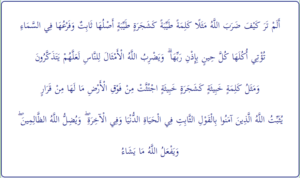
“Have We not made the earth a resting place, and the mountains as pegs?”
— Surah An-Naba (78:6-7)
The Arabic word used here is awtad (أَوۡتَادࣰا), the plural of watad — a term that specifically means a peg, stake, or tent pin. It’s the same word that would be used to describe the pegs that hold down a Bedouin tent against the wind, driven deep into the ground to provide stability from below while only a small portion is visible above the surface.
A watad is not just any object stuck in the ground — it is specifically something whose primary function is anchoring and stabilizing. A tent peg’s visible portion above ground is only a fraction of its total structure; the majority of its length is driven deep beneath the surface to hold everything steady.
What Geology Discovered Centuries Later
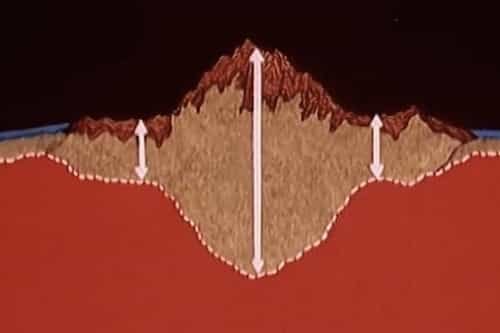
For most of human history, mountains were simply viewed as large mounds of rock — impressive, perhaps, but structurally straightforward. It wasn’t until the development of modern plate tectonics theory in the 20th century that scientists began to understand the true function mountains serve in stabilizing the Earth’s outer shell.
This is remarkably consistent with the image of a watad — a peg whose true strength lies not in what is visible above ground, but in the hidden depth beneath it.
How Mountains Stabilize the Crust
Modern geological research has revealed several specific mechanisms by which mountain ranges contribute to the stability of the Earth’s crust:
There were no seismographs, no satellite imaging, no concept of tectonic plates in 7th century Arabia. The people of that time — including the most educated among them — viewed mountains simply as they appeared: large, solid masses of rock sitting on the surface of the earth. The idea that these visible peaks were merely the tip of massive underground structures functioning as stabilizing anchors was entirely beyond the scientific understanding of that era.
A Sign for Those Who Reflect
This is not an isolated example. Throughout the Quran, there are references to natural phenomena — from the expansion of the universe, to the barrier between two seas, to the stages of embryonic development — that align remarkably with discoveries made only in the modern scientific era. Believers see these correspondences as signs pointing to a source of knowledge beyond human capability at the time of revelation.
“Subhanallah — what an amazing blessing, and something that we all take for granted, is what these mountains do to stabilize this entire Earth.”
What makes this particular verse so striking is not merely that it happens to align with modern geology, but the precision of the word choice. Had the Quran simply described mountains as “great” or “tall” or “solid,” this would be an unremarkable, generic description. Instead, it specifically uses the imagery of a peg — an object defined by its function of anchoring something from below, with most of its structure hidden from view. That specific functional description is exactly what geologists would later confirm.
A Reminder Woven Into Creation
Perhaps the deeper lesson here isn’t only about geology — it’s about awareness. You don’t need a laboratory, a research grant, or an advanced degree to witness the signs of Allah’s design. Look up. Look around. The mountains standing on the horizon, the ground steady beneath your feet, the very stability that allows life to flourish on this planet — these are blessings so constant that they’re easy to take for granted.
Every mountain range on Earth is, in a very real sense, quietly doing its job — anchoring the crust, balancing tectonic pressures, and contributing to the stability that allows oceans to remain in place, ecosystems to thrive, and human civilization to exist without the ground constantly shifting beneath us. It is a blessing so fundamental that most people never think about it at all.
Concept: Isostasy and crustal root formation in mountain geology (modern plate tectonics theory)
Fourteen hundred years before satellite imaging and seismic technology existed, a text described mountains not as simple rock formations, but as pegs — structures whose true strength and function lie hidden beneath the surface. Modern geology has only recently confirmed the depth and stabilizing function of what lies beneath every mountain range on Earth.







Be First to Comment